
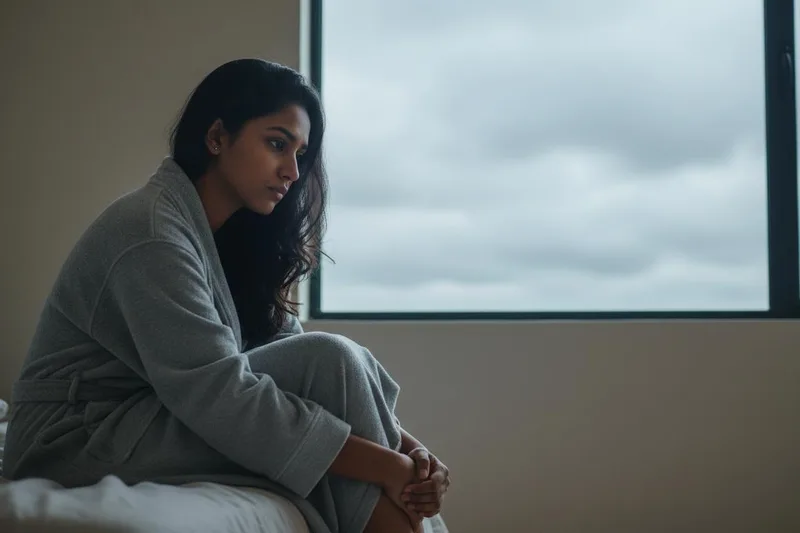
Sometimes, especially when the sun is low and the days are cloudy, do you feel a strange weight, boredom, or sadness in your heart? There are times when you feel like you're bored with everything and don't even want to get out of bed, right? This is not just a feeling of sadness, it also has a medical name. That's what we're going to talk about today.
What is Seasonal Affective Disorder (SAD)?
Okay, so what is Seasonal Affective Disorder, or as we call it (SAD) for short? Simply put, it's a type of depression . But this one is special. Because it only comes at certain times of the year, like when the weather changes. It often starts with cold weather, when the sun is out and the days are short. Then it gradually increases, and then it decreases when the sun comes out again and the days are long, like in spring.
Some people can also experience a milder form of SAD. This is called the 'winter blues'. It's actually normal for us to feel a little anxious and sad during the cold, dark times. Imagine, you can't go out, you have to stay indoors, and it gets dark quickly. Who wouldn't feel sad then, right?
But, the full-blown SAD goes much further than that. It's not just a little sadness, it's actually a form of depression . Unlike the 'winter blues', SAD affects your daily life . The way you think, your emotions, everything. But don't worry, the best thing is that there are good treatments for it. Those treatments can help you get through this difficult time.
Your doctor may also refer to this as 'seasonal depression'.
Can SAD occur in the summer?
Yes, don't be surprised! Some people have a rare side to this (SAD) condition. It's called 'summer depression'. It starts in late spring or early summer. Then it ends when the cold weather starts. But it's not as common as the (SAD) that comes in the cold season.
How common is this (SAD)?
In a country like America, it is said that about 5 percent (5%) of adults suffer from this condition (SAD). Most of the time, it starts in young people , that is, between the ages of 18 and 30. That little upset called the 'winter blues' that I mentioned earlier can affect even more people, that is, between 10 and 20 percent (10%-20%) .
What are the symptoms of SAD?
As I said before, SAD stands for depression.It's a type. The American Psychiatric Association even classifies it as ``major depressive disorder with seasonal patterns.'' So if you have SAD, your mood swings may be accompanied by symptoms of depression. See if you have these symptoms:
Symptoms of SAD during the cold season:
- Feeling sad and anxious most of the day, even for days at a time.
- Feeling afraid and uneasy .
- An unusual craving for carbohydrates (such as bread, rice, and sweets) and weight gain .
- Feeling tired and lifeless .
- Losing hope in life, feeling worthless .
- Having difficulty paying attention to something.
- Feeling anxious and easily angered .
- Feeling a strange heaviness in the limbs.
- Losing interest in things you used to enjoy (like hanging out with friends), feeling like you're withdrawing from society .
- Having sleep problems (often sleeping more than necessary ).
- If you are fed up with life and want to die , think about it. (If you have these thoughts, you should seek medical advice immediately.)
The symptoms of summertime SAD are a little different!
Unlike winter SAD, people with summer SAD are more likely to experience these symptoms:
- Restlessness, inability to stay in one place .
- Feeling afraid and anxious .
- Loss of appetite and weight loss .
- Sometimes there are times when they behave violently .
- Not being able to sleep means sleep problems (insomnia) .
Why does this (SAD) occur? What is the cause?
Researchers still don't know exactly what causes SAD, but a major suspicion is that a lack of sunlight may play a role, especially if you have a predisposition to the condition. Here are some current theories:
- Changes in our body's biological clock: When sunlight decreases, our body's natural clock also changes. This is what controls things like our mood, sleep, and hormones. So when this clock changes, it becomes out of sync with our usual daily routine and we can't adjust to changes in daylight.
- An imbalance of brain chemicals:Our brains contain chemicals called ``Neurotransmitters``. These are the chemicals that send messages between nerves. ``Serotonin`` is one of them. This is what helps us feel happy. If you are at risk for SAD, your body's ``Serotonin`` activity may already be low. Since sunlight helps regulate ``Serotonin``, this condition can be made worse when sunlight decreases during the cold season. ``Serotonin`` levels decrease further, which can lead to depression.
- Vitamin D Deficiency: Vitamin D is also a great help in increasing your serotonin levels. Sunlight helps our body produce vitamin D. So when sunlight decreases during the cold season, vitamin D deficiency can occur. This change can affect your serotonin levels and mood.
- Increased Melatonin: Melatonin is a chemical that affects our sleep patterns and mood. Some people may produce more melatonin when there is less sunlight. This is why you feel sleepy and lethargic during the cold season.
- Negative thoughts: People with SAD often have negative thoughts about stress, anxiety, and the cold weather. However, researchers are not yet sure whether these negative thoughts are a cause or a result of SAD.
Who is more likely to develop SAD?
SAD is most common in people between the ages of 18 and 30 and in women . You may also be at increased risk if you:
- If you already have another mood disorder, for example , major depressive disorder or bipolar disorder .
- If anyone in your family has SAD, other depressive conditions, or a mental illness such as major depression or schizophrenia .
- If you live in an area that is far north or south of the equator, because in such places the amount of sunlight is very low during the cold season.
- If you live in an area with lots of clouds and little sunlight .
How do you accurately diagnose this condition (SAD)?
If you think you have symptoms of SAD, please do not try to diagnose it yourself . It is best to see a healthcare provider for a full evaluation. There may be other causes for your depression. Often, SAD can be part of a more complex mental health condition.
Your doctor will see you.You may be referred to a psychiatrist or psychologist . These mental health professionals will ask you about your symptoms. They will look at your symptom patterns and determine whether you have SAD or another mood disorder. They may also have you fill out a questionnaire to see if you have SAD.
What tests are needed to diagnose SAD?
There is no specific blood test or scan to diagnose SAD. However, your doctor may order some tests to make sure there are no other conditions that cause similar symptoms. For example, they may order a test to see if your thyroid is working properly.
What are the criteria for determining SAD?
Your doctor may decide that you have SAD based on these factors:
- If you have symptoms of major depression .
- If this depressive state occurs at certain times of the year, for at least two consecutive years .
- If this depressive state occurs more frequently at a specific time of the year than at other times.
How is this (SAD) treated?
Your doctor will talk to you about your treatment options. You may need a combination of treatments . Some of these include:
- Light therapy: Bright light therapy, which uses a special lamp, can be used to treat SAD.
- Cognitive Behavioral Therapy (CBT): CBT is a type of talk therapy. Research has found it to be very effective for SAD and to have longer-lasting results than other treatments.
- Antidepressant medication: Sometimes doctors prescribe medication for depression, either alone or in combination with light therapy.
- Spending time outdoors: Getting as much sunlight as possible can help reduce your symptoms. Try to go outside during the day. Also, increase the amount of sunlight that comes into your home or office.
- Vitamin D: Taking a vitamin D supplement may also help improve your symptoms. However, you should definitely talk to your doctor before starting this .
How exactly is light therapy done?
To have light therapy, or ``phototherapy,'' you will need a special lamp .You have to buy it. It consists of a few white fluorescent light tubes with a plastic screen to block ultraviolet rays. The light from this lamp is about twenty times brighter than a normal household light. The intensity of the light emitted should be about 10,000 lux.
When using this ``phototherapy``, it is not a good idea to look directly at the light . You want the light to hit you in a circular motion. While you are reading, eating, working, or doing other work, hold the lamp about two to three feet away .
When is the best time to use light therapy?
The time you use light therapy can also affect its effectiveness. Light therapy in the morning seems to work best . Using light therapy late in the day can cause insomnia. Many health professionals recommend 15 to 30 minutes of exposure to `10,000 lux` light every morning .
How long does it take to see results from light therapy?
People who use a lamp for SAD often see results within two to four days , but it can take up to two weeks to see full results.
How long should light therapy be continued?
Doctors often recommend using light therapy throughout the winter months . Symptoms of SAD can quickly return after stopping light therapy. Continuing this therapy will help you stay well throughout the winter months.
Is light therapy safe? Are there any side effects?
Light therapy is generally safe and has no major side effects . However, you may want to avoid light therapy in the following cases:
- If you have diabetes or retinopathies : If you have diabetes or a disease of the retina, there is a small risk of eye damage.
- If you are taking certain medications : Some antibiotics and anti-inflammatories can make you more sensitive to sunlight. Light therapy may be harmful.
- If you have bipolar disorder : Both bright light therapy and antidepressants can cause hypomania or mania (uncontrolled mood and energy swings). If you have bipolar disorder, tell your doctor. It can affect your treatment plan.
What are the side effects of light therapy?
You may experience things like:
- Eyestrain
- Tiredness
- Headache
- Insomnia
- Irritability/quick temper
Can a tanning bed be used to treat SAD?
Please don't do that! Don't use tanning beds to treat SAD. Tanning beds can be very harmful, even though they provide plenty of light. They emit high levels of ultraviolet (UV) rays . They are very harmful to your skin and eyes.
What types of antidepressants help with SAD?
SAD can be treated with a class of medications called ``Selective Serotonin Reuptake Inhibitors'' (SSRIs). These work by controlling the levels of ``serotonin'' in your body and improving your ``mood''.
Some types of SSRIs are:
- `Fluoxetine (Prozac®)`
- `Escitalopram (Escitalopram - Lexapro®)`
- `Paroxetine (Paroxetine - Paxil, Pexeva®)`
- `Sertraline (Sertraline - Zoloft®)`
- `Citalopram (Citalopram - Celexa®)`
There is another approved antidepressant called `bupropion`. It comes as an extended-release tablet. If taken daily from the start of the cold season until the beginning of the spring, it can also prevent the onset of SAD.
What does the future hold for those with SAD?
If you have SAD, you can look forward to a brighter future . There are effective treatments for SAD. People who are diagnosed with the condition and receive the right combination of treatments can find relief from their symptoms. Talk to your doctor to find out which treatment is best for you.
(SAD) Can you come again?
Yes, people who are prone to SAD can experience relapses every year . However, there are things you can do to prevent or reduce symptoms.
Can SAD be prevented?
You may not be able to prevent SAD from occurring in the first place . However, once your doctor has diagnosed you with SAD, you can take steps to better manage it or prevent it from recurring.
- Use your lightbox: Start light therapy before you even feel symptoms of SAD, which means as soon as the cold weather starts.
- Get outside: Spend some time outside every day, even on a cloudy day. The sunlight will help you feel better.
- Eat nutritious foods: Even if your body craves starchy and sweet foods, choose nutritious foods. Healthy foods rich in vitamins and minerals will give you the nutrition and energy you need.
- Exercise:Try to exercise for 30 minutes at least three days a week. Exercise reduces stress and anxiety, which can also affect symptoms of SAD.
- Meet up with friends: Stay connected with your friends and your usual activities. They can be a great support during the colder months.
- Find help: Consider seeing a mental health counselor trained in ``CBT`` (cognitive behavioral therapy). This treatment is very effective for SAD.
- Consider medication: Talk to your doctor about taking an antidepressant. If your symptoms are severe or persist after other treatments, medication may help. In some cases, starting medication before SAD starts can even prevent the condition from developing.
In this way, talk to your doctor to see if starting treatment early , as a preventative measure, is right for you.
If I have (SAD), how can I best take care of myself?
Talk to your doctor. By planning ahead , you can manage your symptoms and stay well.
Do these things:
- Follow your treatment plan: If you have medication or a lamp for SAD, use it exactly as directed. If your symptoms don't improve, see your doctor again.
- Take care of yourself: Eat a well-balanced diet. Get enough sleep. Exercise regularly . Try to manage stress, perhaps by talking to a counselor or therapist.
- Plan ahead: Make a plan for what to do if your symptoms get worse. If you start to feel depressed, take action. It can help to plan lots of activities during these months. Keeping a busy schedule will keep you from feeling stuck at home.
- Start treatment early: Talk to your doctor about preventative treatment. If you know your symptoms will start in October, consider starting treatment in September.
Don't do these things:
- Don't be alone: Being alone can make your symptoms worse. Even if you don't feel like going out or being social, try to connect with friends and loved ones.
- Do not use alcohol or non-prescribed drugs: They can worsen symptoms and may interact negatively with antidepressants.
When should I see a doctor about SAD?
If you think you have symptoms of SAD or another mood disorder, be sure to see a doctor . He or she will want to make sure there are no other medical conditions that could be causing your symptoms.
When should you go to the emergency room?
If you or someone you love is having suicidal thoughts, please seek help immediately. Call your doctor, go to an emergency room, or call a helpline such as 1926 (Sri Lanka's national mental health helpline). These services provide free, confidential psychological support to those who are in a suicidal crisis or experiencing severe depression. They are available 24 hours a day.
If you have (SAD), what questions should you ask the doctor?
If you have SAD, ask your doctor about these things:
- What is the best treatment for me?
- What can I do to prevent these depressive states from occurring?
- Will light therapy work for me?
- Should I take an antidepressant?
- When should I start treatment?
- How long do I need to continue my treatment?
- What should I eat (or avoid) to help my symptoms improve?
- What else can I do to feel better?
Finally, remember you!
(SAD) is a depressive disorder that occurs at a specific time of year, often during the cold season. It can cause symptoms like low energy and a loss of hope for life. The best thing is that there are good treatments for it. Talk to your doctor. They are there to help you.
👩🏽⚕️ Additional questions (FAQs)
💬 Is SAD (Seasonal Affective Disorder) just a common feeling of boredom that comes with the rainy season?
No! This is a type of depression, which is very serious psychologically. It's not just normal boredom, but SAD is a severe depression that lasts for months due to a decrease in the amount of serotonin in the brain, which causes happiness, during the winter months.
💬 How does a person feel when they develop this depressive condition called SAD?
They feel unspeakably sad and 'disappointed' for no reason. They sleep all day (oversleeping), and feel extremely tired (low energy) no matter what they do. They especially want to eat a lot of sweets and starchy foods (carbohydrates), which is why they gain weight quickly. They lose interest in doing anything.
💬 What is the most effective and unique treatment for this mental problem?
This is due to the lack of sunlight, so the main treatment for this, rather than taking pills, is 'Light Therapy'. That is, sitting in front of a special bright light box for about 30 minutes in the morning to normalize the brain's chemical activity. Along with this, (CBT) counseling and antidepressant medications are also given.
` Seasonal affective disorder, SAD, depression, winter, sunlight, light therapy, vitamin D, serotonin, mood




💬 Comments (0)
No comments yet. Be the first to share your thoughts here.
Add Your Comment