
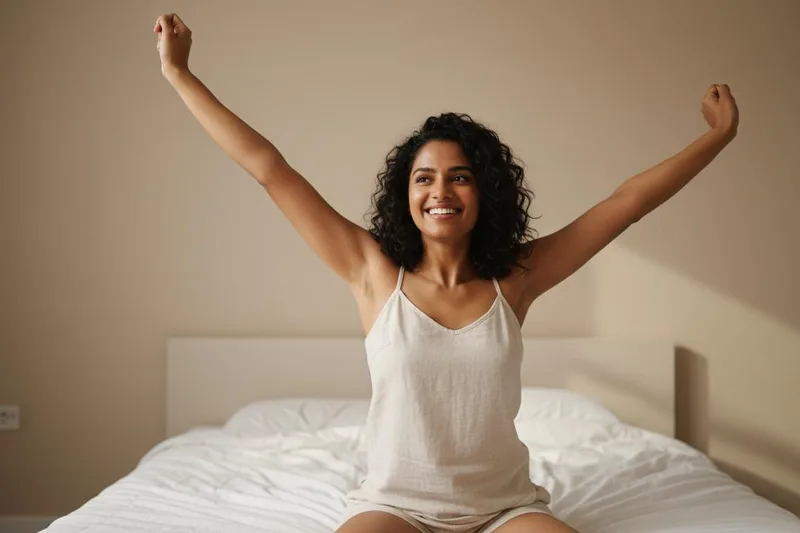
A common problem for many people these days is that they don't get enough sleep. With work, family, and stress, some people don't have enough time to sleep. But did you know that there are some people who actually need less sleep than others? They can wake up feeling refreshed and energetic after sleeping for six hours or less. That's what we call ``Short Sleeper Syndrome'' or ``SSS''. Let's talk about this in more detail, shall we?
What is ``Short Sleeper Syndrome''? Simply put...
Simply put, `(Short Sleeper Syndrome)` means that you need less sleep than the average adult. Usually, we say that an adult should sleep at least 7-8 hours a day. But if you have `(SSS)`, you may be sleeping six hours a night or even a little less, maybe even four hours. The most important thing is that even with such little sleep, you wake up in the morning without any fatigue, sleepiness, and a very relaxed and refreshed mind and body. You can start the day like a fully charged battery.
This is not just a case of not getting enough sleep and working in your sleep, right? That's a different thing. A person with `(SSS)` actually needs less sleep. They are less sleepy during the day, can do their work properly, and don't see any deficits in things like memory and attention.
How common is this condition called ``Short Sleeper Syndrome''?
In fact, very few people have `(Short Sleeper Syndrome)`. It's hard to say exactly how many people have it, because the amount of time a person sleeps depends on many factors. Some people sleep less than usual, but they feel tired during the day. `(SSS)` is not one of those.
Doctors and researchers are still searching for the genetic mutations that cause SSS. So far, about 50 families have been found to have the condition. This means that it can run in families . So if you have this type of sleep deprivation, you might want to check to see if anyone else in your family has it.
Can someone develop ``Short Sleep Syndrome'' later in life?
Symptoms of ``Short Sleep Syndrome'' usually begin in childhood or adolescence. If you are a ``natural short sleeper'', meaning you naturally need less sleep, you will need less sleep than others throughout your life. This is not something that starts suddenly in middle age.
What are the symptoms of ``Short Sleeper Syndrome''?
The main symptom is that you usually get between four and six hours of sleep a night. Maybe you don't have to go to work, school, or anything else, but you just wake up early in the morning.
People who naturally sleep less (natural short sleepers) typically:
- It's like they don't need an alarm clock to wake up in the morning. They just wake up.
- When you go to bed, you fall asleep quickly. You don't have to toss and turn when you can't sleep.
- Even if I sleep for a few hours, I wake up in the morning feeling refreshed and energized. I have the energy to work well throughout the day.
Imagine, while all your friends sleep for 8 hours, you wake up in 5 hours and start your work without any fatigue. That's how it is.
What are the causes of ``Short Sleep Syndrome''?
Researchers are still trying to figure out the exact cause, but they have found that these ``natural short sleepers'' have certain changes in their genes . Specifically, they may have certain changes in their ``DEC2 gene'' or ``ADRB1 gene''. It is believed that these genetic changes are what allow them to stay alert even on less sleep. This means that their bodies may be more efficient at reaping the benefits of sleep.
Is ``Short Sleeper Syndrome'' a hereditary condition?
Yes, there is a good chance that it could be. Researchers have found that the genetic variations associated with this ``Short Sleeper Syndrome`` run in families. This means that children can inherit these genetic traits from parents. So if someone in your family sleeps less and still does well, you are more likely to have these traits too.
What complications can occur due to ``Short Sleeper Syndrome''?
Here's the important thing: Short Sleeper Syndrome doesn't cause any known health problems. That's why doctors don't consider it a sleep disorder. It's just a natural variation, like some people are tall and some are short. Even though you may need less sleep, it won't harm your health .
How do doctors accurately diagnose Short Sleeper Syndrome?
It can be a bit of a challenge for even a doctor to confirm that you actually have Short Sleeper Syndrome. There is no specific test for it. Your doctor will talk to you about your sleep and sleep habits. He or she may ask you things like:
- What are your bedtime routines? - For example, reading a book, checking your phone, or drinking tea.
- How sleepy are you during the day? (Level of sleepiness during the daytime)
- What is your sleep schedule like? (Sleep schedule) – that is, things like bedtime and wake-up time on weekdays and weekends.
In addition, the doctor will do a physical examination. He or she may also ask about:
- Do you drink alcohol?
- Are you under stress?
- Do you exercise every day?
I'm asking all this to understand if there are other reasons affecting your sleep.
What tests help diagnose `(Short Sleeper Syndrome)`?
There is no specific test for Short Sleeper Syndrome. However, your doctor may order a sleep study called Polysomnography. This is done to check for other sleep-related conditions. For example:
- Insomnia
- Narcolepsy
- Nocturnal panic attacks
- Parasomnias and disruptive sleep disorders, such as sleepwalking
- Restless legs syndrome
- Sleep apnea
- Sleepwalking
If you don't have any other problems like this, and you're feeling refreshed even with less sleep as mentioned earlier, you're more likely to have `(SSS)`.
How is ``Short Sleeper Syndrome'' treated?
You may be surprised to hear this, but ``Short Sleeper Syndrome'' does not require any treatment. Because it is not a disease. People who naturally get less sleep usually wake up refreshed in the morning and do not feel sleepy during the day. So there is no treatment.
What happens if I have `(Short Sleeper Syndrome)`?
If you have ``Short Sleeper Syndrome'', it means you don't need as much sleep as other people. You can expect to get by on this short sleep for the rest of your life. But as you get older, your sleep needs may change slightly, and that's normal.
What is the health status of someone with ``Short Sleeper Syndrome''?
People who naturally get less sleep have fewer health risks than those who do not get enough sleep. This means that even though you sleep less, the quality of your sleep is generally very good. Getting good quality sleep can also reduce your risk of developing the following conditions:
- Cardiovascular disease
- Heart attack / Myocardial infarction
- Type 2 diabetes
That means, even though the number of hours is reduced, it's good for your health because you get "quality sleep"!
Can Short Sleeper Syndrome be prevented?
Doctors still don't know exactly what causes Short Sleeper Syndrome. Since the condition may be caused by genetic changes, there's currently no way to prevent someone from becoming a naturally sleep-deprived person. It's not something we can control.
How can I take care of my health if I have ``Short Sleep Syndrome''?
If you wake up feeling refreshed and well throughout the day, it means you're getting the sleep you need. However, there are a few things you can do to help you get the best possible sleep, and for as many hours as possible. These things are good for everyone, not just those with SSS:
- Avoid drinking alcohol a few hours before bed.
- Get some natural sunlight during the day, especially in the morning.
- Get into the habit of going to bed at the same time every day.
- Keep your bedroom dark and quiet.
Sleeping only four to six hours a night may feel a little strange to you. If you live with other people, you may be awake long before they are. However, if you feel fine in the morning and feel energetic throughout the day, there is no reason to worry. However, if you are feeling sleepy during the day, or if your sleep habits suddenly change, definitely talk to your doctor.
Take-Home Message
Okay, so now you have a good idea about the ``Short Sleeper Syndrome'' we talked about. The main thing to remember is:
- `(SSS)` is not a disease, it is a natural condition.
- If you can stay refreshed and energetic all day even after sleeping for 4-6 hours, you too may have `(SSS)`.
- This does not require special treatment.
- This will not harm your health .
- If you have any doubts or questions about this, it's best to talk to a doctor.
So, if you're someone who sleeps less but still stays "super fit," don't worry about it! That might just be your nature.
` Short sleep, insomnia, genetic mutations, sleep patterns, health, DEC2 gene, ADRB1 gene


💬 Comments (0)
No comments yet. Be the first to share your thoughts here.
Add Your Comment