

Are you having trouble sleeping at night? Do you snore? Or do you often feel tired and sleepy during the day? Your doctor may have advised you to have a "Sleep Study" because of these things. Some people are a little scared when they hear this name. "What is this doing? Will it keep me up all night? Will it hurt?" Many questions come to mind. But this is actually a very simple, painless, and very important test that can help you find the exact cause of your sleep problems. Let's talk about everything clearly today.
What exactly is a sleep study?
Simply put, a sleep study, or in medical terms a polysomnogram, is a test that records the activity of various systems in your body while you sleep. It's like a CCTV camera of your sleep. But it doesn't just look at your movements. It looks at many things at the same time, such as your brain, heart, and respiratory system. Special sensors are attached to your body for this. The information from this test helps doctors understand exactly what your sleep problems are and how serious they are.
Why do we need to do a sleep study?
This is a diagnostic test. This means it is done to find out exactly what is causing your symptoms. If your doctor suspects that you have a medical condition that is interfering with your sleep, they will use this test to confirm or rule out a medical condition.
Below are some of the medical conditions that can usually be detected with this test.
| Condition | A simple explanation |
|---|---|
| Sleep Apnea | Breathing stops and starts again during sleep. This is associated with snoring. |
| Narcolepsy | A condition in which you suddenly fall asleep uncontrollably during the day. |
| Restless Legs Syndrome | Feeling like moving your legs when you are resting, especially at night, due to discomfort in your legs. |
| Insomnia | Difficulty falling asleep at night, waking up frequently, or waking up early in the morning. |
| Sleepwalking etc. | Things like sleepwalking, talking, and screaming in fear. |
| Seizures during sleep | Some epileptic seizures may occur only during sleep. |
The most important thing is that with the data from this test, your doctor can choose the treatment method that is most suitable for you.
How does this test work? What are these sensors?
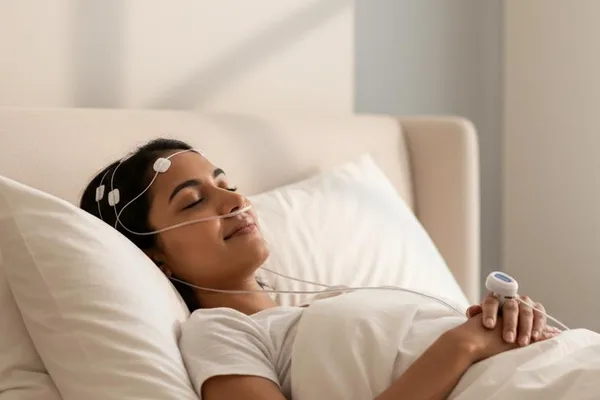
Imagine spending a night in a hospital or a specialized sleep lab. You are given a separate room to sleep in. Then the staff comes in and painlessly attaches small sensors to different parts of your body. Each of these sensors does a different job.
| Sensor Type | What do you do with it? |
|---|---|
| EEG (Electroencephalography) | These are small sensors that are attached to your skull. They measure the electrical activity (brain waves) in your brain . This helps determine whether you are in the deepest stages of sleep or dreaming. |
| EKG/ECG (Electrocardiography) | This is a sensor that you attach to your chest. It monitors your heart rate and checks for any abnormalities in your heart's activity during sleep. |
| EMG (Electromyogram) | These are usually placed on your chin and legs. This measures muscle activity . This can help detect conditions like leg cramps during sleep. |
| EOG (Electro-oculography) | Sensors that are placed around the eyes. These measure eye movement . This is important to detect the period when you are dreaming (REM sleep). |
| Breathing Sensors | This sensor, located near your nose and mouth, measures how you breathe in and out . |
| Belts | Two straps are worn around your chest and abdomen. These are used to measure how your chest and abdomen move up and down as you breathe. |
| Pulse Oximeter | A small clip-like device that attaches to the tip of your finger. This measures the oxygen level in your blood and your pulse rate . |
| Video and sound recording | There's a camera and microphone in the room. This helps monitor your snoring, sleep talking, and any unusual movements. |
How do you prepare for a sleep study?
This doesn't require much preparation, but to get the best results, you need to take care of a few small things.
On the day of the test...
- Avoid caffeine and alcohol: Avoid drinking beverages like coffee, tea, cola, and alcohol for at least 8 hours before the test. These can disrupt your normal sleep.
- Don't nap during the day: If you nap during the day, it may be difficult to fall asleep at night.
- Stay normal: Go about your daily routine as normally as possible.
When it comes to testing...
- Come showered and clean: Before coming, showered and washed your hair. But do not use any creams, lotions, gels, or hair sprays. When your skin and hair are clean, the sensors will adhere well and will be able to collect clear data.
- Remove nail polish: If you have nail polish or artificial nails, remove them as they can interfere with the readings of the Pulse Oximeter placed on your finger.
- Bring night clothes and essentials: Prepare as if you were staying overnight in a hotel. Bring comfortable, night clothes, a toothbrush, a comb, and clothes to wear the next day.
- Tell your doctor and staff about your medications: Tell them in advance what medications you usually take. You may be asked to stop taking some medications the day before the test. But do not stop taking any medications without your doctor's advice.
- Tell us about any skin allergies: If you have any allergies to things like the plaster used to attach the sensors, let the staff know in advance.
You also have these questions... (Frequently Asked Questions)
Will anyone be watching me while I take this test?
Even though there is a camera in the room, the staff doesn't constantly watch you. They only watch the data displayed on the computer screen from the observation room. They only look at the video if a sensor detects unusual data or if they hear a strange sound from you. So your privacy is not compromised.
What do you do if you need to go to the bathroom at night?
Yes, it is definitely possible. All you have to do is talk to the staff. They will come and help you disconnect the wires of the sensors from the computer. They will connect them when you get back to bed. Don't go disconnecting the wires yourself.
Do I have to be alone for this test?
Usually yes. If you are an adult, you should stay alone. If someone else is in the room, it can disrupt your sleep and affect the results of the test. However, for young children or people with special needs, their parents or caregivers are allowed to stay in a separate room.
Does this hurt?
Not at all. This is a completely painless test. There is no pain when attaching or removing the sensors. You may feel a little discomfort when removing the plaster, but that is normal.
When will the results be available?
After the test is complete, the data collected (your brain waves, heart rate, breathing, etc.) is analyzed by a sleep specialist. This can take a few days or a week. Your doctor will then meet with you again to explain the results and, if necessary, any further treatment.
Some people may not sleep well during this test due to the new environment. But don't worry about that. If you get at least two hours of good sleep, even that amount of data will be enough to make a diagnosis.
Take-Home Message
- A sleep study is a painless and safe test to pinpoint the cause of your sleep problems.
- This can identify serious medical conditions like Sleep Apnea and Narcolepsy.
- Avoid caffeine, alcohol, and daytime napping the day before the test.
- Tell the doctor and staff in advance about the medications you are taking and any allergies you have.
- Don't be afraid of the test. This is an important step in improving your health. Ask your doctor any questions you may have.




💬 Comments (0)
No comments yet. Be the first to share your thoughts here.
Add Your Comment