
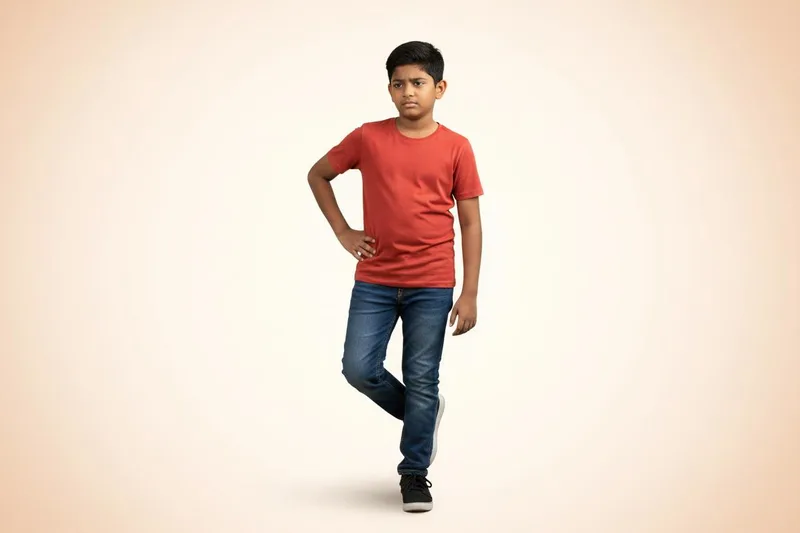
Your child used to run around like a playful butterfly, right? But now he seems to limp a little when he walks, or his hip hurts, maybe even his knee hurts? Don't dismiss these things as "just a physical ailment." Because these could be symptoms of a hip problem that we're going to talk about today called Slipped Capital Femoral Epiphysis (SCFE) . Don't worry, let's talk about this simply.
What exactly is Slipped Capital Femoral Epiphysis (SCFE)?
Simply put, this is a condition that occurs in young children, especially during their growth spurt (which we call puberty ). Your child's thigh bone (the big bone we call ``femur''), has a ball-like part at the top of it, where it fits into the hip socket. This is called the ``epiphysis''. So, in SCFE, what happens is that the ball-like part of the ``femur'' slips a little bit off the neck of the ``femur''. It's like the ice cream cone on an ice cream cone is tilted a little to one side. When it slips like this, it doesn't fit properly in the hip socket, which causes problems when the child walks and runs.
Now you might be wondering, "Why does this happen?" Our children grow taller from a very young age, at a special point at the end of their long bones (like the thigh bone). This is what we call the 'growth plate'. Think of it like a branch of a tree that keeps growing. But this `(growth plate)`, before the bones in a child's body are fully formed, has a soft texture like cartilage. It's like jelly. Because of this soft texture, sometimes the `(epiphysis)`, that ball-like part of the thigh bone, tries to slip off the `(growth plate)`.
The capital femoral epiphysis, which is located at the top of the thigh bone, is particularly prone to slipping, as this area bears the majority of the weight of the child's upper body. So, the child's weight and rapid growth are the two main factors that affect this condition.
This SCFE condition can cause lameness and pain from the hip to the knee. Most of the time, it starts slowly, without any warning. It may start in one hip and then spread to the other. It can get worse over time, and other complications can occur. Therefore, the child will need surgery to correct this, and it is best to do it as soon as possible.
What are 'Stable' and 'Unstable' SCFE?
Doctors divide this SCFE condition into two types: stable and unstable.
- Stable SCFE: Most children have this type. It develops gradually. In this case, the child can walk with weight on the hip, but there may be pain.
- Unstable SCFE: In this case, the head of the bone has slipped too far. This causes severe pain and makes it impossible to walk with weight on the hip. Often, the slippage occurs suddenly, as if in an accident. This ``unstable`` SCFE requires emergency treatment.
What are the symptoms of Slipped Capital Femoral Epiphysis (SCFE)?
The symptoms of SCFE often come on suddenly. You and your child may not remember exactly when they started. Here are some of the symptoms that you and your child may experience:
- Pain in the hip area: This is the main symptom.
- Groin pain: Pain can come from the inner side of the hip, right in the groin.
- Leg pain: Sometimes the pain can spread from the hip to the knee.
- Knee pain: Don't be surprised, some children may complain of knee pain due to a hip problem. Doctors call this ``referred pain''.
- Limping or abnormal gait: You may appear to be leaning to one side or limping when walking.
- Feeling of stiffness when walking and it increasing: You may feel a tightness in your hip, as if it is getting stuck after walking for a while.
- Difficulty putting weight on one leg.
- Difficulty running, jumping, and bending at the hips.
- One hip and leg appear to be turned outward.
- One leg appears to be shorter than the other.
Imagine, your child is not as interested in playing cricket, running, or jumping as he used to be. When he walks a little, he says, "Mom/Dad, my leg hurts." Or when he goes to school, he says, "It's hard to climb the stairs." Even small things like these are very important to take into account.
What are the causes of Slipped Capital Femoral Epiphysis (SCFE)?
It is difficult to pinpoint a single cause for SCFE. As we discussed earlier, the primary cause is the growth of bones at a young age and the weakness of the ``growth plate.'' However, there are a number of other factors that can contribute to this.
Most influential factors:
- Childhood obesity: Many young children with SCFE have a body mass index (BMI) above the 95th percentile for their age. This means they are slightly overweight.
- Growth spurts: This SCFE condition can occur during a short period of rapid growth and bone growth in a child.
- Hormones: Both puberty and obesity can affect your child's hormone levels. These hormonal changes affect bone growth and strength. Some endocrine disorders, or conditions related to the endocrine glands, can also be involved.
Other factors that may affect:
- Injuries: This slippage can be initiated or worsened by something like a fall or a hard blow to the hip.
- Hip abnormalities: Sometimes a congenital defect in the hip joint, such as hip dysplasia, can put extra pressure on the joint.
- Genetic influence: If someone in the family has had SCFE, the risk of the child developing it is slightly higher.
In what age group is SCFE most common?
SCFE usually develops between the ages of 11 and 16. The average age of onset is usually around 12 years. It is slightly more common in boys, and it usually develops later in life. Overall, SCFE is not a common condition, but it is the most common hip disorder affecting young children. Approximately 0.01% of young children are affected by the condition.
What are the possible complications of Slipped Capital Femoral Epiphysis?
When the femoral head slips, the way your child's weight is distributed changes when they walk. This puts pressure on parts of the hip joint that aren't designed to bear weight. This can gradually damage the joint. Two main complications that can occur are:
- Femoroacetabular impingement: This occurs when the head of the femur (thigh bone) does not fit properly into the socket (acetabulum) of the hip joint, causing the two bones to rub against each other. This friction can cause severe pain and damage to the cartilage in the hip joint.
- Avascular necrosis: If the pressure on the femoral head of a dislocated hip becomes too great, the blood supply to it can be cut off. If that happens, the bone tissue will start to die. This is a serious condition.
How do doctors diagnose Slipped Capital Femoral Epiphysis (SCFE)?
Diagnosis begins with a thorough examination of the child's hip. The doctor will ask the child about their symptoms and move the hip in different directions to see what is happening. Then, they will take X-rays to confirm the presence of a bone spur. Sometimes, if it is not clearly visible on an X-ray, an MRI scan can usually detect it.
What is the best treatment for Slipped Capital Femoral Epiphysis (SCFE)?
The treatment for SCFE is always surgery. It is very important to realign and stabilize the displaced femur. If you don't, it can slip further and cause the complications we discussed earlier. There are several ways to do this, depending on how stable the SCFE is. For most young children, a simple operation involving one or two small screws is all that is needed.
Main surgical methods:
- In situ fixation: This is the standard treatment for stable SCFE. This involves a minimally invasive procedure called arthroscopy, which involves inserting a camera through a small incision. A small screw is inserted to hold the bone head in place to prevent it from slipping further.
- Open reduction and internal fixation: In cases of unstable SCFE, meaning the femoral head has slipped too far, the surgeon may need to manually reduce the femoral head back into place and fix it. This requires a slightly larger operation.
After surgery, your child will need to rest and do rehabilitation exercises for about two to three months . Initially, they will be able to walk without putting weight on the hip and using crutches. Once they can use the hip without pain, they will need to do special exercises given by a physical therapist to regain strength and flexibility in the hip.
Can SCFE condition heal on its own?
That's highly unlikely. Sometimes, doctors have seen cases where a new, mild SCFE condition has spontaneously resolved, but it's unlikely. There are many factors that can affect it. Perhaps, during that sudden height gain, the bone may have weakened and slipped, and then it may have healed itself as new bone growth occurs. But in most cases, by the time you discover SCFE, that time may have passed. Therefore, it's best to seek treatment as directed by your doctor.
How is the condition after treatment for Slipped Capital Femoral Epiphysis (SCFE)?
The sooner a doctor diagnoses and treats SCFE, the better the outcome. Treating stable SCFE before the femoral head has slipped too far can prevent long-term damage to the hip joint. Also, the surgery is simpler and the recovery time is shorter. Most children make a full recovery.
Unstable SCFE is less common, and is often associated with an accident. However, it is associated with a higher risk of complications such as femoroacetabular impingement and avascular necrosis. These complications may require more extensive surgery – even joint replacement surgery if the hip joint becomes inflamed, such as arthritis.
Slipped Capital Femoral Epiphysis is a relatively unknown condition. It can be overlooked by parents and some doctors. However, if your young child complains of leg pain for no apparent reason, don't just assume it's a "sore ankle." Some conditions require treatment to get better or stop them from getting worse.
Finally, things to remember (Take-Home Message)
Okay, so let me help you remember some of the most important points from what we've talked about:
- If your young child (especially between the ages of 11-16) frequently complains of hip, groin, thigh, or knee pain , or seems to be limping , don't ignore it.
- See a doctor immediately, especially if your child is a little overweight or shows these symptoms during a sudden growth spurt .
- SCFE is a condition that can be treated with surgery . The sooner treatment is started, the better the outcomes and fewer complications.
- It is very important to seek specialist medical advice rather than just keeping your child at home thinking it is just a "sore throat". This is not "growing pains" or just a physical ache.
Wishing your child a speedy recovery! I hope this information is helpful to you.
` SCFE, Slipped Capital Femoral Epiphysis, Hip pain, Diseases of young children, Limping, Bone growth, Surgery




💬 Comments (0)
No comments yet. Be the first to share your thoughts here.
Add Your Comment