
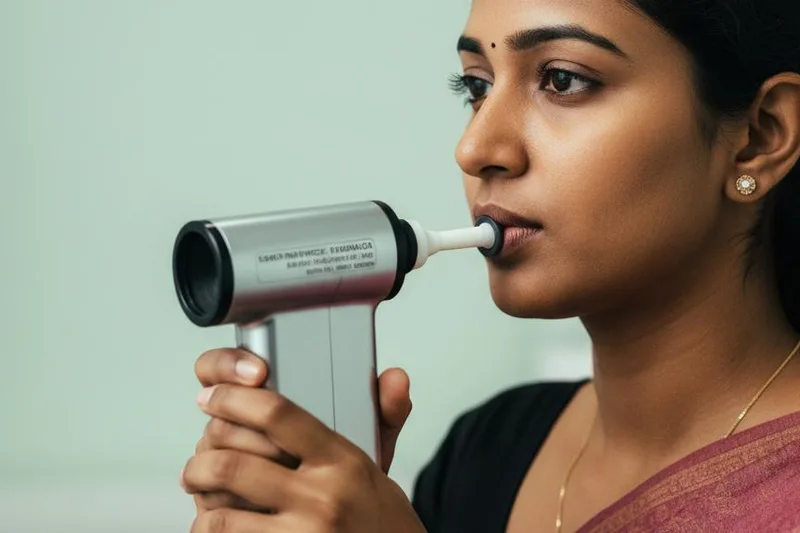
Do you sometimes have difficulty breathing, chest tightness, wheezing, or a constant cough? If you have these symptoms, your doctor may recommend a test to see how well your lungs are working. One of the most common and important tests done at such times is called spirometry. Although the name may sound like a big deal, it is actually a very simple and painless test.
Simply put, what is Spirometry?
Think of it like checking the power of a car's engine. Spirometry is a test that measures the "power" and function of your lungs. It is also called a `Pulmonary Function Test` (PFT) or `Lung Function Test`.
This test mainly measures two things:
1. How much air you can take in and out of your lungs at one time.
2. How fast you can exhale air from your lungs.
This information will help your doctor get a general idea of whether your lungs are healthy and functioning well, or if there is any weakness or disease.
Why is this Spirometry test so important?
There are many reasons why a doctor might order this test. The main ones are:
- Diagnose respiratory diseases: This helps to find out exactly what is causing your symptoms. This test is especially essential for diagnosing conditions like asthma , COPD (Chronic Obstructive Pulmonary Disease) , and Pulmonary Fibrosis .
- Measure your lung capacity: This will tell you the maximum amount of air your lungs can hold.
- Monitor the status of a disease: If you already have a long-term respiratory disease, this test is done periodically to see if it has changed over time, whether the condition is getting better or worse.
- Check the success of the treatment: This helps to confirm whether the medications you are given, such as the inhaler, are opening your airways and whether the treatment is successful.
- Check for narrowed airways: This will help you determine if there is any narrowing or blockage in your airways.
- Assess risk before surgery: This test is sometimes performed before major surgery to assess the risk of respiratory distress during or after anesthesia.
What kind of symptoms would a doctor order this test for?
If you continue to have one or more of the symptoms below, your doctor will most likely recommend a spirometry test to determine the cause.
| Symptom | A simple explanation |
|---|---|
| Shortness of breath | Difficulty breathing, a feeling of suffocation, when you exert yourself a little, when you climb stairs, or even when you are just standing still. Medically, this is called (Dyspnea) . |
| Frequent cough | A prolonged cough that lasts for weeks, with or without phlegm. |
| Chest tightness or pain | Discomfort or pain that feels like a belt is tightening around the chest. |
| Wheezing | A low, "cheese-cheese" sound is heard in the throat or chest when breathing, especially when exhaling. |
| Difficulty taking a deep breath | Feeling as if the lungs cannot be completely filled with air, as if breathing stops halfway. |
How do you prepare before the test?
To get the most accurate results from the test, you need to follow a few simple steps before the test. Your doctor will usually advise you on this beforehand.
- Breathing medications: If you use medications for breathing problems, such as inhalers, you may be asked to stop using them a few hours before the test. This will allow your natural lung function to be measured.
- Clothing: Wear loose, comfortable clothing that is not tight on your body. This will allow you to breathe easily and deeply.
- Food: Do not eat a large, filling meal for at least two hours before the test. A full stomach can put pressure on the diaphragm and affect breathing patterns.
- Exercise: Do not do strenuous exercise for at least 30 minutes before the test.
- Smoking: If you are a smoker, avoid smoking for a few hours before the test.
Following these instructions exactly will greatly help your doctor give you an accurate picture of your condition.
How is the test performed? Is it something to be afraid of?
There's nothing to be afraid of at all! This is a very simple test that can be completed in a short time, about 15-30 minutes.
1. Sitting: First, you will be seated properly in a chair.
2. A nose clip: Next, a small, soft clip will be placed over your nostrils. This is done to ensure that you are breathing only through your mouth, not through your nose.
3. Mouthpiece: Next, you will be asked to place a tube (mouthpiece) connected to a machine called a `Spirometer` in your mouth. You will need to hold it tightly with your lips so that no air escapes.
4. Blowing: This is the most important part. The person doing the test (doctor, nurse, or respiratory therapist) will instruct you to take a deep breath and blow as hard and fast as you can into the tube until all the air is gone.
5. Repeat several times: To get the most accurate results, it is recommended to repeat this process at least three times.
Maybe the second step
Sometimes, your doctor may want to see if your airways are responding to a medication. In that case, after the first test, you will be given a bronchodilator through an inhaler, and then a second spirometry test will be performed a few minutes later. The results are then compared. This can be very helpful in diagnosing conditions like asthma.
Does this hurt?
No, the Spirometry test is not painful at all.
However, because you are taking a deep breath and blowing hard, you may feel a little dizzy and lightheaded . You may also cough while blowing. These are completely normal. All of these discomforts will go away after a while after the test is over. If you feel very tired, you can ask the person doing the test to take a short break.
Important: If you have had a heart attack or other heart condition in the past, be sure to inform your doctor before the test.
What do the results say?
When the test results are received, the doctor compares them to "normal values." These "normal values" are different for each person. They depend on factors like your age, gender, height, and race .
The two main measured values are:
- Forced Vital Capacity (FVC): This is the total amount of air that can be exhaled when you take your deepest breath and forcefully exhale all the air in your lungs.
- Forced Expiratory Volume in 1 second (FEV1): This is the amount of air that can be exhaled in the first second when you exhale forcefully.
Normally, a healthy person's `FEV1` value should be greater than 80% of the `FVC` value. By analyzing these values and the ratio between them (`FEV1/FVC ratio`), your doctor can identify the type of problem you have with your lungs.
| Type of medical condition | Simply put... | Examples |
|---|---|---|
| Obstructive Lung Disease | Due to damage to the lungs or airways, it becomes difficult to quickly exhale the air that has been inhaled. The FEV1 value decreases significantly. | Asthma, COPD, Bronchiectasis, Cystic Fibrosis |
| Restrictive Lung Disease | The lungs do not fully expand. This means that it is difficult for the lungs to take in as much air as they need . The FVC value decreases. | Interstitial Lung Disease, Scoliosis, Muscular Dystrophy |
Take-Home Message
- Spirometry is a simple, non-invasive, painless test that checks the health of your lungs.
- This is a great help in diagnosing chronic respiratory diseases like asthma and COPD, and in determining whether treatment is successful.
- To get the most accurate results, follow the doctor's instructions (about food, drink, medication, and exercise) exactly before the test.
- Don't worry if you feel a little dizzy or cough during the test. This is normal and will go away after a while.
- Always be open with your doctor about any breathing difficulties you may be experiencing, as well as the results of your tests. An accurate diagnosis and treatment plan will definitely help improve your quality of life.




💬 Comments (0)
No comments yet. Be the first to share your thoughts here.
Add Your Comment