

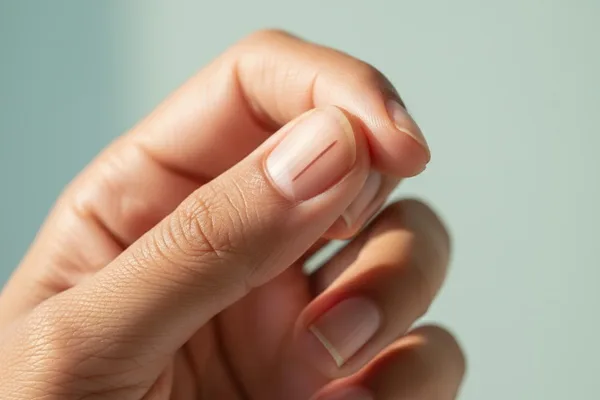
Have you ever noticed a small, red or brown line under your fingernail or toenail? It looks like a splinter of wood has gone into the nail. You may not have noticed it. But today we are going to talk about something like that. In medicine, we call it (Splinter Hemorrhage) . Although the name is a bit strange, sometimes this can be normal, but sometimes it can be a symptom of another disease inside our body. So, don't worry, let's talk about this in detail.
What is this (Splinter Hemorrhage)? Simply put...
Simply put, this (Splinter Hemorrhage) is when a small blood vessel (we call it (Capillaries) ) under your nail bursts and a little blood leaks out. To be precise, these blood vessels are in the skin under the nail (we call it (Nail bed) ). They are very delicate. So, when something damages these, that is, when there is a small wound, a little blood comes out. But that blood does not come out but gets trapped between the nail and the skin. That is what we see as that line when we look at the top of the nail.
These streaks are usually red or dark reddish brown in color. They are called splinter hemorrhages because they look like a splinter of wood under the nail. These streaks are always located in the direction of nail growth, that is, lengthwise.
Who is more likely to develop Splinter Hemorrhage?
It can actually happen to anyone. However, some studies have shown that men are slightly more likely to develop the condition than women. Also, people with darker skin tones may experience these lines more often than those with lighter skin tones.
What exactly does a Splinter Hemorrhage look like?
As we said before, these look like a piece of wood under a fingernail.
- These look like thin lines visible under the nail.
- These lines are located in the direction the nail grows.
- They are usually about 1 to 3 millimeters long. That means they are very small lines.
- These are most often seen on the top edge of the nail, but they can occur anywhere on the nail.
- This line appears red or purple when it first forms. After a few days, it turns brown or black .
- As the nail grows, it may appear to move up with the sun.
Splinter Hemorrhages are more common in fingernails than toenails. In a healthy person, this usually only occurs in one nail. However, if more than one nail has these lines, it may be a sign of another medical condition. That's something we should be concerned about.
Why does this (Splinter Hemorrhage) occur? What are the causes?
Imagine, this (splinter hemorrhage) occurs when the tiny blood vessels under your nail are damaged in some way.
1. Trauma to the nail
This is the most common cause . Even if you don't remember, your nail may have hit something and caused a bruise.
- Imagine you got your finger stuck in a door.
- Or maybe you stubbed your toe like a table leg.
- Sometimes this can happen when you do household chores, lift something heavy, or grab something hard and cause a slight bump on the nail.
- Nowadays, some girls and women use things like acrylic nails to make their nails look beautiful. Sometimes, even when doing something like that, the nail can be slightly damaged and this (splinter hemorrhage) can occur.
So, most of the time, there is nothing to worry about a splinter hemorrhage caused by an injury like this. It will go away on its own as the nail grows back.
2. Underlying medical conditions
However, sometimes this (Splinter Hemorrhage) can occur without any injury. In that case, it can be a symptom of another medical condition in our body. Because some diseases can damage our blood vessels.
Skin Conditions
- Nail Psoriasis: This is a part of the skin disease called Psoriasis. It is an autoimmune disorder, meaning that our body's immune system attacks our skin cells. This causes various changes in the nails, including Splinter Hemorrhage.
- Lichen Planus: This is also an inflammatory condition that can cause itchy, raised bumps on the skin. It is said that about 35% of people with Lichen Planus experience Splinter Hemorrhage.
Vasculitis and Systemic Diseases
- Splinter hemorrhage can also occur due to inflammation of the blood vessels, which is a condition called vasculitis .
- Vasculitis can be caused by certain diseases, such as (Antiphospholipid syndrome) and (Lupus) . These are diseases that affect various systems in our body.
Infectious Diseases
- Splinter hemorrhages can be seen in some bacterial infections, especially endocarditis, an infection of the heart valves. Studies have shown that between 15% and 33% of people with endocarditis have these nail streaks. This can be a very important symptom.
- These can also be seen in people with chronic kidney disease . Perhaps because they are undergoing blood purification treatments ( Hemodialysis ), they can also be seen in people who have had kidney transplants.
As a response to certain medications (Drug Reactions)
- There are some types of anti-cancer drugs (called Kinase inhibitors , for example (sunitinib) and (sorafenib) ). It is reported that between 60% and 70% of people taking these drugs develop Splinter Hemorrhage.
- Also, people who use blood thinners (e.g., Aspirin, Warfarin, Apixaban, Rivaroxaban) to prevent blood clotting are more likely to develop these conditions.
Other Causes
- Very rarely, they can also be caused by a non-cancerous (benign) tumor that forms on the nail ( Onychomatricoma) .
- This is something to be careful of: Sometimes a splinter hemorrhage can look like a subungual melanoma , a type of skin cancer that forms under the nail. That's why we say it's a good idea to seek medical advice if you have these lines frequently for no apparent reason.
How does a doctor diagnose a splinter hemorrhage?
When you go to see a doctor with something like this, he will first examine your nails carefully. Then he will ask you a few questions:
- When did you first see this sun?
- Have you recently had any injuries to your nails? (Acrylic nails, for example)?
- Are there more than one nail with these stripes?
- Do you have any other symptoms after this rash appears? (e.g. fever, joint pain, fatigue)
- Do you have any other current medical conditions (e.g. diabetes, heart disease)?
- Are you currently taking any medications (either prescribed by a doctor or purchased from a pharmacy)?
These questions are asked to help determine the cause of your splinter hemorrhage.
What kind of tests will be done?
Most of the time, the doctor can recognize a splinter hemorrhage immediately. However, sometimes, especially if the cause is not clear, he or she may perform a test called dermoscopy . This involves using a special instrument called a dermoscope to magnify the line under the nail and look at it clearly. This allows the doctor to study the nature, color, and shape of the line and determine whether it is a splinter hemorrhage or something else.
How is Splinter Hemorrhage treated?
Most splinter hemorrhages do not require any treatment . Especially if they are caused by a minor injury to the nail, they will gradually grow out of the splinter and disappear on their own within a few months.
Remember, if it's a splinter hemorrhage caused by an injury, don't worry about it. It will heal on its own.
However, if you don't remember an injury to your nail, or if you see these lines on several nails, then you should definitely see a doctor. Because then the cause will have to be found and the underlying condition will have to be treated . For example, if it is due to a condition like (Nail Psoriasis), the doctor will prescribe a suitable ointment or oral medication. If it is an infection like (Endocarditis), then things like antibiotics will have to be given.
How can you reduce the risk of Splinter Hemorrhage?
To reduce the risk of splinter hemorrhages caused by injuries, you should try to keep your nails strong .
- Eat a nutritious diet . Foods rich in vitamin B and zinc, in particular, help with nail growth. Include vegetables, nuts, and dairy products in your diet.
- Drink plenty of water . Staying hydrated is also good for the health of your nails.
- When cutting your nails, be very careful not to damage the skin around the nails.
- Use protective equipment such as gloves and shoes when doing work that can injure your hands and feet (e.g., gardening, lifting weights).
If splinter hemorrhages are caused by certain medications, they can be prevented by stopping the medication or reducing the dosage. However, never stop taking any medication or change the dosage without consulting your doctor. This can be dangerous.
Other causes, such as those caused by underlying medical conditions (splinter hemorrhages), cannot always be prevented because they appear as a symptom of the disease itself.
What can you expect if you have a Splinter Hemorrhage?
If a splinter hemorrhage occurs due to an injury or other minor accident, it is not harmful at all . Although it may be a little unsightly, it will go away on its own in a few days or when the nail has grown back.
However, if you see these lines without any injury, it could be a sign of a more serious condition . Therefore, it's best to see a doctor to find out exactly what's causing them. Your prognosis will depend on the underlying cause and the treatment you receive.
When should I see a doctor?
Most splinter hemorrhages are caused by injuries and will heal on their own. However, you should definitely see a doctor in these cases:
- If you don't remember any injury to the nail .
- Splinter hemorrhage: If it doesn't go away in a few days or after the nail grows back.
- If you frequently have splinter hemorrhages like this.
- If these stripes are visible on more than one nail .
- If these streaks are accompanied by other symptoms such as fever, body aches, and difficulty breathing.
Finally, take-home message
Splinter hemorrhage can be a common condition seen in nails, or it can be a symptom of another disease.
- The most common cause is minor injuries to the nail. These are nothing to worry about, they will heal on their own.
- However, if these stripes appear frequently on several nails for no apparent reason, it could be a sign of a serious illness (e.g. heart disease, kidney disease, skin disease, some infections).
- Therefore, if you have any doubts about this, please consult a doctor. He or she will be able to determine the cause and provide treatment if necessary.
- Take care of your nail health as well. Good nutrition and good hygiene are essential for healthy nails.
So, I hope you have a better understanding of Splinter Hemorrhage now. Always pay attention to your body. Even if it is a small thing, it is wise not to ignore it and seek medical advice if necessary.
` Splinter Hemorrhage, Nail Streaks, Nail Bleeding, Nail Diseases, Skin Diseases, Heart Disease Symptoms, Nail Health




💬 Comments (0)
No comments yet. Be the first to share your thoughts here.
Add Your Comment