

Do you sometimes feel short of breath when you climb stairs? Or do you feel a strange pain down your leg after standing for a while? Or do you feel like you're choking when you swallow food? Sometimes these things can be caused by the narrowing of important passages, channels or 'tubes' inside the body. Today, we'll talk about these 'narrowings', which is what doctors call this condition (Stenosis) and (Stricture) . Don't worry, let's understand this simply.
What are (Stenosis) and (Stricture)?
Simply put, both the words (Stenosis) and (Stricture) refer to a narrowing or blockage of a channel, passage, or even a small hole in your body. Imagine if a piece of dirt got stuck in a water pipe, it would be difficult for the water to flow through, right? This is something like that. Because of this, things that need to pass through that passage (for example, blood, food, breath, urine, etc.) cannot flow properly.
Often, these two words are used interchangeably. That is, these are processes that really shouldn't happen and can harm you. These conditions require treatment , especially if you have symptoms. So it's important for you to be aware of this when making decisions about your health.
(Stenosis) and (Stricture) - Is there a difference?
In fact, although the basic meaning of both words is "narrowing", doctors sometimes use these words differently for different parts of the body.
The word stenosis is commonly used:
- Narrowing of blood vessels (arteries). For example, the carotid arteries in your neck (the arteries that carry blood to your brain) or the renal arteries that carry blood to your kidneys.
- Narrowing of the heart valves. For example, the aortic valve or the mitral valve.
- Narrowing of some parts of the respiratory system , for example your windpipe (trachea) or your voice box (larynx).
Sometimes this stenosis can be very small, with no symptoms. But even a small one can get bigger over time, cause symptoms, or lead to dangerous conditions. For example, if a blood vessel that carries blood to your brain becomes very narrow, you can have a ``Stroke``.
The word stricture is most often used to refer to narrowings such as:
- Parts of the digestive system . For example, your esophagus, intestines, or bile ducts.
- Parts of the urinary system . For example, the urethra or the bladder neck.
- Parts of the reproductive system . For example, the vagina (`(Vagina)`) or the cervix (`(Cervix)`).
Where can these narrowings occur? (Types of Stenoses and Strictures)
These types of narrowing can occur in many places on your body. Let's look at a few of the main areas affected by this.
Heart valves and blood vessels (circulatory system)
The valves in your heart are like "doors." These doors open and close to allow blood to flow through the chambers of your heart. Blood vessels are like "pipes" that carry oxygen-rich blood throughout your body. If these become narrowed, serious problems can occur.
Here are some examples:
- Aortic valve stenosis: This is a narrowing of the main valve that carries blood from the heart to the body. This can damage the heart.
- Carotid artery stenosis: This is caused by a narrowing of the main artery in your neck that carries blood to your brain. Most people develop symptoms after a transient ischemic attack (TIA) or a major stroke. Imagine a friend suddenly losing their speech and losing control of their limbs. This could be the case.
- (Coronary artery disease): Although the name of this disease does not say (Stenosis), that is actually what happens. The arteries that supply blood to the heart (`(Coronary arteries)`) become narrowed by fatty substances (`(Plaque)`). If they become too narrow, a `(Heart attack)` can occur.
- Mitral valve stenosis: Narrowing of the valve that carries blood from the upper left chamber of the heart to the lower left chamber.
- Pulmonary artery stenosis: This is a condition that occurs in young babies and children. One or more of the arteries that carry blood from the heart to the lungs become narrowed.
- Renal artery stenosis: Narrowing of the arteries that supply blood to the kidneys. Although there may be no symptoms at first, as the condition progresses, kidney function may decrease.
- Subclavian artery stenosis: A narrowing of an artery that supplies blood to your arm. Since it usually affects the left arm, symptoms (such as tingling, numbness) occur in the left arm.
Spine
Your spine is the part of your body that gives you strength and helps you move. It is made up of 33 small bones (Vertebrae) that are stacked on top of each other. When these bones are lined up, there is a small canal running through them. This is called the Spinal Canal. Your spinal cord runs through this canal.
Just as a boat moves along a canal, the spinal cord also moves along this `(Spinal canal).` Just as the canal needs to be wide for the boat to pass through, the spinal cord also needs to have room inside this canal.
If this `(Spinal canal)` narrows anywhere, it can press on the nerves in the spinal cord, causing symptoms like pain and numbness. This is what doctors call `(Spinal stenosis) .` Although it can occur anywhere in the spine, it most commonly affects your lower back (`(Lumbar spine)`) and neck (`(Cervical spine)`).
Foraminal stenosis is another type of spinal stenosis. This is where the holes through which the nerves exit the spinal cord become narrowed.
Respiratory system
Your airways are the passageways your body uses to breathe in and out. Keeping them open is essential for you to breathe.
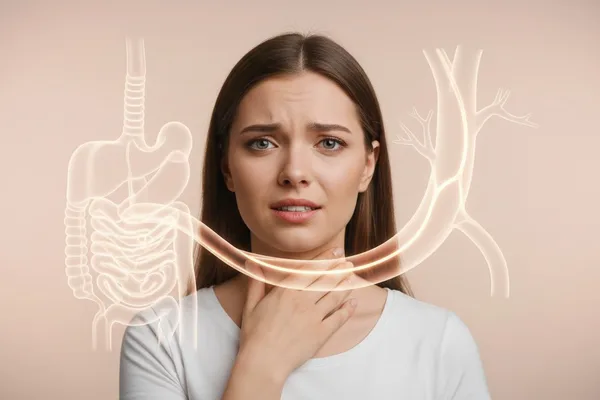
Tracheal stenosis is a narrowing of your main windpipe (trachea). This is caused by scar tissue forming in the windpipe. It can often be a side effect of intubation.
Subglottic stenosis is a narrowing of the lower part of the larynx. It is not as common as tracheal stenosis. It can sometimes be caused by intubation or infection, but in most cases no cause can be found.
Digestive system
The digestive system is where you digest the food you eat and absorb nutrients from it. It is also where you produce and excrete waste (feces).
Narrowings can occur at various points in this system:
- Esophageal stricture: Narrowing of the esophagus. Often, persistent acid reflux is the main cause of this.
- Intestinal stricture: A narrowing of part of the small intestine (`(Small intestine)`) or large intestine (`(Colon)`). This is also called `(Small bowel stricture)` or `(Colonic stricture)`. This risk is higher in people with diseases such as `(Crohn's disease)` due to persistent inflammation of the intestine. This can lead to `(Bowel obstruction)`.
- Anal stenosis: Narrowing of the anal canal. This can often occur due to scar tissue after anal surgery (such as an anoplasty).
- Biliary stricture: A narrowing or blockage of the bile ducts that carry bile (a fluid that helps digest food) from the liver to the small intestine. Pancreatic cancer and bile duct cancer are the main causes of this.
Urinary and reproductive systems
Sometimes parts of your urinary tract or reproductive system can become narrow. This can be a side effect of certain treatments, surgeries, or due to injury or infection. These conditions can vary by gender.
Some examples:
- Bladder neck contracture: A narrowing of the neck where urine exits the bladder (`(Bladder)`) into the urethra (`(Urethra)`). This can occur in men after prostate surgery (`(Prostate surgery)`).
- Urethral stricture: Narrowing of the urethra. This also affects men the most. Posterior urethral stenosis is a narrowing of the upper part of the urethra.
- Vaginal stenosis: Narrowing of the vaginal canal. This can occur in women as a side effect of radiation therapy to the pelvic area.
What are the symptoms of these narrowings?
So, what are the symptoms of a narrowed area? Actually, it depends entirely on where in the body the narrowing is. Sometimes there may be no symptoms at all. But there are a few common symptoms that you can see. For example:
- If a heart valve becomes narrowed: difficulty breathing, chest pain, fainting.
- If the spinal canal narrows: back and leg pain, numbness, difficulty walking.
- If the airway becomes narrowed: Wheezing, shortness of breath.
- If the esophagus narrows: difficulty swallowing food, food getting stuck.
- If the urethra becomes narrowed: difficulty urinating, weak urine stream.
Why do these narrowings occur? What are the reasons?
There can be several reasons why such situations occur.
- Plaque buildup in blood vessels (blockage of blood vessels due to deposits of fat and cholesterol).
- As a side effect of some medical treatments and surgeries .
- Infection.
- Injuries (`Injury` or `trauma`).
- Other diseases, especially those that cause chronic inflammation (e.g. Crohn's disease).
- With the changes in the body as we age .
- Sometimes you may not be able to find a reason.
How does a doctor diagnose this?
If you have symptoms, a doctor will look for these narrowings. This is usually done in the following ways:
- They will examine you and ask you carefully about your symptoms .
- Blood and/or urine tests are performed.
- Special imaging tests are performed to look inside the body . These may include an ultrasound scan, an MRI (Magnetic Resonance Imaging), or a CT scan (Computed Tomography scan).
- Sometimes, an endoscopy is performed, where a small camera-equipped tube (scope) is inserted into the body . This allows a direct view of the inside of the body.
If you have no symptoms, it may be discovered as an incidental finding during a test done for another reason.
What are the treatments for this? (Treatment)
The good news is that there are treatments for these narrowings. Treatment options may vary depending on your condition. Your doctor will talk to you about the best treatment for you. In general, treatments include:
- Oral medications.
- Injections (like ``(Steroid injections)``).
- Physical therapy.
- Special procedures and surgeries.
Surgery and special procedures usually do things like this:
- Using something like a balloon to widen a blocked artery (for example, angioplasty).
- A small mesh-like device called a stent is inserted to keep the blockage from reoccurring. This is like putting another small tube inside the blocked tube.
- Removing blocked `(Plaque)` (things like oil) (`(Endarterectomy)`).
- Removing scar tissue.
- Rebuilding or replacing damaged parts.
Most of the time, these surgeries are performed using ``minimally invasive methods''. That is, they are done through small incisions, without large incisions. Your medical team will tell you more about this.
What can you expect after treatment?
It is important to remember these things:
- Treatment can take some time. You may need to see your doctor several times. For example, dilation for esophageal strictures may be done several times a week.
- This condition can recur after treatment. For example, a blood vessel that was once widened can narrow again (`(Restenosis)`). If this happens, treatment will need to be repeated.
- Follow-ups are very important. The doctor will monitor your condition, monitor your recovery after treatment, and check for any new problems.
- You may need to make some changes to your daily routine. Your doctor may give you advice about your diet and activities. Sometimes they may tell you to rest a little, sometimes they may tell you to move a little more.
When should you definitely see a doctor?
Be sure to go to the appointment your doctor gives you. Ask if there is anything you are unsure about. If any of the following happens, call your doctor immediately:
- If new symptoms appear, or existing ones increase.
- If the treatment does not seem to be bringing the expected relief.
- If there are complications after surgery, such as fever, changes in the incision site (color change, pus discharge, swelling).
Even if a doctor calls it stenosis, you may feel like you're suffocating when you lift a few clothes and climb stairs. Or you may feel a pain that travels down your leg after standing for a while. This narrowing of the arteries inside your body can happen slowly and silently, until one day you realize that these symptoms are more than just a minor annoyance.
If you have unusual symptoms or feel like something is wrong, it is very important to seek medical advice.
Your doctor will talk to you, run tests if necessary, and help you get the treatment you need. Only then will you be able to recover quickly.
The most important things to remember (Take-Home Message)
So, the last thing I have to say is, don't be scared when you hear the words "stenosis" or "stricture." These are all referring to a narrowing of a passageway in your body.
- These conditions can often be treated and cured.
- If you have symptoms, don't ignore them. Even if they seem like a small thing, they could be the beginning of a bigger problem.
- Follow your doctor's instructions carefully. If you do what the doctor tells you to do, you will recover quickly and be able to live a normal life.
- Take care of your body. Pay attention to any changes you notice.
If you have any further questions about this, don't be afraid to ask your doctor. He or she is the best person to help you.
` Stenosis, stricture, narrowing, blockage, blood vessels, heart valves, spine, airways, alimentary canal, (Stenosis), (Stricture), (Aortic stenosis), (Carotid artery stenosis), (Spinal stenosis), (Angioplasty), (Stent)




💬 Comments (0)
No comments yet. Be the first to share your thoughts here.
Add Your Comment