
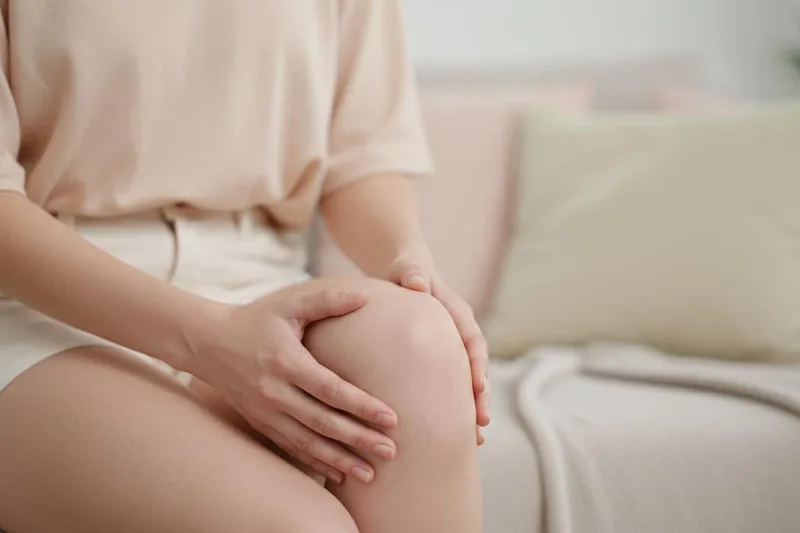
Sometimes when you wake up in the morning, or after a little run or play, do you also feel pain and swelling in your knees? Maybe you even feel a little difficult to walk. This swelling of the knees is not just something, it is a signal that our body is giving us. So let's be aware of this.
What exactly is knee swelling?
Simply put, knee swelling is the accumulation of fluid in or around your knee joint . In medical terms, we also call this ``Joint Effusion``.
Think about it, our knee is a very complex structure. It is the largest joint in our body, connecting our thigh bone (`(Femur)`), shin bone (`(Tibia)`), and kneecap (`(Patella)`). Many things, such as cartilage (`(Cartilage)`), muscles (`(Muscles)`), and ligaments (`(Ligaments)`), help this joint work smoothly. So, if there is any damage, injury, or infection to any of these parts, the body's natural response is to accumulate fluid in that area and swell.
What other symptoms come with swelling?
Knee swelling is usually accompanied by several other symptoms. You may be familiar with these as well.
| Symptom | Description |
|---|---|
| Knee pain | The most common symptom of swelling is pain. Sometimes, it can be so painful that you can't even put your foot down. |
| Knee stiffness | It may be difficult to bend or straighten your knees, and you may feel like you are stuck. |
| Redness | The skin around the swollen area may turn red or a different color. |
| A warm feeling | When you touch the swollen knee, it may feel warmer than the other leg. |
What are the main causes of knee swelling?
Doctors divide the causes of knee swelling into two main categories.
1. Due to an accident or injury (Traumatic)
This is the most common condition, especially among athletes.
- Ligament tear: Tear of the major ligaments in the knee, the ACL and MCL.
- Meniscus tears: Damage to the meniscus, a piece of cartilage that acts as a cushion in the knee joint.
- Bone fractures: Bone fractures in the knee.
- Dislocations: The displacement of parts such as the kneecap.
- Sprains: A sprained ligament in a joint.
2. Due to another medical condition (Nontraumatic)
Knee swelling can be harmless and can be caused by other underlying medical conditions.
- Arthritis: This is the main cause.
- Osteoarthritis: A condition caused by wear and tear of the joints as we age.
- Rheumatoid Arthritis: A disease that attacks the joints due to a problem with the body's own immune system.
- Other reasons:
- Bursitis: Infection of the fluid-filled sacs (bursa) around joints.
- Tendinitis: Infection of the tissue called tendon that connects muscle and bone.
- Various bacterial or viral infections.
- Autoimmune disorders.
How do you treat a swollen knee?
The first and most important thing to remember is that if you have a swollen knee due to an accident, fall, or injury while playing sports, you should definitely see a doctor before trying home treatment .
However, for minor swelling that doesn't require any major surgery, such as after a little exertion, there is a treatment you can start at home. That is the world-famous RICE method .
| Method | What to do |
|---|---|
| R - Rest | Avoid any activities that put stress on your knees and increase pain. Completely stop running, jumping, and lifting heavy objects. |
| I - Ice (Icing) | Apply an ice pack wrapped in a thin towel to the swollen area for about 15 minutes at a time, several times a day. This will reduce both pain and swelling. |
| C - Compression | To control swelling, wrap your knee with an elastic bandage, available from a pharmacy. But remember, don't wrap it so tightly that it stops bleeding. |
| E - Elevation | Whenever possible, keep your leg elevated, such as with a pillow, above the level of your heart. This will help reduce swelling. |
Although you can use painkillers such as NSAIDs to reduce pain, you should definitely talk to your doctor before using them for more than a few days .
If these home treatments don't control it, your doctor will suggest other treatments for you.
- They say to use crutches.
- They recommend wearing a special brace to keep the knee stable.
- Refers to physical therapy.
- Corticosteroid injections are given to quickly reduce swelling and pain.
Is surgery necessary for knee swelling?
This is something that many people fear. But not everyone with a swollen knee actually needs surgery. If a ligament or meniscus is severely torn, a keyhole surgery like a knee arthroscopy may be necessary to repair it.
Also, if the arthritis is severe and no other treatment can control the pain and it is too difficult to perform daily activities, the doctor may suggest knee replacement surgery.
What can we do to prevent knee swelling?
"Prevention is better than cure," they say. So there are things we can do to prevent knee problems.
When playing sports or exercising
- Always wear protective equipment appropriate for the sport in question.
- Don't just "play through the pain." If you feel pain, stop right there and rest.
- Start your workout by warming up and doing a good warm-up. Also, don't forget to cool down after you finish your workout.
In everyday life
- Keep things that could slip and fall, and unnecessary items neatly organized at home and at work.
- Use a device that allows you to reach something above without having to climb on chairs or tables.
- If you have difficulty walking, use an aid such as a cane as directed by your doctor.
When should you see a doctor?
We now know that if you have an accident, you should see a doctor immediately. In addition, if the swelling does not go down after a few days of using the RICE method at home, or if the pain increases, you should definitely see a doctor.
If you have the following symptoms, go to a hospital's Emergency Department (ETU) immediately:
* If you have unbearable, severe pain .
* If you can't bend or move your knee.
* If you have experienced a major accident , such as falling off a ladder or having a serious car accident.
Knee swelling is a bothersome symptom. But don't ignore it. It's an important message from your body. So, it's never too late to seek proper medical advice when needed.
Take-Home Message
- Knee swelling is a buildup of fluid around the joint. Don't ignore this symptom.
- If swelling occurs after an accident, such as a fall or injury, see a doctor immediately.
- For minor swelling, try the RICE (rest, ice, compression, elevation) method at home first.
- If the swelling does not go down in a few days, if the pain increases, or if you have severe symptoms such as unbearable pain and inability to move your knee, go to a doctor or an emergency room (ETU) immediately.
- Many knee injuries can be prevented by exercising correctly and being careful in everyday life.




💬 Comments (0)
No comments yet. Be the first to share your thoughts here.
Add Your Comment