

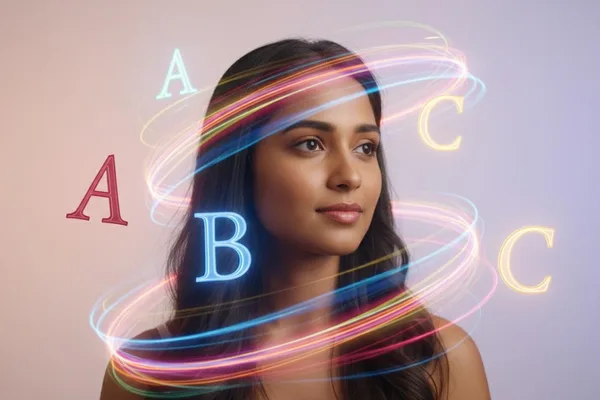
Imagine that when you listen to a beautiful song, suddenly you see different colored flowers in front of your eyes. Or every time you see the letter 'A', you see red, and every time you see the letter 'B', you see blue. Have you ever had an experience like this? Some people might think this is something strange, maybe even a mental problem. But it is actually a very strange and usually harmless condition. In medicine, we call this synesthesia . Simply put, it is when our senses become intertwined.
What is synesthesia? How does it work?
To understand this, let's first look at how our senses normally work. We receive information about the world through our five main senses. These are the eyes, ears, nose, tongue, and skin.
This is what usually happens:
1. Detection: Your senses detect something in your environment. For example, you see a red flower in front of your eyes.
2. Signaling: The sense organ (the eye) sends a signal to the brain, saying, "Here is something red and shaped like a flower."
3. Processing: The brain takes that signal, sends it to the appropriate part, and analyzes it. The brain understands, "Oh, this is a rose."
That is, our senses send information to the brain, and the brain uses that information to make sense of the world.
However, the brain of a person with synesthesia works a little differently in this final step. It's as if the brain's wiring is "a little tangled." Information related to one sensation is processed in two or more parts of the brain at once. As a result, there is an additional experience (secondary effect) along with the main experience.
- Primary effect: This is what actually happens. For example, hearing a song.
- Secondary effect: This is the additional experience. For example, seeing colors for no reason when listening to that song.
This secondary experience also varies from person to person. For some, the color actually appears to float before their eyes. For others, the color is very clearly visible on their internal screen, even though they cannot see it before their eyes.
What are the main types of synesthesia?
When our senses and the way we perceive things come together, more than 60 types of synesthesia have been identified. Some experts say there are more than 150. This is why many people who have this condition don't realize it's unusual or that it has a name.
However, some of these are quite common. Let's look at a few of them.
| Type of synesthesia | Simply put... |
|---|---|
| Grapheme-color synesthesia | When seeing letters, numbers, or symbols, they appear to have a specific color. For example, the number '5' always appears yellow. |
| Sound-color synesthesia | Seeing different colors, especially when hearing sounds like music. Many musicians have this experience. |
| Auditory-tactile synesthesia | Feeling a sensation (like warmth, pressure) as if something is touching the skin when hearing a certain sound. |
| Mirror-touch synesthesia | When you see someone touching someone else's hand, you feel the same way in your own hand. Some people can even feel someone else's pain. |
| Time-space synesthesia | When we think about time (days of the week, months, years), we tend to see them as forming a certain shape or position in our minds. For example, the year seems like a circle. |
Why does this happen to some people?
Experts still can't say with 100% certainty why this happens, but they have identified three main categories of causes.
1. Congenital Synesthesia (Developmental)
This is the most common type. These people have a slight difference in the way their brains develop (neurodivergent). This is not a disease. There are several factors that can cause this:
- Brain development: Some scientists believe that we all experience synesthesia when we are young, and that many people lose this ability as we get older.
- Brain structure: Research has shown that people with synesthesia have more connections between different parts of their brains. This may be one reason why synesthesia is so common among children with autism spectrum disorder (ASD) .
- Genetics: This can be passed down through families. But while a mother can see colors in letters, a child can see colors in songs. That means the type can change.
2. Later-onset Synesthesia (Acquired)
Sometimes it can occur after a brain injury, stroke, or other medical condition. This can happen because new connections are formed as the brain heals. But this is a little different from synesthesia that is present at birth. It is not as stable, and may even go away over time.
3. Drug-induced Synesthesia
Some drugs, especially those that cause hallucinations, can cause temporary synesthesia when used in high doses. Examples of this are things like `(LSD)` and `(Psilocybin)` (magic mushrooms). This is different from natural synesthesia. Because it can be controlled, and depends on the person's mental state. Remember that the use of such drugs is very dangerous and illegal.
Does this require treatment?
The simple answer is, no . Developmental and acquired synesthesia are not medical conditions. Therefore, they do not require treatment.
In the very rare case that someone has difficulty concentrating due to this experience, they can learn ways to manage it.
If synesthesia is caused by drugs, it may be a sign of a drug overdose. In such a case, treatment is not required for the synesthesia, but for the damage caused to the body by the drugs. In such an emergency, it is very important to immediately take the person to a hospital's emergency room (ETU) .
Are there any advantages to having synesthesia?
Yes! Although this may sound strange, having synesthesia has several advantages.
- Better memory: People with synesthesia have a unique ability to remember things, especially those related to their type of synesthesia. For example, someone who sees colors in letters may find it easier to remember a new name because they remember the color pattern of the letters in that name.
- Creativity: There is a strong connection between synesthesia and creativity. These people have an innate talent for artistic things. World-famous musicians like Beyoncé and Billy Joel have also publicly stated that they have sound-color synesthesia.
- Intelligence: Some research has shown that people with synesthesia generally score higher on intelligence tests.
Take-Home Message
- Synesthesia is the activation of one sensation by another. It is not a disease or mental illness.
- This is often due to a unique "wiring" in the brain that is present at birth. It can also be passed down through generations.
- This condition usually does not require any treatment and is not harmful.
- Having synesthesia may be associated with better memory and higher creativity.
- If you think you have synesthesia, don't be afraid to talk about it. It's a unique and beautiful way your brain sees the world. If you have any concerns or fears about it, don't be afraid to talk to your doctor about it.




💬 Comments (0)
No comments yet. Be the first to share your thoughts here.
Add Your Comment