
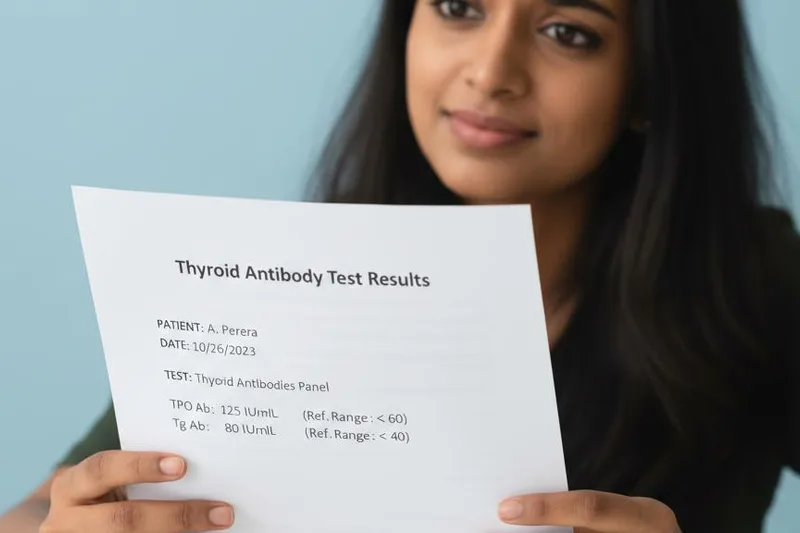
Has your doctor ever recommended a blood test for thyroid hormones, along with another special test? Or are you having trouble finding the exact cause of your thyroid problem? That's when we talk about what's called a 'Thyroid Antibody.' Although this may sound like a complicated word, it's actually quite simple. Let's take a look at what this test is and what it looks for.
What is this antibody?
Simply put, antibodies are our body's defense system. Their job is to find and destroy foreign invaders (called ``antigens'') like viruses and bacteria that enter the body. This is a very important part of our immune system.
But sometimes our immune system makes a mistake. They start attacking not only foreign invaders but also our own healthy cells and tissues. This is how we call antibodies that form against our own bodies 'autoantibodies' .
Most people have very small amounts of these autoantibodies in their bodies. That's normal. But if they increase in quantity, it means you may have an autoimmune condition.
So what is a thyroid antibody?
Thyroid antibodies are another type of autoantibody that we mentioned earlier. What happens here is that our immune system mistakenly starts attacking the thyroid gland in our neck. There are several types of antibodies that try to attack the cells of the thyroid gland in this way. The Thyroid Antibody Test measures these in the blood.
This test mainly checks to see if you have an autoimmune thyroid disease. The two diseases are:
1. Hashimoto's disease: In this, the function of the thyroid gland decreases (Hypothyroidism).
2. Graves' disease: In this, the thyroid gland becomes overactive (Hyperthyroidism).
| Main types of thyroid antibodies | Often associated medical condition |
|---|---|
| Thyroid Peroxidase Antibody (TPOAb) | The main indicator for Hashimoto's disease. |
| Thyroglobulin Antibody (TgAb) | It may be related to Hashimoto's disease. |
| Thyroid-stimulating immunoglobulin (TSI) | The main indicator for Graves' disease. |
| TSH receptor antibody (TRAb) | Another type of antibody associated with Graves' disease. |
These names may seem a bit scientific and hard to remember. That's okay. If your doctor calls these things by other names, never be afraid to ask them specifically what they are.
Why would a doctor recommend this test?
Your doctor will usually do blood tests called TSH and T4 to check your thyroid hormone levels. If the results of those tests are abnormal , they will order this antibody test to find out exactly what is causing it.
In addition, there may be several other reasons:
- After treatment for thyroid cancer, check to see if the cancer has come back .
- Monitor thyroid conditions during pregnancy .
How should I prepare for this test?
This is the best thing. This blood test usually does not require any special preparation . You can eat and drink normally. However, if your doctor gives you other instructions, you should follow them.
However, there is one very important thing. If you are taking any vitamins or supplements containing biotin, you should definitely tell your doctor about it. Biotin can interfere with the results of this test. So ask your doctor how many days before the test you should stop taking it.
This is done in a lab, just like a regular blood test. It involves taking a small amount of blood from a vein in your arm using a small needle.
How do I understand the results of the report?
The report you receive will usually include the following:
- Name of the test
- Your blood test result
- The normal range of the test
- Whether your result is "Positive" or "Negative", or high or low.
Typically, the results of a thyroid antibody report are listed as 'Negative' or 'Positive' .
- A negative result means that the level of that antibody in your body is within the normal range.
- A positive result means that the antibody level is above the normal range.
What are the normal values?
These values may vary slightly from lab to lab, so always compare them to the 'Normal Range' listed on your report. In general, normal values are as follows:
| Antibody type | Average value (approximate) |
|---|---|
| Thyroid peroxidase antibody (TPOAb) | Should be less than 5.6 IU/ml |
| Thyroglobulin antibodies (TgAb) | Should be less than 4 IU/ml |
| TSH receptor antibodies (TRAb) | Should be less than 1.75 IU/L (may vary depending on the type of test) |
| Thyroid stimulating immunoglobulin (TSI) | Should be less than 0.55 IU/ml |
Remember, don't panic when you see the results of the report. Your doctor is the best person to explain exactly what it means.
What does it mean if the antibody is positive?
A positive thyroid antibody test often means you have an autoimmune thyroid disease. But that's not always the case . Some healthy people can also be positive for these antibodies. That's why a doctor will look at this report along with your symptoms and other blood tests (like TSH).
If TPO antibodies are positive:
- If your TSH hormone levels are also elevated, you likely have Hashimoto's disease .
- Even if your TSH level is currently normal, if your TPO antibody is positive, you may be at risk of developing hypothyroidism in the future .
If TgAb antibody is positive:
- This can also be said to be Hashimoto's disease.
- If TgAb levels are elevated in someone who has had surgery and radiation treatment for thyroid cancer, it may indicate a risk of cancer recurrence .
If TRAb and TSI antibodies are positive:
- If your TSH hormone levels are low and you have this antibody positive, there is a very high chance that you have Graves' disease . About 95% of people with Graves' disease have this antibody positive.
If the results are abnormal, what happens next?
If your antibody test results are abnormal, don't worry. Your doctor will explain what to do next and whether or not treatment is needed.
If Hashimoto's disease causes hypothyroidism, treatment is usually a daily pill that is taken for life. For Graves' disease, there are several options, including pills and radiation therapy.
It's normal to feel scared and worried when you see an unusual result on a report. But remember, your doctor will help you by explaining the results and discussing treatment if necessary. Never hesitate to ask your doctor any questions, concerns, or doubts you may have.
Take-Home Message
- A thyroid antibody test mainly looks for whether the cause of your thyroid problem is an autoimmune condition.
- Just because the result is 'positive' doesn't mean you have a disease. It's up to the doctor to compare it with other tests like TSH and your symptoms, and then come to a conclusion.
- It is imperative that you inform your doctor before the test about any vitamins you are taking, especially those containing biotin.
- Don't panic just by looking at the numbers on the report. Always talk to your doctor about it and clarify it.


💬 Comments (0)
No comments yet. Be the first to share your thoughts here.
Add Your Comment