
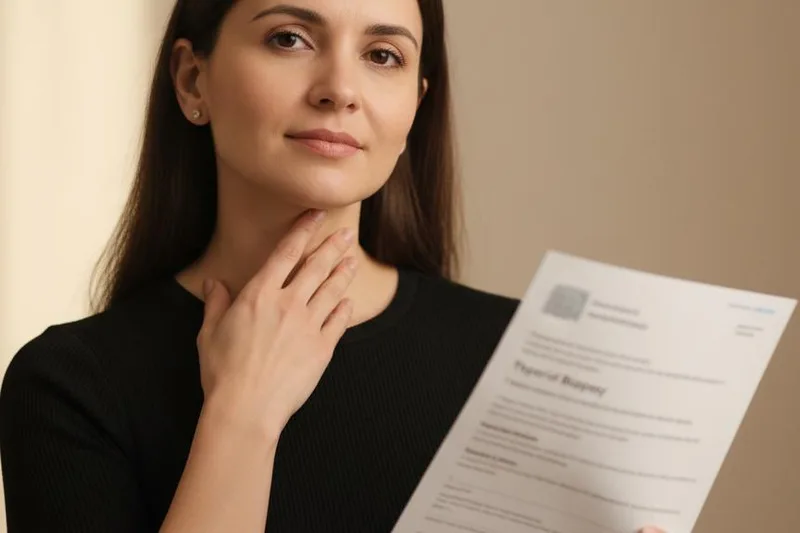
It's normal to feel a little scared and nervous when your doctor tells you that you have a lump in your neck and you need to have a biopsy. When most of us hear the word 'biopsy', we immediately think of cancer. But is this really something to be afraid of? What will happen with this test? Let's talk about all this clearly and in a way that makes you feel at ease.
Simply put, what is a thyroid biopsy?
Imagine you've made a big cake. You don't need to cut the whole cake to see what's inside and if it's cooked properly, right? We can get an idea by cutting a small piece and eating it.
A thyroid biopsy is a similar procedure. A thyroid biopsy is a procedure that involves taking a very small sample of cells from a nodule in your thyroid gland, which is shaped like a butterfly in your neck. This is done to find out exactly what type of cells the nodule is made of.
Why do you want to do this biopsy?
Not all thyroid diseases require a biopsy. Sometimes, a blood test and a scan can be used to diagnose the condition.
However, if you have thyroid nodules, your doctor may suggest a biopsy. These nodules are small, solid or fluid-filled lumps that form inside the thyroid gland. The important thing to remember here is that more than 90% of these nodules are not cancerous (benign). This means that they do not cause any significant harm to the body.
However, a very small percentage (about 5% - 15%) may be cancerous (malignant). Doctors perform this biopsy test to eliminate that small chance.
Generally, if you have a lump larger than 1 centimeter, you are more likely to need a biopsy. So, just because you are asked to have a biopsy, it does not mean that you have cancer. It is to make sure that you do not have cancer.
How is this biopsy done? There are three main methods.
Doctors mainly use three methods to perform this test.
1. Fine-Needle Aspiration (FNA) - The most commonly performed method
This is the simplest and safest method used by 99% of people. Here's what happens:
- The doctor will use an ultrasound machine to find the exact location of the lump in your neck.
- Then, a very fine, thin needle (like a needle used to draw blood) is inserted into the lump and a small amount of cells and fluid is drawn out (aspirated).
- There is no major cut, no incision, and no great pain.
2. Core-Needle Biopsy (CNB)
This is very similar to the FNA method mentioned above. However, the needle used here is a little thicker. This method is used if the FNA test is inconclusive and a larger tissue sample is needed. This is also usually done very rarely.
3. Surgical Biopsy
This is done very, very rarely. It is only considered if the other two methods fail to provide a clear conclusion. Here, a small incision is made in the neck and part or all of the lump is removed and sent for testing.
How should you prepare before the test?
If you are going to have a common FNA or CNB test, it doesn't require much preparation.
- Unless your doctor advises otherwise, you can eat and drink normally.
- But most importantly, if you are taking any blood-thinning medication (such as Aspirin, Warfarin, Clopidogrel), you should definitely tell your doctor beforehand. He or she may ask you to stop taking the medication a few days before the test.
- You will have a surgical biopsy, and your doctor will give you specific instructions on how to prepare for it.
What happens during the test?
Let's take a step-by-step look at what happens during a common FNA test. This is usually completed in a short time, about 10-20 minutes.
1. First, you will be made to lie down on a bed.
2. Then , a small amount of local anesthesia is injected to numb the area where the needle will be inserted. This will prevent you from feeling much pain.
3. Next, the doctor will place the head-like part of the ultrasound scan (transducer) on your neck and, looking at the monitor, will mark the exact location of the lump.
4. Then, very carefully, the fine needle is inserted through the skin at the marked point and into the knot.
5. You will be asked to remain still while the sample is being taken. Do not talk or swallow during this time.
6. After the sample is taken, the needle is removed and a small plaster or bandage is applied to the area.
7. If you have more than one knot, you can take samples from the other knots in the same way.
8. The sample taken is sent to a doctor who specializes in cells (Cytologist) for examination.
What side effects can occur after the test?
This is a very safe test. Serious side effects are rare. Common side effects include:
- A small wound or bruise appears at the site of the piercing.
- For minor pain like this, you can take a painkiller like Paracetamol. However, it is best to ask your doctor before taking any medication.
Very rare complications:
- Bleeding
- Infection
- Formation of a cyst
What does the biopsy report say?
You will usually receive the report within a week. The results of the report can be divided into about 6 main categories. Let's see what each of them simply means.
| Result Category | Simple Meaning |
|---|---|
| Benign (non-cancerous) | This is the good news! The lump is not cancerous. There is nothing to worry about. The doctor says to do another scan in about 12 months. |
| Malignant (cancerous) | The lump is made up of cancer cells. This often requires surgery to remove the lump. |
| Suspicious for Malignancy | There is a possibility of cancer. At this point, the doctor will most likely suggest surgery. |
| Atypia / FLUS (hard to say for sure) | The cells are a little abnormal, but there's not enough evidence to say for sure that it's cancer. At times like this, the doctor may ask you to do another biopsy or wait a while. |
| Follicular Neoplasm / Suspicious (another type of lump) | This may or may not be cancer. This biopsy alone cannot tell for sure. To know for sure, the lump will have to be surgically removed and examined. |
| Non-diagnostic (not enough cells) | There weren't enough cells in the sample taken for testing to reach a conclusion. So you'll have to do the biopsy again. |
If you have these symptoms, call your doctor immediately.
Infection after a biopsy is very rare. However, if you experience any of the symptoms below, contact your doctor immediately.
- If you get a fever
- If you feel cold and shivering
- If the piercing site is red, swollen, and pus-like fluid is coming out of it
Take-Home Message
- Don't be afraid of the word "biopsy." It doesn't mean you have cancer. It's just to help find out exactly what your condition is.
- More than 90% of thyroid nodules are not cancerous.
- The most commonly performed FNA test is very simple, safe, takes just a few minutes, and is not very painful.
- Follow your doctor's instructions carefully before and after the test.
- Once the report arrives, talk clearly with your doctor about it and what to do next.


💬 Comments (0)
No comments yet. Be the first to share your thoughts here.
Add Your Comment