

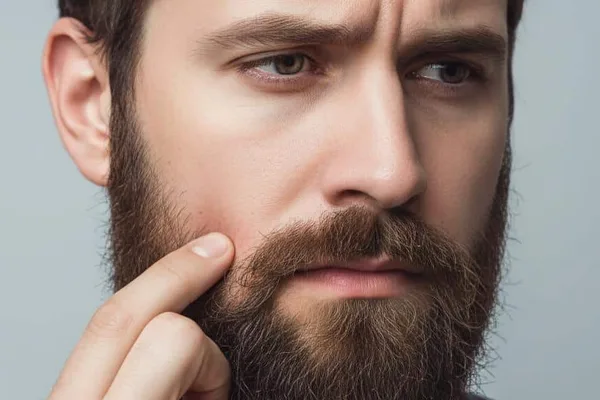
Do you grow a nice beard? Or do you sometimes get little bumps like blisters when you shave? Do you sometimes get red, itchy bumps around your beard? Today we're going to talk about a fungal infection that you might have at some point, but it's not very common. This is called Tinea Barbae.
What is Tinea Barbae?
Simply put, Tinea Barbae is a fungal infection that affects the skin, hair, and hair follicles in your beard and mustache area. Another name for this is 'Beard Ringworm'. But despite the word 'worm' in the name, this is not a disease caused by a worm at all . It is an infection caused by a fungus. The name 'Ringworm' comes from the circular, ring-like appearance it creates on the skin when it occurs.
In the past, this was also called 'barber's itch'. This is because in the past, when many people were shaved using the same razor in barbershops, it spread easily from one infected person to another. However, today, such transmission is very rare due to hygiene measures.
How does this happen? What is the reason?
The main cause of this is several species of fungi belonging to the genus Trichophyton . These are part of the larger group of fungi called dermatophytes. You may have heard of things like 'Athlete's foot' and 'jock itch'. Those conditions are caused by other members of this same family of fungi.
Okay, now let's see how this fungus gets into our bodies.
This infection is most often spread by direct contact with an infected animal or by frequent contact with such animals. This is especially true for people living on farms,
- Dairy cows
- Sheep
- Pigs
- Horses
This fungus can be found on the bodies of animals such as dogs and cats. Not only that, it can also sometimes be transmitted from pets such as dogs and cats.
The important thing is that Tinea barbae is a very rare infection that can be spread from person to person. This means that it is not spread by talking to or shaking hands with someone who has it. It is also very rare to spread it through sharing things like towels.
Who is most at risk of developing this?
This fungal infection is actually quite rare. Since it was first reported in 1842, only about 150 cases have been reported worldwide. Bacterial infections associated with beards are much more common.
However, some people are more likely to develop this than others.
- Young boys and older men who work with farm animals are at greatest risk.
- If you have a disease that weakens the immune system (autoimmune diseases).
- If you have diabetes .
- If your skin is constantly injured or irritated when shaving.
- Some steroids are used incorrectly or taken for a long time.
What are the symptoms? How do you recognize it?
The main symptom of this is a red, round, slightly itchy rash that appears on the beard area, that is, the cheeks, chin, neck, and upper moustache. This is not painful, but it can be quite itchy .
Sometimes this may seem like a normal rash, but for some people it can be a bit more severe. Then the infection goes deep under the skin and the hair follicles start to swell. This can lead to some complications.
Let's explain this further in the table below.
| Characteristic / Condition | Description |
|---|---|
| General characteristics | A red, circular, scaly, itchy rash appears in the beard area. |
| Deep infection (Tinea sycosis) | The fungus enters the hair follicles and infects them. The hair can easily fall out. |
| Kerions | Swollen, pus-filled, painful bumps on the skin. These can cause scarring and permanent hair loss. |
| Other symptoms of complications | Fever, malaise, and swollen lymph nodes. |
How does a doctor recognize this?
If you have these symptoms, the best thing to do is to see a dermatologist, or your family doctor.
He will look at your symptoms and get an idea of this. Then, to be sure, he can scrape off some skin and remove a hair follicle from the area where the rash is and look at it under a microscope. That way, you can see for sure if the fungus is there.
Sometimes these symptoms can be caused by other conditions (e.g. bacterial infections, acne), so the doctor may also perform tests such as these to confirm further if necessary:
- Sending a bearded dragon for a lab test (Lab culture)
- Skin biopsy
What are the treatments for this?
Since this is a fungal infection, antifungal medications are used as treatment. This condition responds very well to treatment.
- Oral antifungals: These help treat the infection from within the body.
- Topical antifungals: These are used to kill fungi on the surface of the skin.
If the infection is severe, meaning that there are pus-filled bumps like the ones we mentioned earlier and they are very swollen, your doctor may prescribe a steroid medication like prednisone to reduce the swelling. This can also reduce scarring.
The most important thing is to not use any over-the-counter medications, especially creams, without consulting a doctor. The steroids in some creams can make the fungal infection worse.
This infection usually clears up completely in about six weeks .
Can't this be prevented?
Yes, this can be largely prevented by following a few simple steps.
- Wash your hands thoroughly with soap after handling farm animals, especially cows.
- Do not let anyone else use your personal items, such as razors, brushes, and towels, and do not use other people's items yourself.
- If a pet at home or on the farm has this type of fungal infection, take it to a veterinarian for treatment .
Does this fungal infection spread to other parts of the body?
Yes. This fungal infection can affect different parts of the body. However, the name given to it varies depending on the area affected. Tinea Barbae is only for the beard area.
| Name of the infection | Affected area | Common name |
|---|---|---|
| Tinea barbae | Beard and mustache area | Beard Ringworm |
| Tinea capitis | Scalp | Scalp Ringworm (Ringworm) |
| Tinea corporis | Body, limbs | Ringworm (eczema) |
| Tinea cruris | Groin, upper thigh | Jock Itch |
| Tinea pedis | Feet | Athlete's Foot (Leather) |
| Tinea unguium | Fingernails and toenails | Nail Fungus |
Take-Home Message
- Tinea barbae is a rare fungal infection of the beard. It is not a disease caused by a worm.
- It is most often transmitted from farm animals such as cows. Person-to-person transmission is very rare.
- The main symptom is a red, circular, itchy rash that appears in the beard area.
- This condition can be completely cured with antifungal medications prescribed by a doctor.
- This can be prevented by washing hands thoroughly after handling animals and not sharing personal items such as razors.
- If you have these symptoms, seek medical advice immediately.




💬 Comments (0)
No comments yet. Be the first to share your thoughts here.
Add Your Comment