

You might be wondering how serious a stroke is. The main reason for this is that the most important artery (carotid artery) on either side of our neck that carries blood to the brain gets blocked by fat deposits. It's like rust building up inside a water pipe and gradually clogging it. But don't worry, there are now very advanced and simple treatments for this. That's what we're talking about today.
What is this so-called TFCAS treatment?
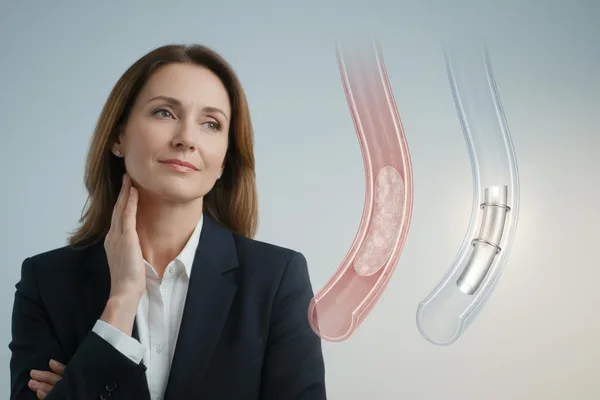
Simply put, Transfemoral Carotid Artery Stenting (TFCAS) is a minimally invasive procedure that is used to reopen a blocked carotid artery in the neck. It involves inserting a very small mesh-like tube, called a stent, into the blocked artery to widen it again.
Think about it, the carotid arteries on either side of our neck are the two main arteries that carry oxygen and nutrients to our brain, face, and neck. Over time, cholesterol and fats from the foods we eat start to build up in the walls of these arteries. We call this plaque. This plaque buildup causes the artery walls to thicken and become hard (atherosclerosis). Eventually, the blood vessels become narrowed (stenosis). When this blood flow is obstructed, the blood supply to the brain decreases, greatly increasing the risk of stroke.
In TFCAS treatment, a special tube (catheter) is inserted through a very small incision in your groin or arm and guided to the blocked artery in your neck. A stent is then inserted through the catheter to reopen the artery. The stent, like a tent pole, helps keep the artery from collapsing again. This restores blood flow to the brain, reducing the risk of stroke.
Who needs this treatment?
This treatment may be recommended if your doctor determines that you have carotid artery disease. Sometimes you may not have any symptoms at all. However, some people may experience symptoms similar to mini-strokes (or transient ischemic attacks - TIAs).
There are usually several treatments for carotid artery stenosis. Your doctor will choose the treatment that is best for you based on your health condition, the shape of the artery, and the location of the stenosis.
The most important thing is to discuss with your doctor which of these treatments is best for you.
| Treatment method | What simply happens | Specialty |
|---|---|---|
| TFCAS (the method discussed in this article) | Inserting a stent into a vein in the neck using a tube inserted through the groin or arm. | There is no big cut. The healing time is short. |
| Carotid Endarterectomy (CEA) | An incision is made in the neck, the artery is opened, and the fatty layer (plaque) that has accumulated there is removed. | Traditional surgery performed on many people. |
| Transcarotid Stenting (TCAR) | A small incision is made in the neck just above the collarbone and the stent is inserted directly into the artery. | Some studies have shown that it has a lower risk of stroke than TFCAS. |
Who is TFCAS treatment best suited for?
TFCAS treatment may be better for you than CEA surgery if you have these risk factors:
- If the artery is blocked in a place that cannot be easily reached by surgery.
- If you have other health problems (comorbidities) such as heart disease, lung disease, or obesity.
- If you have scar tissue on your neck due to previous surgery or radiation therapy.
- If your vocal cords have been damaged.
How do you prepare before surgery?
Before this surgery, your doctor may ask you to:
- Get some blood tests and other health tests done.
- Have an echocardiogram or stress test to check the function of the heart.
- Do an imaging test such as `carotid angiography`, `vascular ultrasound`, or `MRA` to see exactly where the artery is blocked.
- Provide a list of all medications and supplements you use.
- Medications such as aspirin may be prescribed to prevent blood clots.
- Refrain from eating or drinking (fast) for a few hours before surgery.
How is the surgery performed? Step by step
This surgery usually takes less than two hours and is performed by a specially trained team of doctors.
| Steps | What is happening? |
|---|---|
| 1. Anesthesia | You will often be fully anesthetized. You may also be given a small amount of medicine to calm you down while you are awake. |
| 2. Inserting the catheter | A special tube (catheter) is guided through a small hole made in the groin to the carotid artery in the neck with the help of X-rays. |
| 3. Installing the filter | A small filter is placed just beyond the blockage to catch any plaque that may break off while the artery is being widened. This reduces the risk of stroke. |
| 4. Using the balloon | A small balloon is inserted into the blockage and inflated, which presses the fatty layer against the artery wall and widens the artery. The balloon is then removed. |
| 5. Placing the stent | Now, a self-expanding stent is inserted into the widened area. This helps keep the artery open. |
| 6. Finishing | The filter and catheter are removed, and the hole in the groin is closed with a special device. |
What happens after surgery?
After surgery, you will be monitored in a recovery room for several hours. You will then usually have to stay in the hospital overnight.
- You will be given painkillers for any discomfort you may experience.
- Your doctor will prescribe you to take antiplatelet medications (e.g., Aspirin, Clopidogrel) for the rest of your life to prevent blood clots at the site of the stent.
Most people can go home from the hospital after 24 hours. There may be bruising, swelling, and mild pain at the incision site for a few days.
What are the benefits and risks of this treatment?
Benefits
- Reduced risk of stroke: As blood flow to the brain is restored, the risk of stroke is significantly reduced.
- Small incision: There is no large incision, so there is less pain, risk of infection, and scarring.
- Quick recovery: You can resume normal activities within a few days.
Risks
As with any surgery, there is a small risk, but the risk of serious complications is less than 3%.
- Restenosis: Very rarely, scar tissue can form under the stent and narrow the artery again.
- Stroke: During surgery, pieces of fat can break off and block an artery in the brain. However, this risk is greatly reduced by the filter we discussed earlier.
- Heart attack
- Bleeding or infection
When do you need to see the doctor?
If you experience any of these symptoms when you go home after surgery , call your doctor immediately.
- If you feel feverish or have a cold
- If nausea and vomiting go away
- If the incision site is red, swollen, or oozing yellow fluid (signs of infection)
Most importantly: If you experience symptoms of a stroke, such as slurred speech, weakness on one side of the body, facial drooping, or changes in vision, go to a hospital's Emergency Department (ETU) immediately without delay.
Take-Home Message
- TFCAS is an advanced, minimally invasive procedure used to open blocked arteries in the neck and reduce the risk of stroke.
- This treatment is not suitable for everyone. Discuss with your doctor what treatment option is best for you.
- It is very important to maintain a healthy lifestyle (good diet, exercise, and smoking cessation) and take your prescribed medications exactly as prescribed after surgery.
- Being aware of the warning signs that may occur after surgery, and especially the signs of a stroke, can help save your life.




💬 Comments (0)
No comments yet. Be the first to share your thoughts here.
Add Your Comment