
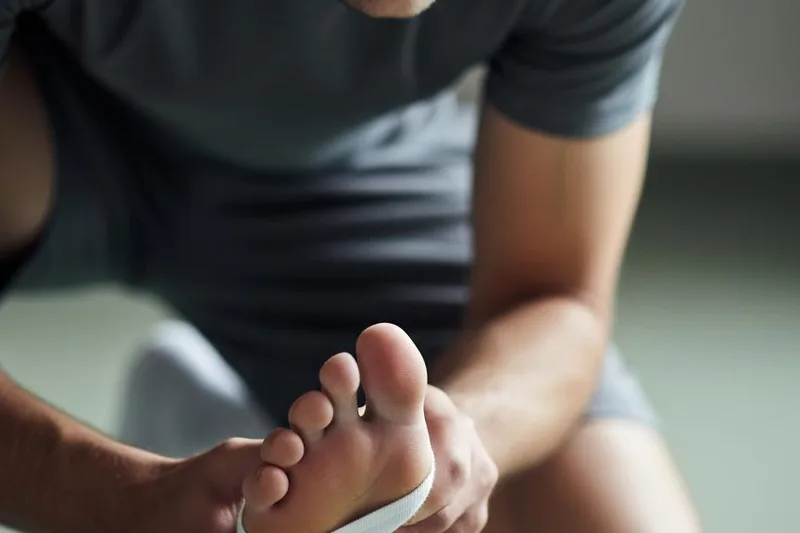
Imagine you are playing cricket, football or rugby. What if you suddenly try to run fast, your big toe is stuck on the ground, and when you lift your heel and jump forward, you feel a sharp pain at the base of your big toe with a "tuck" sound? Or have you been walking a little awkwardly for several days with pain and swelling coming from the big joint of your big toe? If you have had this experience, it is often due to a condition known in medical science as "Turf Toe".
Simply put, what is Turf Toe?
When you hear this name, some people may think that this is a new disease. But it is not. Simply put, Turf Toe is a sprain of the big toe, the largest joint that connects the foot. Just like a sprained ankle, it is a strain or tear of the soft tissues and ligaments around the joint of the big toe.
It got its name, Turf Toe, because it became more common after American football players started playing on artificial turf fields. Since this artificial turf is a bit harder than regular grass, running on it, stopping suddenly, and changing direction puts a lot of pressure on the big toe joint. But this isn't just something that happens to players; it can happen to anyone.
Where exactly on the finger does this disorder affect?
Let's understand this a little more clearly. Our big toe has two joints. The largest joint at the base of the big toe, which connects to the other bones of the foot, is what we medically call the Metatarsophalangeal joint (MTP joint) .
To keep this joint working properly, it needs a lot of support from the ligaments, tendons, and connective tissue that surround it. Like a rope, these help to keep the joint stable. Turf toe occurs when the big toe is hyperextended, causing damage to these supporting tissues.
What are the main grades of Turf Toe?
A doctor will divide the severity of the condition into three main levels (grades). This classification is very important in determining what treatment you need and how long it will take to recover.
| Grade | Nature of damage | Common symptoms |
|---|---|---|
| Grade 1 | The soft tissue at the joint of the big toe is only pulled without tearing. | A slight pain when touched. A little swelling. You may feel a little discomfort when playing sports, but you can continue to do so. |
| Grade 2 | A partial tear of the soft tissue occurs. | Severe pain. Pain when touching the joint. There is obvious swelling and bruising. Difficulty playing sports and exercising. |
| Grade 3 | Complete tear of the soft tissue. Possibly dislocation of the MTP joint. | Extremely painful and swollen. It's so bad I can't even move my finger. I can't even think about playing sports. |
What are the symptoms of Turf Toe?
The symptoms of turf toe vary depending on the severity of the injury. If the injury occurs suddenly, you may hear a "click" or feel something breaking inside the toe. The pain may also begin immediately.
However, if this condition is caused by repetitive movements over a long period of time, symptoms may appear gradually and worsen over time.
The main symptoms are these:
- Pain and tenderness: The pain may be constant, or it may only hurt when you press on the area. Sometimes the pain is so severe that you can't even put your foot down.
- Swelling and bruising: The base of the big toe may be swollen and red. Sometimes the bruising can turn blue/purple, and the color may spread up the foot.
- Difficulty bending the big toe: It becomes difficult to bend the big toe up and down. You may feel like you can't push off the ground when running or jumping, and your leg may feel weak.
- Joint loosening: The MTP joint may feel unstable, like it is jumping. The joint may also feel tight or stiff.
Why does Turf Toe occur?
The main reason for this is that the big toe is pressed against the ground, with the heel pointing up and the toe bent too far back. This is similar to a sprinter's starting position. If too much force is applied to the toe at this point, it can go beyond its natural range of motion, causing the ligaments and soft tissues around the joint to tear or stretch.
This can happen in two ways:
1. Due to repetitive movements: For example, when people like ballet dancers and gymnasts constantly jump on their toes, this damage can occur gradually over time.
2. Accident: This injury can occur suddenly, such as when a football or rugby player's leg is stuck in the ground and another player comes and hits them.
Most importantly, our shoes also play a role. Especially when we continue to wear loose, unsupportive rubber sandals (flip-flops), our foot muscles have to work harder. This can also lead to foot problems like turf toe over time.
What complications can occur if left untreated?
Turf toe injuries often resolve completely with proper treatment, but if left untreated, some complications can occur.
- Persistent pain and stiffness in the joint.
- Loss of push-off strength needed to run and jump.
- Deformity of the joint of the big toe. This is what we call bunions .
- Arthritis of the joint. This is called hallux rigidus .
- The big toe is permanently raised.
Therefore, if you experience finger pain, do not ignore it. It is very important to seek medical advice immediately.
How does a doctor diagnose this?
When you go to see a doctor, he will first examine your finger. He will press on the area where there is pain and swelling. He will also ask you to bend your finger up and down to check its range of motion.
You will be asked to describe how the injury occurred. Being able to clearly describe everything you remember at the time, such as how your finger was positioned and where you felt the pain, will help a lot in making an accurate diagnosis.
After that, an X-ray may be recommended to check for bone damage and, if necessary, an MRI (Magnetic Resonance Imaging) scan to accurately assess damage to soft tissues such as ligaments and tendons.
What are the treatments for turf toe?
The good news is that most cases of turf toe (especially grades 1 and 2) can be treated with rest and simple treatments. Your doctor may recommend treatments such as:
1. Rest: Depending on the severity of the injury, you may be advised to avoid putting weight on your leg for a few days to a few weeks. During that time, you may need to use a walking boot or crutches to help you walk.
2. Ice and Elevation: Apply ice to the painful, swollen area for about 20 minutes every few hours. Also, keep the leg elevated above your heart. This will greatly reduce pain and swelling.
3. Painkillers: Your doctor may prescribe medications like nonsteroidal anti-inflammatory drugs (NSAIDs) to reduce swelling and pain. However, always take medications only as directed by your doctor.
4. Physical Therapy (PT): An experienced physical therapist will teach you specific exercises and stretches to reduce joint stiffness, increase flexibility, and strengthen the muscles that support the MTP joint.
5. Stabilization: Limit movement of the joint until it heals. Your doctor or physical therapist will show you how to tape the big toe together with the other toes. When you start playing again, wear sturdy, well-supported shoes.
6. Orthotics: You may be advised to use special inserts or stiff-soled shoes. These increase the support provided to the joint when running and jumping.
7. Surgery: This is rarely necessary. In cases where there is severe tissue tearing, bone fractures, or significant joint damage (level 3 injuries), surgery may be required to repair the injury.
How long will it take for this condition to heal?
Recovery time varies from person to person. It depends on the severity of your injury, age, activity level, and other health conditions. Typically:
- A level 1 injury can heal in about a week.
- A level 2 injury can last two to three weeks.
- A level 3 injury can take anywhere from two to six months to heal. If surgery is required, the recovery time is even longer.
When should I see a doctor?
If you have pain, swelling, or bruising in your big toe or foot, even if the pain is mild, it's important to see a doctor to find out exactly what's wrong. Then you can start the best treatment plan for you.
In particular, see a doctor or go to the Emergency Department (ETU) immediately if:
- If the pain is very severe.
- If you can't put your foot down and put weight on it.
- If the joint on the big toe looks abnormal, as if it has popped out.
Take-Home Message
- Turf toe is a sprain of the big toe's main joint, which connects to the base. It is a common injury, especially for athletes.
- The main symptoms include pain at the base of the big toe, swelling, bruising, and difficulty bending the toe.
- Simple treatments such as rest and ice can often completely cure this condition.
- Never ignore finger pain. See your doctor as soon as possible for proper advice and treatment.
- You can prevent this injury by wearing shoes that are appropriate for the sport or activity you are playing, have good support, and warm-up well before exercising.


💬 Comments (0)
No comments yet. Be the first to share your thoughts here.
Add Your Comment