
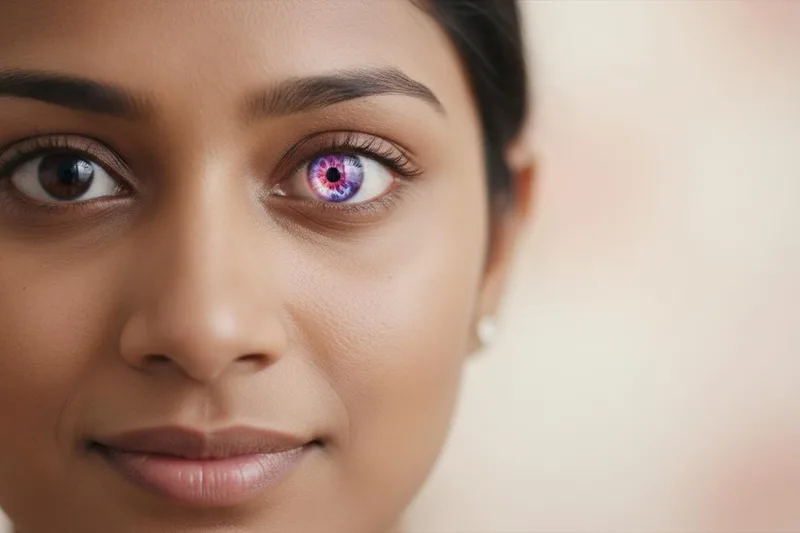
Have you ever looked at your eyes in the mirror and wondered how intricately complex things are inside them? All we see is the white part of the eye and the black iris. But our eyes are actually like a tiny camera that works amazingly well. Today we're going to talk about a hidden part inside the eye that is essential to vision. That part is called the uvea.
What is this Uvea?
Simply put, the uvea is the middle layer of the three main layers that make up our eye. It's like the middle layer of a sandwich. The name Uvea comes from the Latin and Greek words for "grape." It's named because it looks like a grape when viewed from the outside.
Another name for this is the "vascular tunic." "Tunic" means a shirt-like garment. "Vascular" means blood vessels, or something related to blood circulation. So this uvea is also wrapped around our eye like a shirt, and it's filled with blood vessels that supply the eye with the blood it needs.
What are the main parts of the uvea and their functions?
The uvea is made up of three main parts. Each part has a specific function. Let's look at it this way to make it easier to understand.
| Part | Its function simply put |
|---|---|
| Iris | This is the part that determines your eye color. This part is responsible for eye colors like blue, brown, and black. And, like the lens of a camera, it expands and contracts to control the amount of light that enters the eye. It shrinks in the sun and expands in the dark to help the eye get the light it needs. |
| Ciliary body | This is located behind the iris. This part of the eye helps to change the shape of the lens of the eye and 'focus' so that you can see clearly when you are reading a book or looking at something far away. Not only that, it also helps to produce a liquid inside the eye (aqueous humor), which helps to keep the eyeball in shape. |
| Choroid | This is the largest part of the Uvea. This is a thin membrane filled with blood vessels. Think of your eye as a house. Then this Choroid is like the plumbing system that supplies water to that house. It is this one that provides the blood and nutrition needed by the eye, especially the retina, which gives us vision. The melanin pigment in this one also reduces the unnecessary reflection of light inside the eye. |
What conditions can affect the uvea?
There are a number of diseases that affect these different parts of the uvea. You may have heard of some of these.
- Uveitis: Inflammation of the uvea.
- Eye cancers: especially intraocular melanoma.
- Diabetes-related retinopathy: Damage to the blood vessels in the eye due to diabetes.
- Albinism: Lack of pigmentation in the body.
- Presbyopia: As we age, the function of the ciliary body decreases, making it difficult to focus on near objects.
- Eye injuries.
- Reduced blood supply to the eye (Eye ischemia): Due to things like an eye stroke.
- Coloboma: Congenital underdevelopment of part of the eye.
- Diseases that affect other body systems, such as sarcoidosis and syphilis .
- Iris abnormalities: For example, the iris is not in the middle (Corectopia) or there are multiple irises (Polycoria).
What are the common symptoms of a problem with the uvea?
Symptoms can vary depending on which part of the uvea is affected, but if you have one or more of these symptoms, it could be an eye problem.
| Symptom | Description |
|---|---|
| Blurred vision | The state of not seeing things clearly. |
| Eye pain | Pain coming from inside or around the eye. |
| Sensitivity to light (Photophobia) | Difficulty seeing even in dim light, eyes turning blue. |
| Red eye | Eye redness or inflammation. |
| Floaters in the scene | The vision of black dots or threads floating in front of the eyes. |
| Vision loss | Sudden or gradual loss of vision. |
How can I keep my eyes healthy?
There are a few simple things you can do to keep your eyes, including the uvea, healthy.
- Get your eyes checked regularly: Whether you wear glasses or not, it's important to see an eye doctor at least once or twice a year to detect problems before they become symptoms.
- Protect your eyes: If you are welding, working with wood, or working with dust or chemicals, be sure to wear safety glasses . Your glasses are not enough for that.
- Avoid smoking: Smoking and vaping are not good for the delicate blood vessels inside the eye. They can be very harmful to eye health.
- Don't ignore infections: If your eye is red, oozing, or itchy for a few days, don't ignore it. It could be something serious, so see a doctor right away.
When should I see an ophthalmologist?
In addition to regular eye exams, if you experience any of these symptoms, see an ophthalmologist immediately.
- If eye symptoms last more than a few days .
- If those symptoms are interfering with your daily activities .
- If you experience any type of vision loss .
If you suddenly lose your vision, become blurred, or have a sudden change, consider it a medical emergency. Go to a hospital's Emergency Department (ETU) immediately.
Even though we don't talk about the uvea every day, you probably understand by now how important it is to our vision. As long as it's working properly, we may not realize its value. But if there's a problem with it, it can be very scary. So getting regular eye exams is the best way to detect problems before symptoms appear and maintain good vision for a lifetime.
Take-Home Message
- The uvea is the middle layer of our eye, and it consists of three parts: the iris, the ciliary body, and the choroid.
- The uvea is essential for controlling light, focusing things, and supplying blood to the eye.
- Don't ignore symptoms like eye pain, blurred vision, sensitivity to light, or red eyes. They should be reported to a doctor.
- Getting regular eye exams, protecting your eyes, and avoiding smoking are the best ways to keep your eyes healthy.
- Sudden loss or change in vision is an emergency. Go to a hospital's Emergency Department (ETU) immediately.


💬 Comments (0)
No comments yet. Be the first to share your thoughts here.
Add Your Comment