

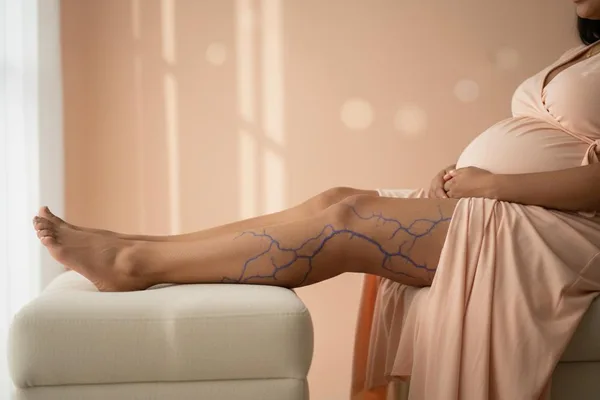
Many mothers experience blue or purple veins on their legs towards the end of their pregnancy, around the third trimester. Sometimes they look a little swollen, twisted, and knotted. It can be a little scary to see. But don't worry, this is a common occurrence for many people during pregnancy. Today, let's talk about varicose veins in more detail.
What are varicose veins during pregnancy?
Simply put, varicose veins are swollen, twisted, and enlarged veins under our skin. The Latin word "varicose" means "twisted." So when you look at these veins, they look like twisted, knotted ropes under the skin. They can appear blue or dark purple.
During pregnancy, these varicose veins are most commonly seen in the legs, especially the thighs and buttocks, around the ankles, and sometimes around the vulva .
Another thing related to this is hemorrhoids. Hemorrhoids are actually a type of varicose vein that occurs in or around the rectum. This is also very common during pregnancy.
Some people may also notice a network of tiny red or blue veins under the skin, similar to spider veins, along with these large varicose veins. These are not as swollen and knotted as the larger veins, but they are visible through the skin.
How do these vascular tangles form? What happens in our bodies?
Veins are part of our body's circulatory system. Veins carry blood from the body back to the heart. Inside these veins are small valves. These valves help the blood flow in one direction, that is, towards the heart, and prevent it from flowing backwards.
Imagine, what happens if the walls of these veins, or those valves, become weak for some reason? Then the blood can't flow properly, that is, it can't flow towards the heart, and it collects in one place inside the veins and forms pools. That's why the veins in that area swell, become large, and appear on the surface of the skin.
What are the symptoms of varicose veins during pregnancy?
Some people may not experience any symptoms. They may just be visible. But some people may experience some discomfort. These symptoms may be more noticeable, especially when you stand or sit in the same position for a long time :
- My legs feel very heavy, like they are hanging from a rock.
- Sometimes it itches around the areas where the veins are tangled.
- Leg cramps, especially in the legs, occur more often at night.
- Pain in the lower legs, aching, tenderness when pressed, sometimes it just feels like a tickle.
- Legs and ankles swell (`(Edema)`).
If you have hemorrhoids, they can also cause pain and itching. You may experience straining during bowel movements or bleeding when you wipe. If this happens, you may see bright red blood on the toilet paper.
What are the main reasons for varicose veins to develop during pregnancy?
During pregnancy, your body goes through hormonal changes, along with the increasing weight of the baby in your belly, which increases your risk of developing varicose veins. There are several main reasons for this:
- Increased levels of the hormone progesterone: During pregnancy, the body produces a lot of the hormone progesterone. This hormone relaxes the walls of the blood vessels and reduces the function of the valves we talked about earlier. Then, blood does not flow as easily.
- Increased blood volume: During pregnancy, the total blood volume in your body increases. This increased blood volume also puts more pressure on the veins.
- Pressure from the baby: As your baby grows, it puts pressure on the large blood vessels in your pelvis. This can change the blood flow in your pelvis and legs.
All of this makes it difficult for blood to move from the legs to the heart, against gravity.
Constipation is also very common during pregnancy. This constipation is a major cause of hemorrhoids.
Are there other factors that increase the risk of this condition?
In addition to the aforementioned reasons, some other factors may increase the risk of developing venous thromboembolism during pregnancy:
- Diet: If you add too much salt (`(Sodium)`) to your meals, or if you eat too little fiber (`(Fiber)`) , and if you drink too little water, your body can retain water and become swollen. This can also affect varicose veins and hemorrhoids (`(Hemorrhoids)`). Imagine how good it would be if we reduced the amount of salt we eat, packaged foods, and more fiber-rich foods like greens, vegetables, and fruits, and drank 8-10 glasses of water a day?
- Genetics: Another thing is genetics. If your mother or grandmother had varicose veins during pregnancy , you are more likely to develop them. That's something we can't control.
- Weight: Another factor is body weight . If you were overweight before pregnancy, or gained more weight than expected during pregnancy, the pressure on the veins can be higher. This can also cause this condition.
How do doctors diagnose this?
When you go to see a doctor, he or she will examine your legs, vagina, and anus based on your symptoms.
If your symptoms are severe, your doctor may order a Doppler Ultrasound . This is a test to check the blood flow in the veins on the surface of your skin, as well as in the deep veins inside your body. This is because there is a small risk of developing a blood clot in a deep vein (Deep Vein Thrombosis - DVT). This can be a serious condition, and it can even lead to a blood clot in your lungs (Pulmonary Embolism). Therefore, it is important to have this test if you have severe symptoms.
How to treat varicose veins during pregnancy?
Most of the time, these varicose veins are not serious. They usually improve after the baby is born, and sometimes go away completely. That's why doctors don't usually treat them during pregnancy.
However, there are a few things you can do to help reduce your discomfort or prevent the condition from getting worse:
- Don't stay in the same position for too long: Avoid standing or sitting for long periods of time. Change positions every now and then. This will improve blood circulation.
- Exercise: Regular exercise is great, but it's important to first ask your doctor about what exercises are safe and suitable for you during pregnancy.
- Reduce salt in your diet: Eating too much salt (sodium) can increase swelling in the body. So be careful about the amount of salt you add to your food.
- Elevate your legs: Whenever possible, elevate your legs a few times a day. This helps blood flow from your legs to your heart.
- Sleep on your left side: Try to sleep on your left side. This will reduce the pressure on your inferior vena cava, a large vein that carries blood from your legs to your heart.
- Don't cross your legs when sitting: Don't cross your legs when sitting. This can interfere with blood circulation.
- Wear compression stockings: There are special types of stockings that help prevent blood from pooling in the legs. These are also called supportive pantyhose and tights. Ask your doctor about these.
If your varicose veins don't go away completely after you have your baby, you can talk to your doctor about treatment options, including sclerotherapy (a method of injecting medication into the veins), laser therapy (laser treatment), and surgery.
How to treat hemorrhoids during pregnancy?
Like varicose veins, hemorrhoids are often not serious and can get better after having a baby.
Try these things to reduce the discomfort caused by hemorrhoids:
- Apply an ice pack or a cloth soaked in cold water (`(Cold Compresses)`).
- Ask your doctor about stool softeners and rectal creams that are safe to use during pregnancy.
- To prevent constipation , drink plenty of water and eat foods high in fiber (fruits, vegetables, and legumes).
- Sit in a basin of lukewarm water for 10-20 minutes several times a day (`(Sitz Bath)`). This will reduce pain and itching.
Can varicose veins be prevented during pregnancy?
If you are pregnant, maintaining good blood circulation can go some way to preventing these vein clots. For example:
- Avoid sitting or standing for long periods of time, and change positions frequently.
- Don't cross your legs when sitting.
- Keep your legs slightly elevated several times a day.
- Turn to the left side and sleep.
- Wear supportive stockings (Maternity Pantyhose or Compression Socks) suitable for pregnant women.
Do these varicose veins go away after childbirth?
Yes, most of the time these are temporary. They gradually shrink and diminish after the baby is born. However, if you have multiple children, this condition may become a little worse with each pregnancy and the chance of it going away is less.
When should you see a doctor?
We now know that most of the time, varicose veins are not serious. However, if you have any of these symptoms, you should definitely see a doctor :
- If blood is flowing from a bruised vein.
- If a skin ulcer (`(Ulcer)`) has formed near a vein.
- If you have pain, swelling, and redness in your leg, these could be signs of a blood clot.
Don't forget, it is very important to seek medical advice immediately if you notice any of these symptoms.
In summary, the take-home message
Okay, so we've talked a lot about varicose veins during pregnancy today. The important thing is to say that this is a normal thing that happens to many people during pregnancy . It's not harmful to you or your baby in most cases. It's just one of your body's responses to adjusting to the baby growing inside you.
Most likely, this condition will improve after the baby is born. But if you feel any discomfort, pain, or have any doubts, be sure to talk to your doctor. He or she will give you the advice you need to manage your discomfort and stay healthy until the baby arrives. There is no reason to panic!
` Varicose Veins, Pregnancy, Varicose Veins, Leg Swelling, Hemorrhoids, Pregnancy Health, Vein Diseases




💬 Comments (0)
No comments yet. Be the first to share your thoughts here.
Add Your Comment