

Have you ever wondered how the blood that flows through our veins can sometimes get stuck in one place and form clots? This may sound a bit scary, but it's actually very important to be aware of this. Because only then can we take action quickly if necessary. Today we're talking about a blood clot in a vein, a condition that doctors call `(Venous Thromboembolism - VTE)`.
What is Venous Thromboembolism (VTE)?
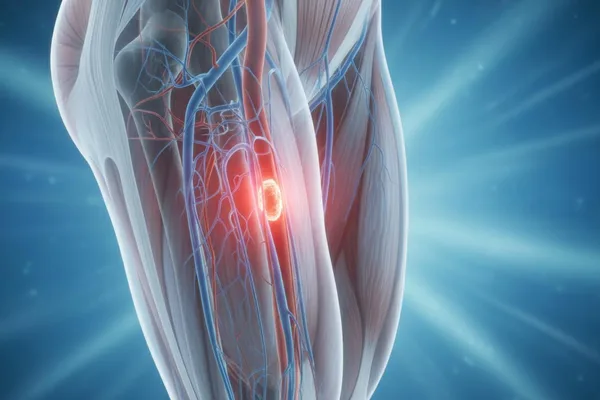
Simply put, `(Venous Thromboembolism)` is when a blood clot forms inside a vein in our body, a type of vein that carries impure blood to the heart, obstructing the flow of blood. Here, "Thrombo" means a blood clot. "Embolism" means when such a blood clot travels along a blood vessel and gets stuck somewhere. "Venous" means in the veins.
When doctors talk about VTE, they are mainly talking about two types of blood clots:
1. Deep Vein Thrombosis (DVT): This is when blood clots form in the deep veins that run through the muscles, deep inside the body.
2. Pulmonary Embolism (PE): This occurs when a blood clot from a DVT or a blood clot from another location breaks loose and becomes lodged in a vein in the lungs.
Think about it, these veins bring blood back to the heart from distant parts of our body, like our limbs. So, when a vein becomes blocked by a blood clot, blood starts to pool behind the blocked area. Then that area can swell and become inflamed. Also, the cells in front of the blocked area do not get the oxygen and nutrients they need. This can cause serious damage to the veins, tissues, and even organs. In some cases, for example, if a vein that carries blood to the lungs becomes blocked by a ``VTE'', it can be life-threatening .
How do blood clots form in veins like this?
Actually, blood clotting is a normal, healthy response of our body. You can think of it as a scab that forms when a small wound on the surface of our skin dries up and a little blood drains out. That's how it is. When there is an injury inside the body, whether it's an infection, the blood thickens a little to stop the blood from flowing out. Even if this is an infection, the lining of a blood vessel is treated as if it were a wound.
Normally, when the wound or infection starts to heal, the blood clot dissolves. But sometimes, that doesn't happen . Or, blood clots can form without any injury. This can be caused by a number of things. In such cases, if the blood clot is large enough, it can completely block the vein.
How do these blood clots affect your body?
Many people think that when they think of a blood clot, it means a blood clot that causes a ``Heart Attack'' or ``Stroke.'' However, ``VTE'' is not the type of blood clot that usually forms in the arteries (the veins that carry blood from the heart to the rest of the body). However, it can be just as dangerous .
The most serious complication is when a VTE, or blood clot, breaks free from its place of origin, travels through the bloodstream, and lodges in the veins of the lungs . This is called a Pulmonary Embolism (PE). A PE restricts the flow of oxygen and blood to the lungs. At the same time, the blood pressure in the arteries increases. This condition is called Pulmonary Hypertension. If this continues, heart failure and even death can occur.
VTE most often occurs in the deep veins of our body, especially in the legs or arms or in the veins inside the muscles. When a blood clot forms in a deep vein, it is called Deep Vein Thrombosis (DVT). When a DVT blocks a vein, it can cause inflammation, swelling, and redness, which can damage the vein in the long term. This can lead to a condition called Chronic Venous Insufficiency or Post-thrombotic Syndrome. Not all DVTs block a vein, but they can, so they are classified as Venous Thromboembolic Disease. It is also important to remember that if a blood clot breaks loose and travels to the lungs, it can cause a PE.
What is the difference between `Thrombosis` (a blood clot) and `Thromboembolism` (a blockage of a blood clot in the circulation)?
Simply put, `(Thrombosis)` means a blood clot. `(Thromboembolism)` means a blood clot that travels through the bloodstream and gets stuck somewhere, obstructing the flow of blood. `(Deep Vein Thrombosis - DVT)` and `(Pulmonary Embolism - PE)` both fall under the umbrella of `(Venous Thromboembolic Disease)`. Because both of these can obstruct the flow of blood in the veins.
Superficial venous thrombosis (SVT) is a blood clot that forms in small, superficial veins close to the surface of the skin, and is less likely to cause serious complications. Although about half of DVTs do not cause complications, they should be considered because they can cause complications and are a risk factor for PE.
How common is this condition called `VTE`?
Even in some developed countries of the world, `(VTE)` is the third most common vascular disease after `(Heart Attack)` and `(Stroke)`. This means that this condition affects approximately one in 1000 people per year. About half of those who develop `(VTE)` also develop `(Pulmonary Embolism - PE)`. Also, about 25% of those who develop `(PE)` die. It is also said that the risk of developing `(VTE)` doubles every decade after the age of 40 .
Who is at higher risk of developing VTE?
In fact, anyone can get VTE. However, there are some factors that increase the risk. Consider that about 25% to 50% of VTE cases occur for no apparent reason. Another 20% are related to cancer. Another 20% are related to surgery. Also, some people have blood clotting disorders, which make them more likely to develop blood clots.
What are the causes of VTE?
There are many reasons why blood clots can form. However, it is difficult to say for sure whether a blood clot will grow large enough to block a vein or break loose and travel to the lungs. People who develop VTE usually have more than one risk factor.
Some people have an imbalance of proteins in their blood that help blood clot (`(Thrombophilia)`). This can cause their blood to clot more easily and make it less likely to dissolve clots that have formed. This can be hereditary, or it can be a side effect of another medical condition.
Sometimes, when the body is stationary, that is, when it is not moving , the blood flow in the veins slows down and blood clots can form. Just think, when you are on a long journey, when you are in the same position for hours on the bus or train, or when you are sitting in a chair all day in the office, or when you are sick and confined to bed, this risk exists.
The most common cause of blood clots is an injury or infection. Sometimes, this injury is caused by medical treatment. For example, it can happen during surgery, chemotherapy for cancer, or when an IV (intravenous liquid) line is inserted into the arm or a catheter is inserted. People who stay in the hospital for a long time are at higher risk of blood clots. This is because they are recovering from an injury or infection, are undergoing aggressive medical treatments, and are spending a lot of time in a hospital bed.
What factors increase the risk of VTE?
Here are some things that can increase your risk of developing VTE:
- Injury to a vein due to a fracture or surgery.
- Infectious conditions.
- Decreased blood circulation due to staying still in one place for too long.
- Genetic conditions that are passed down through generations and a family history of VTE.
- Increased levels of the hormone `(Estrogen)` due to pregnancy, birth control pill use, or hormone replacement therapy (`(Hormone Replacement Therapy)`).
- Blood clotting diseases, for example `(Factor V Leiden disease)`, `(Polycythemia Vera)` and `(Sickle Cell Disease)`.
- Some chronic diseases, for example cancer, heart disease, and Inflammatory Bowel Disease (IBD).
- Lifestyle factors, that is, smoking, obesity, and lack of exercise.
- Age (VTE is more common among older people. This may be due to the prevalence of comorbidities and adverse lifestyle factors among them).
What are the symptoms of a `VTE`?
If a vein becomes blocked due to a deep vein thrombosis (DVT), symptoms may develop at the site of the blood clot. These include:
- Swelling (especially in one leg or arm)
- Redness
- Feeling warm when you touch that area
- Pain (especially when standing or walking)
Symptoms of a ``(PE)``, that is, a blood clot in the lungs, can appear suddenly, sometimes without any previous signs of a ``(DVT)``. These symptoms include:
- Chest pain (especially when taking a deep breath)
- Difficulty breathing (sudden onset)
- Increased heart rate
- Increased breathing rate
- Vertigo (feeling like you're spinning)
- Loss of consciousness
- Sweating or feeling cold
- Coughing up blood
Important: If you have any of these symptoms, it is very important to seek medical advice immediately , as these could be signs of a serious condition.
How is `VTE` diagnosed?
There are other conditions that have similar symptoms to DVT and PE. To make sure you have Venous Thromboembolic Disease, your doctor will ask about your medical history, identify risk factors for VTE, and rule out other conditions. They may also do a basic blood test to look for signs of blood clots. They will then use imaging tests, such as scans, to find the location of the clot.
What tests are used to diagnose `VTE`?
Various tests are performed to diagnose `(DVT)` and `(PE)`.
Tests that detect `DVT`
- Blood tests: There is a blood test called the D-dimer test. This measures the level of a substance released when blood clots break down. If the level of this substance is high, it can be a sign of a blood clot. Blood tests can also be done to measure the oxygen level in the blood and to check for inherited blood clotting disorders.
- Vascular ultrasound: This is a painless imaging test. It is usually the first choice to look at the veins and how blood flows through them. It is sometimes called a duplex ultrasound because it has two parts. In the first part, the doctor uses a wand-like device to direct sound waves at the veins and obtain images on a screen. The vein can then be compressed to see if it is contracting normally or if it is blocked by a blood clot. In the second part, the sound waves are directed to see how the blood is flowing in the vein. When blood is flowing normally, the sound waves change through a phenomenon called the Doppler effect.
- MR venography: A technique called Magnetic Resonance Imaging (MRI) can be more reliable than ultrasound for examining veins in areas such as the abdomen, chest, and pelvis. MR venography uses radiofrequency waves to detect blood clots. This test requires you to lie down inside a standard MRI machine. You may also be given a special dye to help the veins show up more clearly.
- Contrast venography: This is a traditional X-ray test. Again, a contrast dye is injected into a vein to make the veins more visible on the images. Although it is a little more invasive than other imaging tests, it is considered more accurate. This may be done if other tests are inconclusive. The X-ray technician inserts a small tube into one of your large veins, guides it in the right direction, injects the contrast dye, and then takes an X-ray.
Tests that detect `PE`
- Pulse oximetry: If your symptoms suggest a PE, your doctor may first measure the oxygen level in your blood by placing a pulse oximetry sensor on your fingertip. If the oxygen level is low, it could be due to PE or another lung or heart condition.
- Chest X-ray: Although a chest X-ray cannot diagnose a PE, it can identify other lung or heart conditions that may be causing your symptoms.
- CT pulmonary angiography (CTPA): This is the standard test for diagnosing PE. A CT scan produces three-dimensional (3-D) images of the veins and arteries in your lungs. "Pulmonary" means related to the lungs, and "angiography" is an X-ray of the blood vessels. CTPA is noninvasive, but may require the injection of a contrast dye into a vein.
- Pulmonary angiogram: If other tests are inconclusive, a traditional pulmonary angiogram can provide definitive results. However, it is a bit invasive. For this angiogram, the X-ray technician inserts a tube into one of your large veins, threads it through your chest, injects contrast dye, and then takes an X-ray.
What are the treatments for VTE?
Treatment options for `(Venous Thromboembolism)` depend on how dangerous the blood clot is. Some `(DVT)` cases can be managed with oral medications. However, some `(PE)` cases may need to be removed urgently . Your doctor may remove a life-threatening `(PE)` with a catheter inserted through a vein, or may inject a `(thrombolytic)` medicine that quickly dissolves the blood clot. However, because of the complications that can occur, such interventions are only done in emergency situations.
If a VTE is not immediately life-threatening, treatment focuses on stopping existing clots from getting bigger and preventing new clots from forming. Such preventive treatments include anticoagulants, which are medications that thin the blood, and compression stockings, which help maintain good circulation. In more complex cases, your doctor may suggest a physical intervention, such as inserting a filter into a vein to prevent blood clots from traveling to your lungs.
How can you prevent a VTE?
There are many risk factors for developing venous thromboembolism, not all of which we can control. However, in general, staying active is the easiest way to prevent it . Since most DVTs occur in the legs, maintaining good circulation in the legs can greatly reduce the risk.
If you sit for long periods of time, whether at work or while traveling, make sure to get up and walk around regularly and exercise your leg muscles. This will help reduce blood pooling. Whether you're sick or recovering from surgery, getting up and moving around as soon as possible can help reduce your risk of blood clots. Exercise can also help reduce stress and maintain a healthy weight . These are other factors that can contribute to VTE.
How do you take care of yourself after a VTE?
If you develop a VTE, be aware of these things:
- Go for routine follow-up care. Your doctor will monitor your condition and decide how long you need to take your medication.
- Take your medication exactly as prescribed. However, if you experience excessive bleeding (a serious side effect of blood thinners), stop taking the medication immediately and contact your doctor.
- Be aware of the signs of a blood clot, especially swelling in the legs and pain when touched.
- Adopt a healthy lifestyle. Stay active, drink plenty of water, manage stress, and quit smoking if you smoke.
Remember, there are many different causes of Venous Thromboembolism. There may be risk factors that you are not aware of and that you cannot change.
After all this talk, you need to remember!
There are many factors that can contribute to a condition called `(Venous Thromboembolism - VTE)`. You may have risk factors that you are not aware of, and some of them we cannot control. However, there are many things you can do to prevent a `(VTE)` . And, if unfortunately it does occur, it can be managed successfully.
If you have any concerns about this, talk to your doctor about your specific risk factors and how you can reduce your risk. The most important thing is to seek medical advice immediately if you develop symptoms of a ``VTE''. We take all blood clots, both those you have now and those you may develop in the future, very seriously. So do n't be afraid to see a doctor as soon as you have any concerns. Your health is our top priority!
` Blood clot, vein, DVT, PE, lung, Venous Thromboembolism, VTE




💬 Comments (0)
No comments yet. Be the first to share your thoughts here.
Add Your Comment