

Have you ever thought that a blood vessel inside our body, like a water pipe, can become weak at one point and bulge like a balloon? This is simply called an `(Aneurysm)`. Sometimes this can be hidden without showing any signs, but it can suddenly become a big problem in life. Today we will talk about a condition that can be dangerous, but many people are not aware of it, namely `(Visceral Artery Aneurysm)`.
What is `(Visceral Artery Aneurysm)`? Let's understand it very simply!
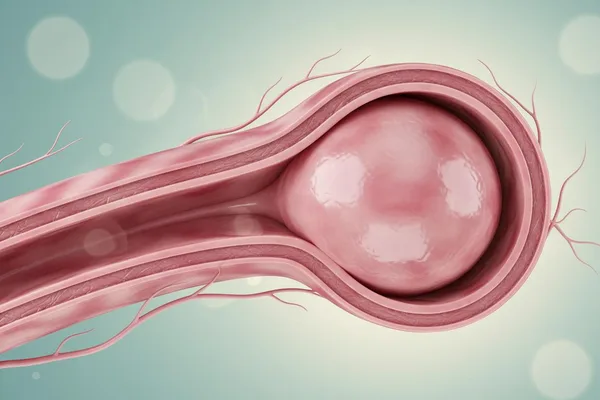
Imagine, we have a blood vessel in our body, and its wall is a little weak. Then, due to the pressure of the blood flowing through it, that weak spot bulges out like a balloon. That is what is called an ``Aneurysm``. Now, if this ``Aneurysm`` gets too big, that means that the balloon-like bulge can burst. If that happens, blood starts flowing inside the body. We call this ``Hemorrhage``, and this is a really life-threatening situation.
Now, what are these `(Visceral Arteries)`? These are the main blood vessels in our body, the `(Aorta)`, which branch off and supply blood to the most important organs inside our abdomen.
These organs are:
- Our intestines
- Kidneys
- Liver
- Pancreas
- Spleen
- Stomach
Most often, these ``Visceral Artery Aneurysms'' occur in the arteries that carry blood to the spleen, kidneys, and liver.
Are there types of `(Visceral Artery Aneurysms)`?
Yes, there are mainly two types.
1. Pseudoaneurysms: This is when a small hole forms in the wall of a blood vessel, and some blood leaks out of the hole, collecting in the tissues outside the vein. Then, due to the blood clotting process in our body, a weak wall forms around the collected blood. However, because this wall is not very strong, these pseudoaneurysms are more likely to burst.
2. True Aneurysms: This is when a weakened part of the blood vessel wall bulges out like a balloon. As mentioned earlier.
How common are these? Who gets them more often?
Visceral Artery Aneurysms are actually a fairly rare condition. But since most people don't show any symptoms, it's hard to say exactly how many people actually have them.
The incidence of some types of visceral artery aneurysms varies by gender. For example, women are more likely to develop an aneurysm in the artery that carries blood to the spleen.
What are the symptoms of this? How do you recognize it?
Here's the most important thing. Most of the time, there are no symptoms! Doctors often find these by accident during a medical test, such as a ``(CT scan)`` or ``(MRI scan)``, for another condition.
However, if the bulging blood vessel, or ``aneurysm'', bursts, symptoms will appear. The main symptoms are:
- Anemia (which means a decrease in blood volume in the body)
- Pain in the stomach or back . This pain can sometimes be very subtle, sometimes it can be severe. Therefore, it is sometimes difficult to accurately identify the disease.
Other symptoms may vary depending on the location of the aneurysm. For example:
- Vomiting blood
- Blood in the stool
If you suddenly experience severe pain in your stomach or back, don't ignore it. It's important to seek medical advice immediately.
Why do these `(Visceral Artery Aneurysms)` occur? What are the causes?
There are several main reasons why true aneurysms develop:
- Atherosclerosis: This is the most common cause. Fat deposits build up inside our blood vessels, gradually weakening the walls of the arteries.
- Connective tissue diseases: For example, conditions like Fibromuscular dysplasia, Marfan syndrome, and Ehlers-Danlos syndrome. These can cause the walls of the veins to become weak from birth.
- Trauma: Imagine a big accident, a severe blow to the stomach. Even then, this kind of situation can occur.
The causes of pseudoaneurysms are:
- Injuries after liver or pancreas surgery.
- Inflammation of the pancreas (Pancreatitis).
- Injuries (from an accident or other blow).
- Vasculitis.
How do doctors diagnose this?
Doctors mainly use special medical imaging tests such as CT scans (Computed Tomography scans) and MRI scans (Magnetic Resonance Imaging) to diagnose Visceral Artery Aneurysms. These tests can accurately measure the size of the aneurysm. Knowing this size is important for determining treatment options.
There is another special test, which is called `(Angiography)` . In this, a very thin tube (`Catheter`) is inserted into one of your veins and sent to the `(Visceral Artery)` where the `(Aneurysm)` is located. Then, a special liquid (`Contrast dye`) is injected through that tube. Then, when viewed with `(X-ray)` or `(CT scan)`, the liquid makes the abnormal areas in the blood vessels clearly visible. Sometimes, treatment can be done at the same time as this `(Angiography)`.
In some cases, especially those with the connective tissue diseases mentioned earlier, there may be aneurysms in more than one visceral artery. In such cases, your doctor may examine all of the arteries in your abdomen.
What do you do after you find out you have an `(Aneurysm)`? Do you just wait? `(Monitoring)`
Whether or not to treat depends on the size and type of aneurysm. In general, if a true aneurysm is smaller than 2 centimeters , doctors often recommend "watchful waiting."
This means that the doctor will check you at regular intervals to see if the aneurysm is getting bigger. He or she may also give you medication to lower your blood pressure, as high blood pressure can make the aneurysm bigger.
When does this definitely need to be treated?
If you think an aneurysm might burst, it's best to treat it. Especially in cases like these:
- Pseudoaneurysms of any size: because they have a high risk of bursting.
- True aneurysms larger than 2 centimeters: (However, in the case of a splenic artery aneurysm, repair is usually recommended when it is larger than 3 centimeters).
Also, regardless of the size of your aneurysm, you may also need treatment if you are at high risk of rupture. Your risk may increase if you:
- If you are pregnant or of childbearing age.
- If you have persistent symptoms such as anemia or stomach/back pain.
- If you need a liver transplant or other surgery to treat cirrhosis.
Also, some `(Visceral Artery Aneurysms)`, regardless of their size, need immediate treatment, depending on their location, because they have a high risk of bursting. For example:
- An aneurysm in the gastroduodenal artery, which supplies blood to the stomach, upper part of the small intestine, and upper part of the pancreas.
- An aneurysm in the pancreaticoduodenal artery, which supplies blood to the pancreas and upper part of the small intestine.
- An aneurysm in the superior mesenteric artery, which supplies blood to the small intestine.
What are the treatment options?
There are two main treatment methods:
1. Open surgery
2. Minimally invasive endovascular procedures
Doctors decide which of these two methods is right for you by considering factors such as:
- The nature of your blood vessels (such as their shape and size).
- Where is the `(Aneurysm)`?
- The risks of open surgery (depending on your age and overall health).
In open surgery `(Open surgery)`What is done is that, after making a relatively large incision, the surgeon goes directly to the location of the aneurysm, removes the damaged part of the artery, and either transplants a new piece of artery or repairs the existing one.
Minimally invasive treatment involves inserting a thin tube (catheter) into a blood vessel, usually from your groin, and guiding it to the location of the aneurysm. Then, small instruments are passed through the tube to support the aneurysm and stop it from bursting, using one or more of the following methods:
- Coil embolization or plug embolization: This involves inserting a small coil or mechanical plug into the aneurysm and filling it.
- Liquid embolization: In this, a special glue, gel, or other liquid substance is injected into the aneurysm and sealed off.
- Stenting: In this, a tube (a stent) made of metal mesh covered with fabric is inserted into the artery where the aneurysm is located.
If you are having an angiography to find a visceral artery aneurysm, sometimes this minimally invasive treatment can be performed at the same time, using the same catheter used for that examination.
What is the difference between open surgery and endovascular treatment?
Both of these treatments have been studied. In general, both are equally safe and effective. However, minimally invasive techniques may result in a faster recovery and shorter hospital stays. However, in some cases, a second treatment may be necessary.
Is there a way to prevent the formation of `(Visceral Artery Aneurysm)`?
Many types of `(Visceral Artery Aneurysms)` are difficult to prevent. However, the `(Aneurysms)` that are caused by the previously mentioned thinning and hardening of the arteries `(Atherosclerosis)` can be prevented by a healthy lifestyle. Here are some things you can do to reduce your risk of developing `(Atherosclerosis):
- Control your cholesterol and blood pressure.
- Exercise regularly.
- Follow a heart-healthy diet .
- Get enough sleep.
- Limit alcohol consumption.
- Control stress.
- Stop smoking and tobacco use completely.
What is the outlook for this situation? `(Outlook)`
If a Visceral Artery Aneurysm ruptures, it can sometimes be fatal. Studies show that about 25% of people who present to the emergency room with a Visceral Artery Aneurysm have a ruptured aneurysm. Of these, at least 10% die.The risk of death for pregnant mothers who have a ruptured aneurysm is even higher.
In general, people who have no symptoms (pain or internal bleeding) before treatment begins are more likely to have good outcomes. People with pseudoaneurysms are at higher risk of rupture and death than those with true aneurysms.
When should I see a doctor?
If you suddenly experience severe pain in your stomach or back, seek medical advice immediately. Don't delay.
Visceral artery aneurysms are weak spots in the walls of your arteries in your abdomen. If these walls burst, they can cause internal bleeding. Not everyone with this condition has severe symptoms, so diagnosis can be delayed. However, with the widespread use of medical imaging tests for other diseases, many Visceral Artery Aneurysms are found before they rupture. Therefore, early treatment can reduce the risk of death. Although not all Visceral Artery Aneurysms can be prevented, a healthy lifestyle can reduce the risk of aneurysms caused by atherosclerosis. Talk to your doctor about what you can do to reduce your risk of atherosclerosis.
Take-Home Message
- A ``Visceral Artery Aneurysm'' is a balloon-like bulge in a blood vessel inside the abdomen. This can be very dangerous if it bursts.
- Most of the time, it doesn't show any symptoms. It can be discovered accidentally during a scan for another condition.
- If you experience symptoms such as sudden stomach/back pain, vomiting blood, or passing blood in your stool , see a doctor immediately.
- There are treatment options. Treatment is determined based on the size and type of aneurysm, as well as your health condition.
- A healthy lifestyle (good diet, exercise, and avoiding smoking) is very important to prevent aneurysms caused by atherosclerosis.
If you have any further questions about this, don't hesitate to ask your family doctor or a specialist. Stay healthy!
👩🏽⚕️ Additional questions (FAQs)
💬 What is Visceral Artery Aneurysm?
An aneurysm is not just something that occurs in the brain. It is when the walls of the main blood vessels that carry blood to the major organs inside our abdomen (liver, intestines, spleen, kidneys) become weak, causing those vessels to bulge out like a balloon.
💬 What is the problem when this happens?
There is a lot of pressure inside this. If this balloon bursts, the patient can die from internal bleeding within seconds. This often occurs in pregnant mothers in the vein leading to the spleen (Splenic artery), and if it bursts, the lives of both the mother and the baby are in danger.
💬 If I get a stomach ache, could it be that this is a blowout?
It doesn't show any symptoms before it bursts. Many people find it by accident when they do a CT scan for another illness. But as soon as it bursts, you suddenly feel unbearable pain in your lower abdomen. Then you should go to the hospital immediately without thinking anything.
` Aneurysm, artery, abdomen, blood vessel rupture, internal bleeding, surgery, CT scan




💬 Comments (0)
No comments yet. Be the first to share your thoughts here.
Add Your Comment