

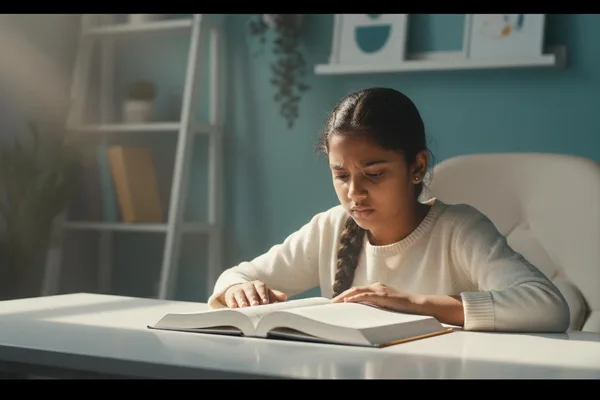
Is your child a little behind in schoolwork? Do you say, "Mommy, my eyes hurt" when looking at a book? Or do you yourself feel a lot of fatigue and weight in your eyes when looking at something nearby? At times like these, you may have heard some people talk about something called 'Vision Therapy'. It is a method of exercising the eyes, just like 'physiotherapy' for the body. So today, let's talk about this very simply, that is, whether it is true or not, who is it suitable for and who is it not suitable for.
Simply put, what is Vision Therapy?
Think of it like a training program that strengthens the connection between the eye muscles and the brain. This is usually done by some optometrists or occupational therapists.
This treatment process has to be continued for several weeks to several months. It mainly involves two things.
1. Exercises performed under the supervision of a doctor: There are specific eye exercises that you can do in-office.
2. Exercises to do at home: Also, you will be given a separate set of exercises to do at home.
In addition to these eye exercises, other devices are sometimes used. For example, these may include special training glasses, light-bending prisms, and eye patches that cover one eye.
Are there main types of Vision Therapy?
Yes, there are several treatments known by this name. But there is no consensus among ophthalmologists about all of them. Let's see what they are.
| Name of the treatment method | Simply put... | Expert opinion |
|---|---|---|
| Orthoptic Vision Therapy | This involves exercises that improve eye movement and alignment. This is usually done under the supervision of an orthoptist. | A scientifically accepted method. This has been proven to be effective, especially for certain medical conditions. |
| Treatment for Myopia (nearsightedness) | Exercises to delay the onset of nearsightedness or control its progression. | There are different opinions among experts about the success of this method. |
| Treatment for amblyopia (lazy eye) | For those with lazy eye, they try to strengthen the weak eye by covering the good-seeing eye (patching). | Many of these treatments have a solid scientific basis, but not all of them fall into the controversial category of "Vision Therapy." |
| Light exposure therapy | A method of treatment that involves exposing the eyes to different colors of light. | Most experts consider this to be pseudoscience, which has no scientific basis . |
| Behavioral vision therapy | Exercises to improve the brain's ability to understand (visual processing) what the eyes see. | This is the most controversial method. Although it is recommended for things like learning disabilities, major medical associations do not endorse it. |
So, do doctors really recommend this treatment?
Here's the most important thing you need to know.
The general consensus among most ophthalmologists and pediatricians is that Vision Therapy has only been scientifically proven to be effective for two specific conditions .
Those two situations are:
1. Convergence Insufficiency: This is the inability to focus by turning both eyes inwards when looking at something close (e.g., reading a book). This can cause eye strain, headaches, and double vision.
2. Accommodative Dysfunction: This is the difficulty in quickly switching focus between near and far objects.
Remember, only two conditions known as `Convergence Insufficiency` and `Accommodative Dysfunction` have been scientifically proven to benefit from Vision Therapy (specifically Orthoptic Vision Therapy).
There is no strong scientific evidence that Vision Therapy is effective for other conditions, especially learning disabilities (such as dyslexia) or attention problems (such as ADHD) in children.
For this reason, many of the world's leading medical associations have issued recommendations against the use of Vision Therapy for conditions other than these two. Some of them are:
- The American Academy of Pediatrics
- The American Academy of Ophthalmology
- The American Association for Pediatric Ophthalmology and Strabismus
So what should I do if my child is having difficulty learning?
There can be many reasons why a child may be struggling with learning disabilities. It doesn't have to be an eye problem. Therefore, before resorting to controversial treatments like Vision Therapy, it is important to first find the correct cause .
Here are the main reasons why a child may have difficulty learning and what to do about it.
| Possible reason | What to do? |
|---|---|
| A simple eyesight problem | The child may be nearsighted ( Myopia ), farsighted ( Hyperopia ), or have an irregular shape of the iris ( Astigmatism ). Or they may have a condition like lazy eye ( Amblyopia ) or strabismus . What to do: First, see a pediatric ophthalmologist and get a complete eye exam with pupil dilation. Often, this problem can be completely resolved with a pair of corrective glasses or other simple treatment. |
| Dyslexia | This is not a disease of the eyes. What happens in this is that the brain does not correctly recognize the letters and words seen with the eyes. What to do: Vision therapy is of no use in this situation. See your child's pediatrician. He or she will refer you to a specialist (e.g., an educational psychologist) for this. |
| Other learning disabilities or behavioral problems | Many other conditions, such as attention deficit hyperactivity disorder (ADHD), can interfere with a child's learning. What to do: These should not be treated by ophthalmologists. Your pediatrician will refer you to the appropriate specialists for this. |
We understand how frustrating and frightening it is for parents to see a child who is unable to see the world clearly and who has difficulty learning. At such times, when you hear about something like Vision Therapy, you may think that it would be a good solution.
But remember, the biggest harm that can come from trying a treatment that has not been scientifically proven is that the child will not receive the effective treatment they really need. That delay may even cause permanent damage to their vision. Also, since this Vision Therapy treatment is usually not covered by insurance, you will have to spend a lot of money out of your own pocket.
Therefore, if you have any doubts about your child's vision or learning, the best thing to do first is to talk to your pediatrician. He or she will conduct the most accurate tests and refer you to scientifically proven treatments.
Take-Home Message
- Vision Therapy is a series of eye exercises. But it's not a 'magic bullet' that will cure every eye condition.
- This treatment has only been scientifically proven to be effective for two specific conditions: Convergence Insufficiency and Accommodative Dysfunction .
- Please note that Vision Therapy is not effective and is not recommended for children with learning disabilities (e.g. Dyslexia).
- If your child is having difficulty with schoolwork, the first step is to have a complete eye exam by a pediatric ophthalmologist. Often, the problem can be resolved with a pair of correct glasses.
- Before resorting to controversial treatments, always talk to your family doctor or pediatrician. They will provide you with accurate, scientific guidance.




💬 Comments (0)
No comments yet. Be the first to share your thoughts here.
Add Your Comment