

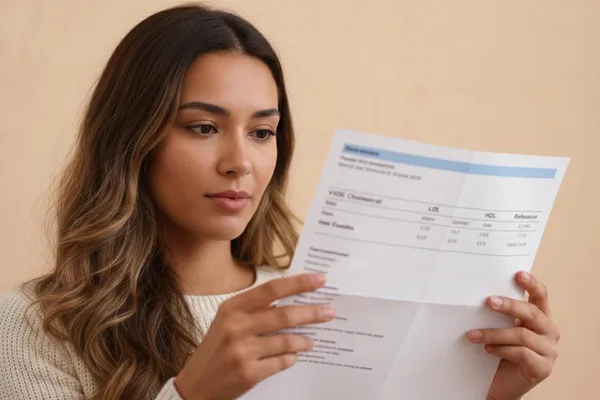
Have you ever had a blood test to check your cholesterol level? If you have, you must have noticed that the report includes words like LDL, HDL, and Triglycerides, along with the letters VLDL. We often hear about LDL and HDL. They are also called "good cholesterol" and "bad cholesterol." But what is VLDL? This is a word that many people are unfamiliar with. So if your doctor says that your VLDL level is high in your report, it is normal to feel a little scared. But don't worry. Today, in this article, we will talk about exactly what VLDL is, how it is important for the body, and how it can affect our health if it increases, and how to control it.
Simply put, what is VLDL?
The full meaning of VLDL is “Very-Low-Density Lipoprotein”. Okay, hearing this name made your head even more confused, didn't it? Let's break it down very simply and understand it.
Think of our blood vessels as roads. These roads carry a lot of things that our body needs, such as nutrients and oxygen. Meanwhile, the fats in our body, such as cholesterol and triglycerides, also need to be transported throughout the body. But there is a problem. These fats cannot float in the blood on their own, just like when you add oil to water, they separate instead of mixing.
So, our body has a special "vehicle" system to safely transport these fats throughout the body. We call these vehicles `(Lipoprotein)`. `Lipo` means fat, `protein` means protein. That means these vehicles are made up of fat and protein.
Do you understand now? VLDL is such a special vehicle. This vehicle is made by our liver and released into the blood. The main function of VLDL is to carry triglycerides and cholesterol from the liver to various parts of the body, that is, to places where energy is needed and places where energy is stored.
So VLDL is essential for our body to function. But like anything, too much of it is not good for the body.
What is a VLDL particle made of?
If we look at what's inside the VLDL we talked about earlier, it's mostly a type of fat called triglycerides. Just like a bus has a lot of passengers. That's why doctors also call VLDL a "triglyceride-rich lipoprotein."
In addition, there are a few other things in a VLDL particle:
- Cholesterol
- Fatty acids
- A special type of protein called apolipoprotein B (Apolipoprotein B or apoB).
Research has found that elevated levels of this `(apoB)` in the blood are also a cause of increased risk of heart disease.
Are VLDL and VLDL cholesterol the same thing?
Although we often use these two words interchangeably, there is a small but important difference between the two.
Simply think of it this way.
- VLDL is the bus. It's the entire vehicle that's made by the liver and carries fat.
- VLDL cholesterol is one of the passengers on that bus. That is, the amount of cholesterol that travels inside the vehicle called VLDL.
Similarly, LDL and HDL are two different types of buses. We call the cholesterol that goes on the LDL bus LDL cholesterol. We call the cholesterol that goes on the HDL bus HDL cholesterol. Now it's clear, right?
So is VLDL also a type of "bad" cholesterol?
Yes, if the level of VLDL in the blood increases too much, it falls into the "bad" category. Although our bodies need a certain amount of VLDL to function, when its level increases, it opens the door to heart disease and a number of other health problems.
The main problem is a condition called `(Atherosclerosis).` Simply put, this is when fat, cholesterol, and other substances build up inside the walls of our blood vessels (arteries) and form something called ``plaque.`` These plaques gradually narrow the blood vessels, just like dirt builds up inside a water pipe. This hinders blood flow.
How is VLDL related to this?
Imagine that our liver starts making more VLDL than it needs. Now there are too many VLDL carriers in the blood. Our body breaks down these extra VLDL and uses them to make another type of carrier called LDL (Low-Density Lipoprotein). LDL is the main type of carrier that we call "bad cholesterol."
Now the blood is full of LDL particles. This extra LDL gets stuck in the walls of the blood vessels, where it starts to form the plaques mentioned earlier.
Research shows that having high levels of both VLDL and LDL in the blood at the same time is more dangerous than having high levels of either alone.
Not only that, when VLDL breaks down in the body and LDL is formed, there are also some "pieces" left over from that process. These are called ``remnant particles''. These are small particles that are often filled with cholesterol. Because they are small in size, they easily get stuck in the walls of blood vessels, accelerating the formation of clots.
| Dangerous conditions that can occur due to atherosclerosis (narrowing of blood vessels) | |
|---|---|
| Medical condition | Simple explanation |
| Coronary Artery Disease | Narrowing of the arteries that supply blood to the heart, which increases the risk of heart attack. |
| Cerebrovascular Disease | Narrowing or blockage of the blood vessels that supply blood to the brain can cause a stroke. |
| Peripheral Artery Disease | Often, the veins that supply blood to the legs become narrowed. This can cause pain in the legs when walking. |
| Aortic Aneurysm | The aorta, the body's main blood vessel, weakens and bulges like a balloon. This can be very dangerous if it bursts. |
Is LDL more dangerous? VLDL?
This is a question that many people ask. In fact, one cannot be said to be "worse" than the other. Both contribute equally to the formation of plaque in the blood vessels. Therefore, both are equally dangerous. The important thing is to control the levels of both and maintain them at a healthy level.
How are VLDL levels measured? What are the normal values?
Your VLDL cholesterol level is measured with a blood test called a lipid panel . This test is usually done after you have fasted for 10-12 hours. This test shows your total cholesterol level, HDL (good) cholesterol, LDL (bad) cholesterol, and triglyceride levels.
But here's something special. Most of the time, labs don't measure VLDL levels directly. Instead, they use your triglycerides levels to calculate your VLDL levels with a mathematical formula.
Simply put, your VLDL level is approximately equal to your triglyceride level divided by 5. (For example, if your triglycerides are 150 mg/dL, your VLDL level is approximately 30 mg/dL).
However, if a person's triglyceride levels are very high (e.g., over 400 mg/dL), this calculation method may not be very accurate. In such cases, your doctor may use other methods to measure VLDL.
Generally, the recommended values for VLDL cholesterol levels are as follows:
- Healthy level: Less than 30 mg/dL (milligrams per deciliter).
- Risky/high level: equal to or greater than 30 mg/dL.
What should we do if VLDL levels are elevated?
If your VLDL level is high, it means you have an increased risk of heart disease. But don't worry, this is a manageable condition.
When a doctor treats you, they will focus more on lowering your LDL cholesterol and triglyceride levels rather than directly targeting VLDL levels. Because when those levels are controlled, VLDL levels will automatically be controlled.
Many people with high VLDL levels may have one or more of these conditions:
- High triglyceride levels (Hypertriglyceridemia)
- High LDL cholesterol levels
- High total cholesterol level (Hyperlipidemia)
Here are some things you can do to control all of these types of fat. It's essential to talk to your doctor before starting any of these.
1. Following a heart-healthy diet:
- Reduce oil, fried foods, and deep-fried foods as much as possible.
- Limit foods and drinks high in sugar (cakes, sweet drinks, toffee).
- Add more fresh vegetables, fruits, herbs, and whole grains (buckwheat, barley, oats) to your diet.
- Choose fish and chicken instead of processed meat.
2. Exercising regularly:
- Engage in exercise such as brisk walking, cycling, or swimming for at least 30 minutes a day, at least 5 days a week.
- Important: If you are new to exercise, ask your doctor for advice on what exercises are right for you.
3. Maintaining a healthy weight:
- It is very important to maintain a healthy weight for your height. If you are overweight, losing weight can significantly lower your cholesterol and triglyceride levels.
4. Taking medicines on medical advice:
- In some cases, lifestyle changes alone may not be enough to control your cholesterol levels. In such cases, your doctor may prescribe medications such as ``statins.`` It is very important to take the medications prescribed by your doctor in the correct dosage and for the correct duration.
Sometimes, triglyceride and VLDL levels can be elevated due to other medical conditions such as diabetes, thyroid problems, or other medications you are taking. Therefore, if you have any questions about the values in your report, talk to your doctor. Don't worry, with the right guidance and treatment, this condition can be well controlled.
Take-Home Message
- VLDL is a special vehicle made by our liver that mainly carries triglycerides (a type of fat) throughout the body.
- A VLDL level in the blood above 30 mg/dL is harmful to heart health. It can lead to narrowing of the blood vessels (atherosclerosis).
- VLDL levels are not usually measured directly. They are calculated from your triglyceride levels.
- The best way to control VLDL is to control triglyceride and LDL (bad) cholesterol levels.
- VLDL levels can be controlled by following a heart-healthy diet, exercising regularly, maintaining a healthy weight, and taking medications as prescribed by your doctor.
- If you have any concerns about your cholesterol report, be sure to discuss it with your doctor.




💬 Comments (0)
No comments yet. Be the first to share your thoughts here.
Add Your Comment