
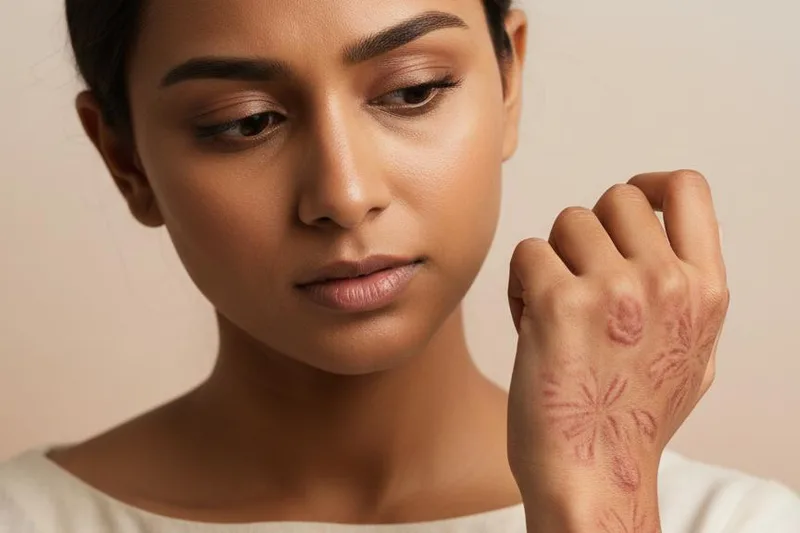
Has a spot on your skin suddenly become red, slightly swollen, and itchy? It may look like some kind of bacterial infection, but it may not actually be an infection. Today we're going to talk about a rare skin condition that many people haven't heard of, but it's important to know about. It's called Wells' Syndrome . Let's take a look at what it is, why it occurs, and what you can do about it.
Simply put, what is Wells' Syndrome?
Wells' Syndrome is a rare skin condition. It is also known as "eosinophilic cellulitis." When you hear the name, you might think that it is a skin infection called cellulitis. But it is not actually an infection. It is a condition that causes red, swollen, itchy, and inflamed patches of skin in one or more areas.
Now you have a question, what are these "eosinophils"? It's very simple. Eosinophils are a type of white blood cell in our blood. They are like soldiers in our body. Their main job is to fight infections. But sometimes, these eosinophil cells are produced in the body in more quantities than necessary, or they become overactive. Then these cells cause inflammation that damages our own skin. That's what happens in Wells' Syndrome.
Simply put, Wells' Syndrome is not caused by an infection, but by an overactive type of immune cell in our own body.
This condition is very rare worldwide. Less than 100 cases have been reported. It mostly affects adults, but can sometimes affect children. It affects both men and women equally.
Why does something like this happen?
The exact cause of this is not yet known , but doctors believe it may be an autoimmune disorder .
Think of it this way: our immune system is like an army that protects a country. Its job is to protect us from foreign invaders like germs and viruses. But sometimes this system goes haywire and starts attacking our own healthy cells, thinking they are "enemies". That's what we call an ``autoimmune disorder''. Wells' Syndrome is suspected to be caused by a similar immune system malfunction.
Most of the time, it just happens. However, there may be a genetic component, as the condition runs in some families. In addition, certain things can trigger or worsen the condition.
| Factors that can contribute to the development of Wells' Syndrome | |
|---|---|
| Insect bites | Especially after being bitten by animals like mosquitoes. |
| Viral infections | This condition can occur after some viral infections. |
| Skin diseases | Other skin conditions such as dermatitis. |
| Intestinal infections | Intestinal infections such as Giardiasis. |
| Other medical conditions | Blood cancer conditions such as leukemia, fungal infections. |
| Reactions to drugs or metals | As a reaction of the body to certain drugs or metals. |
What are the symptoms of this disease?
Symptoms of this disease usually begin with a burning or itching sensation in one or more areas of the skin. Then the areas become red and swollen. These swollen areas are often painful . For some people, the first sign may be new blisters or nodules.
The main features visible on the skin:
- Redness and swelling: This is the main symptom.
- Itching and burning: There may be severe itching or burning in the reddened area.
- Ring-shaped spots: Sometimes circular spots may appear.
- Color change: Over time, these red spots change color. First, they turn brown-red , then blue-gray , and finally green-gray . This is a special feature of this disease.
Other physical characteristics:
Symptoms such as asthma, joint pain, and fever may occur, but they are often not noticeable . The main symptoms are on the skin.
The best part is that these spots usually heal without leaving any scars within a few weeks or months. However, they can recur at a later date.
How does a doctor recognize this?
If you have these symptoms, you should definitely see a doctor. He or she will examine you and run some tests to determine if this is Wells' Syndrome or another condition.
1. Skin biopsy: This is the best way to confirm the diagnosis. The doctor will take a small piece of skin from the affected area under anesthesia and send it to a laboratory for testing. This test will look for large numbers of the eosinophils we talked about earlier in the skin and the underlying tissues. It can also help to confirm that this is not an allergy, a parasite, dermatitis, an insect bite, or another condition such as Churg-Strauss syndrome.
2. Complete Blood Count: This test, which is performed by taking a blood sample, can check whether the number of eosinophils in the blood has increased.
What are the treatments for this?
Your doctor will determine the treatment for Wells' Syndrome. There are usually very effective treatments for this.
- Systemic Steroids: The most common and effective treatment is oral or injectable steroids such as prednisone . These have an immunosuppressant effect. This means that they suppress the immune system from attacking its own tissues. Prednisone is a synthetic version of the steroid hormone cortisol, which is naturally produced in the body. Symptoms usually begin to improve within a few days of taking this medication. The dosage can be gradually reduced over a period of about a month, as advised by your doctor.
- Other medications: In some cases, antifungals (e.g., griseofulvin) or antibiotics (e.g., dapsone) may also be used as treatment.
- Creams: If the condition is not too severe, simply applying a steroid cream such as hydrocortisone to the affected area may provide relief.
The most important thing is, never use these medications as you please . Be sure to see a doctor and take the treatment only on his advice, in the prescribed dosage, for the prescribed period of time.
What is the outlook? (Prognosis)
The outlook for someone with Wells' Syndrome is very good . This means that it is not a life-threatening condition.
- The spots usually heal completely within a few weeks or months.
- Often no scars remain .
- Sometimes, there may be a slight change in skin color where the spots were. But that usually fades over time.
- This disease can recur. In such cases, it may take several years to completely control it. But it can also be well managed with treatment.
Since the exact cause of this disease has not yet been found, there is no specific way to prevent it. However, if you experience these symptoms, the best thing to do is not to panic and see a doctor as soon as possible for advice.
Take-Home Message
- Wells' Syndrome is a rare, non-infectious inflammation of the skin. It is completely different from the bacterial infection called cellulitis.
- This is due to the overactivity of cells called 'eosinophils' in our own immune system.
- The main symptoms are red, swollen, itchy, and painful patches of skin. These patches change color over time.
- It is essential to perform a skin biopsy to accurately diagnose the disease.
- This condition can be controlled very successfully with treatments such as steroid medications.
- This is not a dangerous disease. It usually heals without scarring.
- If you have unusual spots or swellings like these on your skin, see a doctor immediately.


💬 Comments (0)
No comments yet. Be the first to share your thoughts here.
Add Your Comment