

Have you ever seen a beautiful red fruit that looks like a small pumpkin? You probably have this tree growing in your garden for its beauty. We call it the Surinam cherry. Some people also call it the Brazilian cherry or the Florida cherry. This is not just a beautiful fruit, but a super fruit with many amazing health benefits. So let's talk about it in a little more detail today.
What is this Surinam Cherry?
Simply put, the Surinam cherry (scientific name: *Eugenia uniflora*) is a fruit that grows in tropical countries. It belongs to the same family of plants as our guava, jambu, and mangoes, called myrtaceae. It is native to South American countries like Suriname, Brazil, and Guyana.
In our country, these are often grown for garden decoration and as a hedge. This tree can grow to a height of about 25 feet. It blooms with white flowers and produces shiny red fruits.
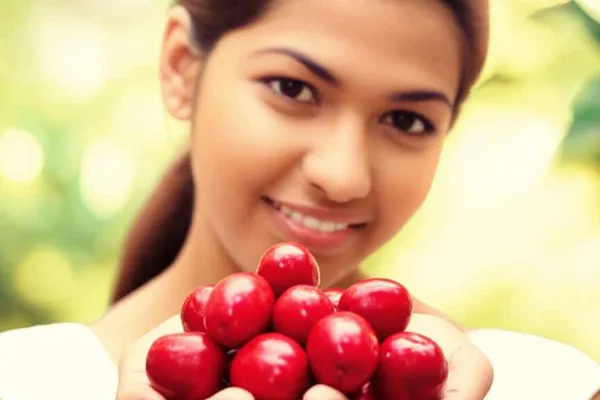
These fruits are very small, about 2-4 centimeters wide. Each fruit has 7 or 8 vertical stripes. They look like tiny pumpkins . The fruit is green at first, then turns orange. When fully ripe, it turns dark red or dark purple-red. Inside is an orange-red pulp. Each fruit can contain one to three seeds.
What is the nutritional value of this small fruit?
Surinam cherries are a fruit packed with vitamins and minerals. Let's take a look at what's typically in a cup (about 173 grams) of Surinam cherries.
| Nutrient section | Serving size: 173 grams (about a cup) |
|---|---|
| Calories | 57 |
| Protein | 1.4 grams |
| Calcium | 16 milligrams |
| Magnesium | 21 milligrams |
| Potassium | 178 milligrams |
| Vitamin C | 46 milligrams |
| Vitamin A | 130 micrograms (RAE) |
Health benefits of Surinam cherries for our body
Surinam cherry has been used in traditional medicine for a variety of health conditions, including chest inflammation, high blood pressure, stomach pain, and bronchitis.
But remember, modern scientific research on the properties of this fruit is still at a very basic level. Most of the research has been done at the laboratory level. Therefore, further research is needed to know exactly how it affects the human body.
Now let's see what the main advantages are that have been discovered so far.
Antibacterial, antiviral and antifungal properties
Researchers have discovered that an extract from the leaves and fruit of the Surinam cherry tree has antifungal properties. Laboratory tests have shown that this extract can work against a fungus called Candida. Although this fungus normally lives in our bodies, it can cause infections when the immune system is weakened.
Additionally, this extract has been shown in laboratory studies to be effective against bacteria such as `(Streptococcus)`, `(Listeria)` and `(Staphylococcus aureus)`. `Strep` is a bacteria that causes throat and skin infections. `Staph` is a bacteria that mainly causes skin infections.
Rich in antioxidants
Simply put, antioxidants are 'protectors' that protect our body's cells from damage. This damage is caused by unstable particles called 'free radicals'. Surinam cherries are a fruit that are full of these antioxidants.
In particular, the darker the fruit, the higher its antioxidant properties . The rare deep purple fruits have the highest amount of antioxidants. Also, these compounds are more abundant in the peel than in the core of the fruit. The carotenoids `(Lycopene)`, `(Gamma-carotene)` and `(Beta-cryptoxanthin)` in this fruit act as powerful antioxidants.
Help for healthy skin
Surinam cherries are rich in vitamin C. Vitamin C is also a powerful antioxidant. Vitamin C is also essential for the production of collagen, a protein that is essential for healthy skin and wound healing. On average, women need 75 milligrams of vitamin C per day and men need 90 milligrams.
Helps maintain good eyesight
This fruit is rich in vitamin A. Vitamin A is essential for our eyesight and immune system. One of the main symptoms of vitamin A deficiency is reduced vision in low light. This is called 'xerophthalmia'. If this condition is not treated, it can even lead to blindness.
Could it have anti-cancer properties?
This is something that needs to be understood very carefully. Preliminary laboratory studies have shown that extracts from Surinam cherry leaves and berries may have some ability to slow the growth of cancer cells and increase the death of cancer cells. However, these are still in the very early stages of research . Therefore, it is not possible to say that this is a cure for cancer. A lot more research needs to be done to know for sure.
Be careful of these things when eating Suriname cherries
There are a few things you need to know before eating this fruit.
- Only pick ripe fruits: You should pick a fruit only when it is ripe enough to easily come off the tree when you lightly touch it with your hand. If it doesn't come off, it's not ripe enough. Eating raw fruits tastes very unpleasant.
- Don't eat the seeds: The seeds of the Surinam cherry are not suitable for eating. Eating them can cause stomach upset. So, be sure to remove the seeds when eating the fruit.
- Tree Smell: Some people may experience nasal and throat discomfort due to the pungent smell of pruning Suriname cherry trees.
How does it taste? How do you prepare it for eating?
There are two main types of Suriname cherries. The most common dark red variety and the very rare dark purple-red variety. The dark variety is slightly less sweet.
Some say its juicy flavor is very refreshing. Others say it takes some getting used to.
If you are eating fresh fruit, try this. Cut the fruit vertically with a knife, cut it in half, and remove the seeds. Then, refrigerate it for about 2-3 hours. This will reduce the resinous flavor. If you sprinkle some sugar on it before refrigerate, it will increase the sweetness and make it more juicy.
You can add this fruit to your diet in various ways:
- For salads
- For custard pudding
- For ice cream
- For fruit cups `(Fruit cups)`
- For pies
- Make sauces
They also make things like pickles, jams, and jellies from Surinamese cherries.
Take-Home Message
- Surinam cherry is a nutritious fruit rich in vitamins C and A and high in antioxidants.
- Since research on the health benefits of this fruit is still in its early stages, be sure to consult your doctor before using it as a treatment for serious illnesses.
- When picking fruit, choose only well-ripened, easily-separated fruits. Avoid eating the seeds .
- These can be eaten fresh, with a little sugar and refrigerated, or added to jams, jellies, and salads.




💬 Comments (0)
No comments yet. Be the first to share your thoughts here.
Add Your Comment