
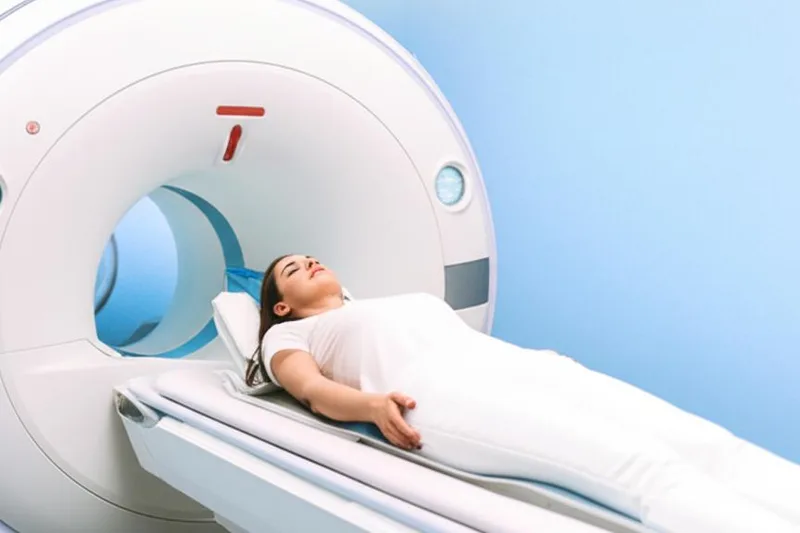
It's normal to feel a little scared and curious when your doctor tells you that you need to have an MRI scan . "What is this machine? What will happen when it goes inside your body? Will it hurt?" Many questions like these probably come to mind. This is actually a new experience for many people. So don't worry. Today, we'll find answers to all your questions about this MRI scan .
Simply put, what is an MRI scan?
MRI stands for Magnetic Resonance Imaging. Simply put, it's a test that uses a powerful magnet, radio waves, and a computer to take very clear, detailed pictures of organs and tissues inside your body.
Think about it, our bodies are mostly water. When we go into this MRI machine, the strong magnetic field inside it causes the protons in the water molecules in our bodies to align in one direction. Then, the radio waves emitted by the machine cause these protons to vibrate. When the radio waves are stopped, these protons align back to the way they were. When this happens, they emit special signals. Those signals are what the computer picks up and turns into beautiful, clear pictures.
An MRI scan does not use any radiation that is harmful to the body, like X-rays. Therefore, it is considered a very safe test.
What is the difference between an MRI and a CT scan?
One thing that confuses many people is whether MRI and CT scans are two different things or one. Both of these take pictures of the inside of the body. But the two methods and what they look at are different. Let's understand this difference clearly.
| Feature | MRI scan | CT scan |
|---|---|---|
| Technology used | Strong magnets and radio waves. | X-rays and computer technology. |
| Mainly looking at | Soft tissue (organs, muscles), nervous system , ligament tears, back injuries, etc. | It is used for rapid diagnosis in emergencies, such as fractures, tumors, and internal bleeding. |
| Time spent | It can usually take from 15 to 90 minutes (about an hour). | Very fast. Results can be obtained in as little as 10 minutes. |
| Use of radiation | No. No harmful radiation is used. | Yes. It uses X-rays. |
What is this MRI done with contrast?
Sometimes your doctor will order an "MRI with contrast." This involves giving a small injection of a special liquid (medicine) into a vein in your arm before the scan. This is called contrast dye. The most common type used is gadolinium.
This medicine makes certain parts of the body, especially blood vessels and tumors , stand out more clearly on scans. It's like highlighting an important part of a book with a colored pen. You may feel a slight metallic taste in your mouth when you take this medicine.
But not every MRI requires this contrast agent. In most cases, a regular MRI can provide the necessary information. Also, pregnant women and people with kidney disease are not given this contrast agent because it can cause complications.
What diseases can be detected with an MRI scan?
An MRI scan is used to examine different parts of the body. It can help diagnose a disease or disorder and see how you are responding to treatment.
Brain and Spinal Cord
- Damage to blood vessels, aneurysm of a brain artery
- Brain injuries
- Cancer conditions
- Multiple Sclerosis (MS)
- Back injuries and spinal cord injuries
- Stroke
- Eye and inner ear problems
Heart and Blood Vessels
- Blocked blood vessels
- Damage caused by a heart attack
- Heart disease
- Inflammation of the membrane surrounding the heart (pericarditis)
- Problems with the structure of the heart
Bones and Joints
- Arthritis
- Bone infections
- Bone cancer and tumors
- Damage to joints
- Problems with the discs between the vertebrae of the spine
- Neurological disorders that accompany neck and back pain
Breast
- As a screening for women at high risk of breast cancer
- To see the size and spread of cancer once it is diagnosed
- To check if breast implants are damaged
Liver, kidneys and other organs
MRI scans can very clearly identify cancer, cirrhosis, infections, and other disease conditions in organs such as the liver, kidneys, pancreas, ovaries, and prostate.
Risks and precautions of MRI scan
Although MRI is generally a very safe test, there are a few things we should definitely be aware of.
Metal implants
This is the most important and important thing to pay attention to. The MRI machine has a very strong magnet. So if you have anything metal inside your body or on your clothes, it can be attracted to the magnet and cause a dangerous accident.
If you have any of the following, you should definitely tell the doctor and the technician performing the scan before your MRI:
- Pacemaker or ICD device
- Aneurysm clips for brain aneurysms
- Cochlear implants for hearing
- Drug pumps implanted in the body
- Pins or screws used to fix bones
- Artificial heart valves
- Metal fragments, such as bullet fragments, in the body
Things like dental fillings and knee replacements are usually not a problem, but whatever the case, it's important to let us know in advance for your safety.
Pregnancy and breastfeeding
- MRI scans are not usually performed during the first trimester of pregnancy . This is because the baby's organs are still developing, so unnecessary risks are not taken. However, if it is absolutely necessary, a decision is made based on the doctor's advice.
- If a breastfeeding mother is given a contrast dye and has an MRI, there is no need to worry. Only a very small amount is added to the milk. However, if you are concerned, you can stop breastfeeding your baby for 24 hours after the scan and then remove the contrast dye.
How do you prepare for an MRI scan?
Be sure to do these things before the scan
1. Talk to the doctor: Ask questions like why you're having this scan and what the results mean.
2. Tell your doctor about your health conditions: If you have any conditions like kidney or liver disease, diabetes, allergies, are pregnant, or have recently had surgery, tell your doctor about all of these.
3. Disclose any metal on your body: As mentioned earlier, be sure to disclose any metal you have on your body. Also, if you have tattoos, disclose them, as some types of ink may contain metal.
4. Remove any metal you are wearing: Before entering the scanning room, remove all metal objects such as earrings, necklaces, rings, watches, eyeglasses, hairpins, and underwires. Also, keep items such as cell phones and credit cards outside the room.
Do you have claustrophobia, a fear of confined spaces?
Some people may be afraid of being in a confined space like an MRI machine. This is called ``claustrophobia.`` If you have this problem, tell the doctor or staff in advance. They may give you a sedative to relax you or refer you to an "Open MRI" machine that is open to both sides.
What happens during the scan?
You will be placed on a bed and slowly moved into the machine. Straps may be used to help you stay still. When the machine is turned on, you will hear a loud knocking or tapping sound . This is normal. Don't be alarmed by the sound. You will be given earplugs or headphones to help reduce the noise.
The technician who is doing the scan will be watching you from a separate room. He or she will talk to you. Sometimes you will be asked to hold your breath for a while. During the scan, you may feel a slight tingling sensation as your nerves are stimulated. This is normal. The entire test can take anywhere from 15 to 30 minutes to an hour and a half.
After the scan...
Once the scan is over, you can go home normally. You can do your usual activities. However, if you were given a sedative, you will need to stay in the hospital until you are fully conscious. Also, you will not be able to drive for the day, and you will need someone to drive you home.
The results (report) will be reviewed by a specialist (radiologist) and sent to your doctor. The doctor will then explain the report to you and what to do next.
Take-Home Message
- MRI is a test that does not use harmful radiation, is very safe, and can produce detailed images.
- This mainly looks at problems related to soft tissues such as the brain, spine, joints, and muscles.
- If you have even the smallest piece of metal in your body, be sure to tell the doctor and staff about it before the MRI.
- If you have claustrophobia, let us know in advance. There are solutions for that.
- Don't be alarmed by the loud noise you hear during the scan, it's a normal process of the machine operating.
- Feel free to talk to the doctor about any questions or concerns you have.


💬 Comments (0)
No comments yet. Be the first to share your thoughts here.
Add Your Comment