
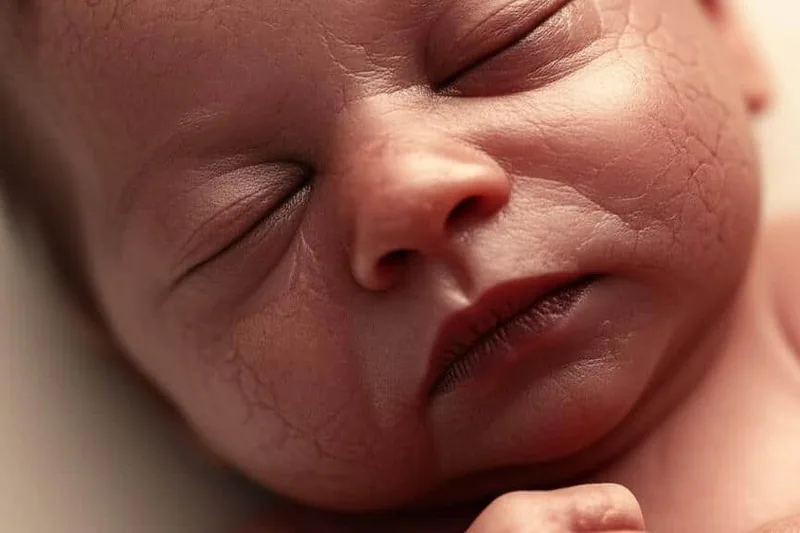
How excited are you to see the new addition to your family? But, imagine, if your baby's entire body was covered in thick, scaly, scaly skin right after birth? The shock and fear that any parent feels upon seeing that is hard to put into words. Today we are going to talk about one such extremely rare and serious condition, Harlequin Ichthyosis. Don't be scared when you hear this. Today, with the advancement of medical science, there are many ways to manage this condition. Let's learn more about it.
Simply put, what is Harlequin Ichthyosis?
Harlequin Ichthyosis is the most severe and serious form of the skin disease called Ichthyosis . Ichthyosis is a condition that occurs when there is a problem with the way our skin cells grow and die. Some types of Ichthyosis are very mild and can be controlled with good skin care. However, Harlequin Ichthyosis is a life-threatening condition that requires close medical attention from birth.
This is a genetic disease . This means that it is inherited from parents to children. The condition is so rare that it affects only about one in 500,000 children. However, with today's advanced treatments, children born with this disease now have the chance to live into adulthood.
What are the main symptoms of this disease?
The symptoms of this disease vary slightly with the age of the child. The symptoms of a newborn baby and those of a slightly older child are different. Let's break it down like this to understand it clearly.
| Age group | Commonly seen symptoms |
|---|---|
| Newborn babies |
|
| Older children and adults |
Is this condition painful?
Yes, this can be painful for a newborn. Think of the deep cracks in the skin, the pain of the skin peeling off. Therefore, the doctors and nurses in the neonatal intensive care unit (NICU) give the baby pain-relieving medications (e.g., Paracetamol, Ibuprofen). They measure the pain by monitoring the baby's heart rate and crying, and make sure they are as comfortable as possible .
Why is this happening? What is the reason?
The main reason for this is a mutation in the gene ABCA12 . Let's understand this simply.
Think of this ABCA12 gene as a 'Delivery Service' that transports essential substances like fats (lipids) to the outermost layer of our skin. This layer of fat is what keeps our skin flexible and healthy. In a person with Harlequin Ichthyosis, due to a defect in this gene, that 'Delivery Service' does not work properly. As a result, fat does not get to the skin cells properly, and the skin cells pile up on top of each other, forming a thick, hard layer.
Because it is a genetic disease, for a child to develop the disease, both parents must inherit the defective gene. If both parents are carriers of the defective gene (meaning they do not have symptoms, but have the gene), there is a 25% (one in four) chance that their child will develop the disease.
How do doctors diagnose and treat this disease?
Often, doctors can diagnose the condition at birth because of the baby's unique appearance. However, genetic testing is done to confirm it. Even during pregnancy, doctors may suspect the condition if they see signs such as skin changes or a baby's mouth opening frequently on ultrasound scans. If necessary, they can also diagnose the condition early with special tests (such as amniocentesis) during pregnancy.
Treatment methods
Harlequin Ichthyosis is not a completely curable disease, but symptoms can be managed and the child can live a comfortable, long life.
Treatment can be divided into two main parts:
1. Neonatal Intensive Care Unit (NICU) Treatment: The first few weeks of a baby's life are the most vulnerable. The treatment given during this time is what saves the baby's life.
2. Long-term management at home: Lifelong care after returning home from the NICU.
Let's look at this treatment in detail.
| Treatment method | Description |
|---|---|
| NICU ( Neonatal Intensive Care Unit) Treatment | |
| Retinoid Therapy | This is a medicine that is given orally or applied to the skin. It helps the thick layer of skin to peel off quickly and the skin underneath to heal. This has been the main reason for saving the lives of these children in recent times. |
| Skin care | Special moisturizers and ointments are applied regularly to retain moisture in the skin. Antibiotic ointments are applied to prevent germs from entering through cracks in the skin. |
| A humid environment | The humidity in the incubator where the baby is kept is very high. This reduces skin dryness. |
| Nutrition and breastfeeding | Since he cannot suck milk, he is given the necessary nutrition through a small tube placed in his stomach (feeding tube). |
| Long-term management at home | |
| Bathing frequently | Bathing daily helps soften the skin and remove thick layers of dead skin. |
| Applying moisturizer regularly | You should apply moisturizer or something like petroleum jelly to your entire body several times a day. This will prevent the skin from drying out and cracking. |
| Meeting with specialists | It is essential to have a close relationship with a dermatologist . Also, you will need to see specialists for eye, ear, and joint problems regularly. |
| Protection from high temperatures | Since you can't sweat, the body can overheat in the heat. Therefore, you need to be careful of the sun and heat. |
The most important thing is the love, care, and mental strength of parents and family. This is a challenging journey. Therefore, it is very important to seek support from doctors, counselors, and other families with children like this.
Take-Home Message
- Harlequin Ichthyosis is a very rare but severe genetic skin disease. It is not contagious.
- This condition can be life-threatening for a newborn, so it is essential to receive treatment in a neonatal intensive care unit (NICU) for the first few weeks.
- Thanks to modern medical treatments, especially retinoid therapy , the survival rate of these children has increased significantly.
- This is a lifelong condition. It is important to take care of the skin regularly, provide proper nutrition, and follow the advice of specialist doctors.
- With proper management, people with this condition can live long, comfortable, and meaningful lives.


💬 Comments (0)
No comments yet. Be the first to share your thoughts here.
Add Your Comment