
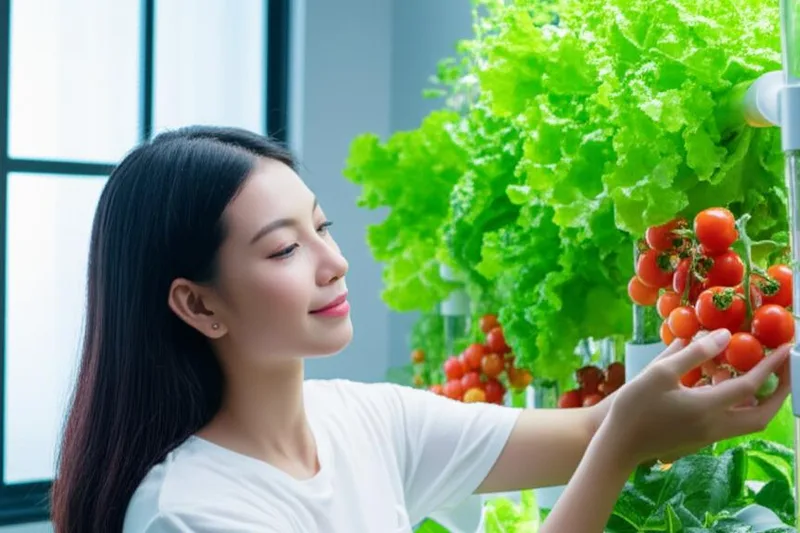
Nowadays, we are increasingly concerned about the things we eat and drink and the environment, aren't we? You must have thought about how great it would be to be able to grow fresh, non-toxic vegetables and fruits at home. But the problem that many people have is, "Oh, we don't have the space." So if you have the same problem, today we are going to talk about a great way to grow vegetables all year round, even indoors, without soil, using less space.
What is hydroponics?
Simply put, hydroponics is a method of growing plants without the use of soil, using only water with dissolved nutrients. Yes, you heard that right, not even a drop of soil is needed.
Imagine, in this method, we add the nutrients that normally come from the soil to grow a plant directly to the water. We call this a nutrient solution. Instead of sunlight, specially designed bulbs, namely `(LED)` lights, are used to provide the necessary light to the plants. Therefore, this cultivation can be done indoors, on the balcony, or anywhere there is space. This is also called Controlled Environment Agriculture (CEA)`.
This method is often used to grow vegetables, herbs, lettuce, and greenhouse crops like peppers, cucumbers, and tomatoes. This method saves space and uses much less water than conventional farming.
How does this system work?
There is some simple science behind hydroponics. There are several key elements to a successful hydroponics system.
1. Nutrient Solution: This is the heart of this system. This is a solution made by mixing specific amounts of major nutrients such as phosphorus, nitrogen, potassium, and magnesium, which are essential for plant growth, and micronutrients such as iron and zinc. This is added to the water tank and nourishes the plants.
2. Oxygen: Just like us, plant roots need oxygen to breathe. Roots can rot when submerged in water. To prevent this, use a small air pump and an air stone to provide oxygen to the water tank. It's similar to the bubble system you might see in a fish tank.
3. pH control: The measure of the acidity/alkaline nature of the water is called the `(pH)` value. For plants to absorb nutrients optimally, this `(pH)` value should be kept at an optimal level between 5.8 and 6.2. There are small `(pH)` meters to check this. You can use things like citric acid to lower the `(pH)` value, and things like baking soda to increase it.
4. Lighting: If you are using this method outdoors, you can use sunlight. However, if you are using it indoors, you will definitely need fluorescent or LED bulbs to provide the necessary light for the plants. The light spectrum required varies depending on the type of plant, so you can choose the right bulbs for it.
What are the main types of hydroponics systems?
There are several hydroponics methods. You can choose one of these depending on the type and size of the crop you are growing. The table below shows some simple methods that are best suited for home cultivation.
| System Name | How it Works |
|---|---|
| Ebb and Flow / Deep Water Culture (DWC) | This is the simplest and most popular method used in gardening. The roots of the plants are immersed in a tank filled with a nutrient solution. An air pump is used to provide oxygen to the roots. |
| Nutrient Film Technique (NFT) | Here, the plants are placed in a slightly inclined tray or tube. A nutrient solution is constantly flowing along this tray like a very thin film using a pump. The roots receive the nutrients and oxygen they need through it. |
| Wick System | This is also a very simple method, very suitable for home cultivation. The roots of the plant are allowed to absorb nutrients from the tank containing the nutrient solution through a cotton-like screen (wick). This does not require any motors or pumps. |
What are the benefits of hydroponics?
The advantages of this method are truly many.
Simply put, the biggest advantage is that you can use up to 90% less water than traditional gardening and get a higher yield.
- Space is limited: This cultivation can be done on the balcony of an apartment, near the kitchen window, or even in a small space.
- Fewer pests and diseases: Since there is no soil, there are very few soil-borne diseases, worms, and insects. Therefore, there is almost no need to use pesticides or herbicides. This means you get clean, non-toxic food.
- Higher yields: Since the nutrients, light, and oxygen needed by the plants are controlled and provided at optimal levels, the plants grow much more vigorously and quickly. The yield is also higher.
- Year-round cultivation: Since it is grown indoors in a controlled environment, the weather outside (rain, sun) does not affect it in any way. You can grow whatever you like at any time of the year.
- Environmentally friendly: This is a very environmentally friendly method because it uses water sparingly and does not use agrochemicals.
How to start a hydroponics farm at home?
This is not as difficult or expensive as you might think. These are the basic things you need to start a hydroponic system at home.
- Growing system: You can buy a small hydroponics kit from a store. Or, even cheaper, you can make one at home. Any container that can hold water (e.g., a large bucket, a plastic basin) can be used as a water tank. You can make this bucket by drilling holes in the lid to hold the plants. Small net pots with mesh are used so that the roots of the plants can reach the water.
- Lighting: If indoors, an LED or fluorescent bulb is needed.
- Aeration: This requires a small air pump and air stone that you put in a fish tank. These are now available in general stores.
All of this can be done with minor modifications depending on the type of plant you plan to grow.
There are no small challenges.
The biggest challenge with this system is the initial cost. It costs a little to buy things like lights, pumps, and tanks. But for a small system for personal use in a home, the cost is not that much. Also, things like the `(pH)` value of the water, nutrient levels, etc. need to be maintained with some care. But once you learn those things properly, the effort is not wasted when compared to the long-term benefits.
Take-Home Message
- Hydroponics is a highly effective and environmentally friendly method of growing plants without soil, using nutrient-diluted water.
- Through this method, a higher yield can be obtained with very little space and less water .
- This is a great solution for growing fresh and clean vegetables and fruits at home, without poisons or pesticides.
- Being able to grow it at any time of the year, even indoors, is a big advantage.
- Setting up a small hydroponics system for home use is not as difficult or expensive as you might think.


💬 Comments (0)
No comments yet. Be the first to share your thoughts here.
Add Your Comment