
What is the Myelin Sheath? Let's understand it simply!
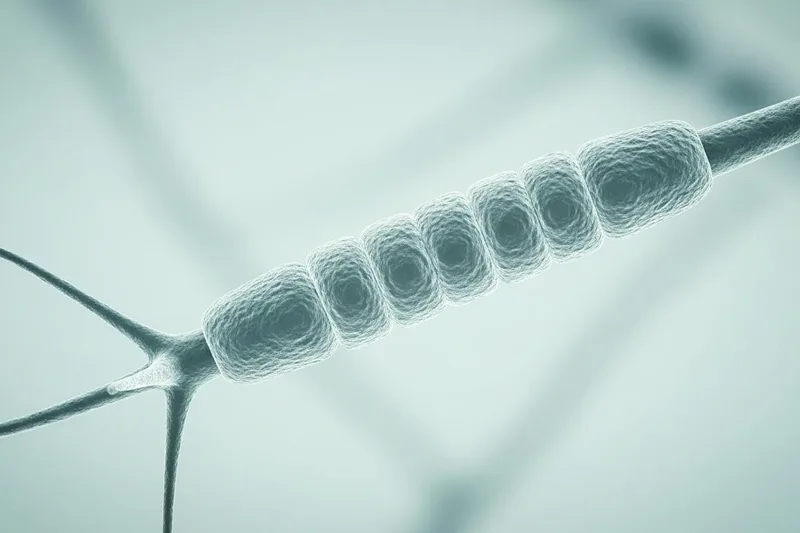
Simply put, the myelin sheath is a protective covering that wraps around each of our nerve cells (which we also call `(Neuron)`). It's like a little glove. It's made of fats (i.e. `(Lipids)`) and proteins. This covering covers the main "trunk" part of the nerve cell, which is called the axon . Think of it like an electrical wire in our homes. It has a plastic sheath around the copper wires. That's how this myelin sheath protects the nerve cells and helps them function properly.What are the parts of a neuron? It's like a tree!
Before we talk more about the myelin sheath, let's understand what a nerve cell is and what its parts are. Nerve cells make up our nervous system . This nervous system is like the main information exchange center in our body. It receives information from all over the body, responds to it, and adapts to what is happening inside and outside the body. When we consider a nerve cell, it has three main parts. Imagine that a nerve cell is like a tree : 1. Soma or Cell Body: This is like the root system of a tree. The dendrites , which are like the roots of the soma, absorb "nutrients" from the soil. But here, "nutrients" are chemical messages coming from other nerve cells nearby. These messages are then converted into electrical impulses. The nucleus of the cell is also inside this soma. 2. Axon: This is like the long trunk of a tree. Just as the nutrients absorbed from the roots of a tree go up the trunk, the axon also carries the electrical impulses coming from the soma along it. 3. Axon Terminal: This is like the buds at the ends of the branches of a tree. Leaves and pollen come out of these buds. In this way, the electrical impulses are "released" from this axon terminal so that they can be picked up by the next nerve cell. This process continues until the message reaches your brain, spinal cord , or other parts of your body. The result is things like the muscles that contract to move your arm, help you breathe, or make your heart beat. Now you may have a little idea about the basic structure of a nerve cell.What happens to the Myelin Sheath?
The myelin sheath has three main functions:- Providing protection: As I mentioned earlier, this lipid-protein coating provides protective insulation for the nerve cell, much like the plastic sheath around the wires of an electrical cable.
- Fast communication: This is why electrical impulses travel from one nerve cell to the next very quickly and efficiently . Without myelin, this journey would be very slow.
- Maintaining the strength of the impulse: This myelin sheath helps to maintain the strength of the message as it travels along the axon.
What are the gaps in the myelin sheath called?
Don't think of the myelin sheath as a continuous, thick covering. No, it's like a long train of boxes. Where one box ends and the next box begins, there's a small gap. Similarly, the myelin sheath is made up of a series of myelin strands that are separated from each other. Each of these myelin strands is called an internode . These small gaps between two myelin strands are called nodes of Ranvier . These nodes of Ranvier contain a large number of positive sodium ions. When an electrical signal, or impulse, travels along the axon, it jumps from one node of Ranvier to the next. When it crosses this gap, the sodium ions recharge the electrical signal. Then the signal can continue to travel without losing its charge or losing its strength. It's a very amazing mechanism, isn't it?What happens if the myelin sheath is damaged?
It is said that there are about 100 billion nerve cells in our body. Each of these is constantly active, sending and receiving messages, controlling every function in our body. Imagine what would happen if the myelin sheath around these nerve cells were damaged. Then the speed of the electrical signal would slow down, or it could stop altogether. One of the main reasons for damage to myelin is the immune system in our body.The cells mistakenly think that myelin is something foreign from outside. Then our immune system starts attacking myelin. This causes inflammatory substances to be produced, which damage the myelin. Eventually, the cells that make myelin (oligodendrocytes and Schwann cells) also die. This destruction of the myelin sheath is called demyelination . Depending on where the myelin is attacked, your symptoms will vary.What diseases damage myelin?
There are several diseases that damage myelin. You may have heard of some of these diseases.Diseases affecting myelin in the central nervous system (CNS):
The most common disease that most people have heard of, which attacks the myelin of the central nervous system (that is, the brain and spinal cord), is multiple sclerosis . In addition, there are several other diseases that affect the myelin of the central nervous system:- Acute Disseminated Encephalomyelitis: This is a rare, acute, severe immune reaction that occurs in the central nervous system.
- Schilder's Sclerosis: Also known as ``Diffuse Myelinoclastic Sclerosis'', this is a rare neurodegenerative disease that occurs in children.
- Transverse Myelitis: This is an autoimmune disease that causes inflammation of the spinal cord.
- Neuromyelitis Optica: In this, the immune system attacks the nerves of the eye and spinal cord through antibodies .
- Optic Neuritis : This also involves inflammation of the optic nerve.
- Tumefactive Demyelination : This is a single myelin-damaging lesion larger than 2 centimeters.
Diseases affecting myelin in the peripheral nervous system:
- Guillain-Barre Syndrome: These symptoms can occur after an infection or, very rarely, after a vaccination.
- Chronic Inflammatory Demyelinating Polyradiculoneuropathy ( CIDP ): This is a progressive autoimmune disease that attacks myelin.
- Paraproteinemic Demyelinating Neuropathy: This is a type of neuropathy associated with the presence of an antibody linked to cancer.
- Charcot Marie Tooth disease type 1 and type X: This is an inherited neurological disease.
- Copper Deficiency: When copper levels are low, myelin loses its protective properties and is more susceptible to damage.
What other conditions can damage myelin?
There are other reasons why the myelin sheath can be damaged or destroyed in adults:- Stroke
- Infections, Immune and Metabolic Disorders (`(Metabolic Disorders)`)
- Types of poisons
- Vitamin B12 Deficiency
- Some medications, for example `(Ethambutol)`
- Excessive alcohol use
Imagine how much our body's functions would be impaired if these fast pathways that carry messages in our body were blocked, like being stuck in traffic. That's why the health of the myelin sheath is so important.
Can damage to myelin be repaired?
This is the question that many people have. Yes, damaged myelin can be repaired , both in the central nervous system and in the peripheral nervous system. But it is important to control the factors that cause myelin breakdown, such as inflammation, and to use immune suppression/modulation (for example , steroids , intravenous immune globulin (IVIG) , and other drugs). Scientists have made great progress in understanding the potential ways to promote myelin repair. Although there are some promising studies, it is not yet clear how much benefit they have actually had for patients. There are currently no approved drugs for myelin repair. Here are just a few examples from the studies:- A small Phase II clinical trial has shown that the oral antihistamine clemastine has myelin repair properties. Clemastine improved the transmission of electrical signals in multiple sclerosis patients with optic nerve damage. Another early human trial found that the combination of the diabetes drug metformin and clemastine helped regenerate myelin.
- Stem CellsBy blocking a molecule in oligodendrocyte cells, which make myelin in the central nervous system (these are the "building blocks" of all cell types), mice with multiple sclerosis-like symptoms were able to repair their myelin and recover to some extent.
- Research continues into the potential of stem cells to repair myelin damage and slow the progression of the disease.
- Other drugs show promise in protecting the nervous system from further damage. The anti-inflammatory drug ibudilast significantly reduced the rate of brain cell death (atrophy) in a Phase II trial. The epilepsy drug phenytoin has been shown to be safe, reducing myelin damage by 30% compared to a placebo. The antioxidant lipoic acid may help prevent further damage to nerve fibers.
Take-Home Message
So, you can see now how important this myelin sheath is to the healthy functioning of our nervous system. Myelin is essential for the proper functioning of these billions of nerve cells that communicate with every part of our body and control everything.- Myelin is a protective sheath made of fats and proteins that surrounds nerve cells.
- It helps nerve impulses travel quickly and efficiently.
- Damage to myelin can lead to serious diseases such as multiple sclerosis.
- Research is ongoing into methods for managing and repairing diseases that cause myelin damage.
Myelin, myelin sheath, nerve cells, neurons, nervous system, central nervous system, peripheral nervous system, demyelination, multiple sclerosis


💬 Comments (0)
No comments have been posted yet. Add your comment here for the first time.
Add your comment