
Help for your heart: What is interventional cardiology?

Help for your heart: What is interventional cardiology?

Have you ever heard of the term "Interventional Cardiology"? Maybe your doctor has mentioned it, or maybe you're looking into it because you have a heart problem. Anyway, this is a very important field of medicine. Let's talk about it briefly, shall we?
What is Interventional Cardiology? Very simple!

Simply put, interventional cardiology is a special procedure that uses a very small, flexible tube called a ``catheter`` to diagnose and treat heart and blood vessel diseases. Think of it like a small cannula that we use when we put saline in our arm, but this ``catheter`` is an even finer tube. This is inserted through one of your blood vessels. Therefore, there is no need to make a large incision in the skin and perform surgery. This is the biggest advantage of this method.

Doctors in this field (we call them interventional cardiologists) help people with vascular and coronary heart disease. They also treat babies, young children, and adults with heart defects, such as heart valve defects or congenital heart disease, such as septal defects.

What is the difference between Interventional Cardiology and Cardiothoracic Surgery?

Although both of these are related to the heart, there is a slight difference.

An interventional cardiologist performs the ``Minimally Invasive`` treatment, which I mentioned earlier, using a ``(Catheter)``, without a large incision, through a small hole. That is, they do not perform `` open-heart surgery`` , which involves making a large cut in the middle of the chest (``Sternotomy``).

However, a cardiothoracic surgeon is someone who performs surgery on the organs in the chest, such as the heart, lungs, and esophagus. They perform open-heart surgery. Sometimes they also use multiple small incisions instead of one large incision.

The most important thing is that, in most cases, both of these specialists work together to decide which treatment method is most suitable for you.

What specifically does an interventional cardiologist do?

These doctors specialize in using that ``(catheter)'' to diagnose and treat diseases of the heart and blood vessels. Some methods are used to find out exactly what the disease is, while others are used to treat the disease.

What tests does an interventional cardiologist order?

In this field mainlyIt checks whether the blood circulation in your body is working properly. It looks for problems that are interfering with the blood flow and tries to solve them. For example, it checks the blood flow and pressure in the blood vessels that supply blood to your heart (the ``Coronary Arteries``) and inside the heart chambers.

Some of the tests done for this are:

  • A CT scan of the blood vessels of the heart (computed tomography (CT) of Coronary Arteries).
  • An echocardiogram (intracardiac echocardiogram).
  • Heart MRI .
  • Chest X -ray.

What is an Interventional Cardiac Procedure?

This is a method of treating the heart using only a `(Catheter)`, without cutting the skin or performing surgery. For example, if replacing a heart valve or repairing a heart valve is done using a `(Catheter)`, it is an interventional heart treatment.

What treatments does an interventional cardiologist perform?

There are many treatments that these doctors perform. You may have heard of some of them.

  • Cardiac catheterization: An examination of the heart by inserting a catheter into it.
  • Angiogram (`Angiogram` - `Peripheral` or `Coronary`): A special fluid is injected into the blood vessels and X-rays are taken to find out where the blockages are.
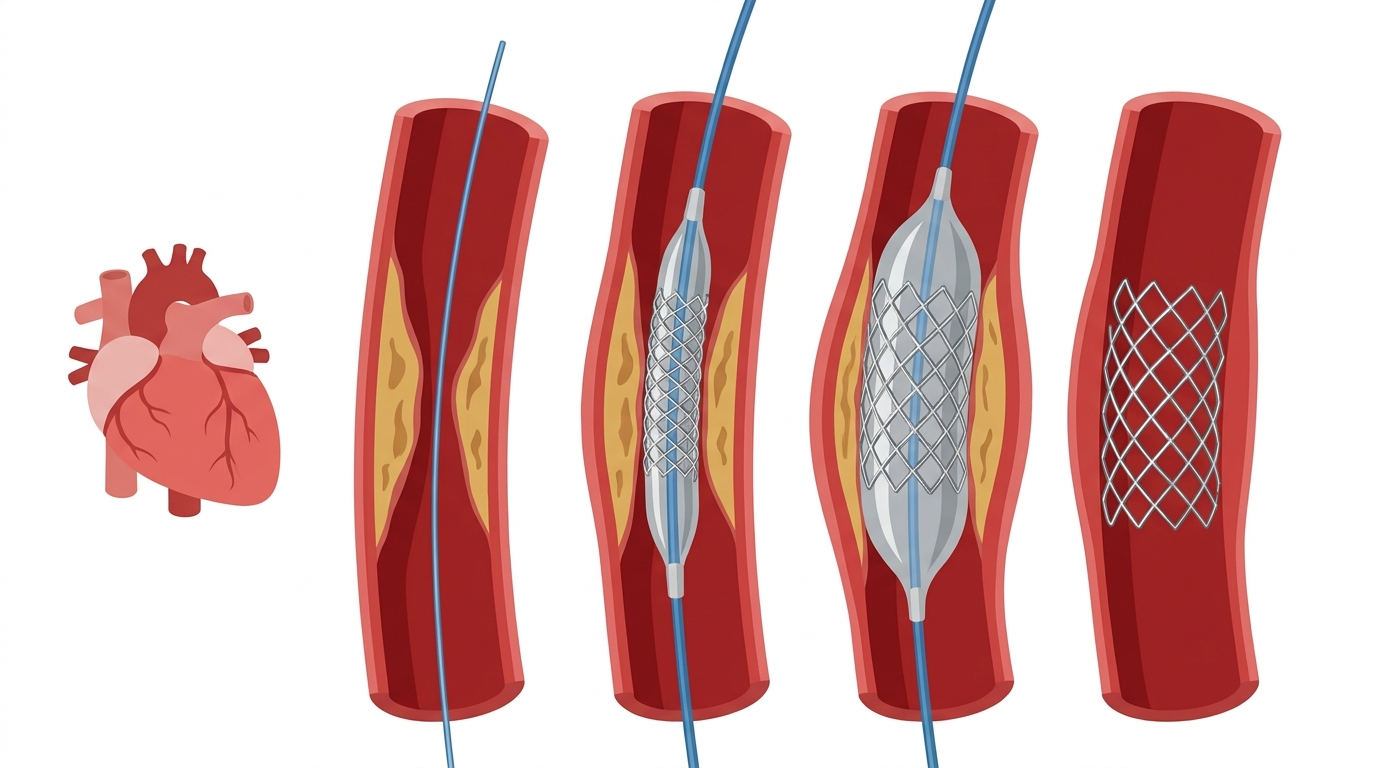
  • Angioplasty: A procedure that reopens a blocked blood vessel by inflating it with a small balloon-like device.
  • Coronary Atherectomy: Removal of fatty deposits (plaque) in the blood vessels .
  • Fractional Flow Reserve (FFR) measurement: A measurement of how much blood flow is obstructed due to a blockage in a blood vessel.
  • Intravascular Ultrasound (IVUS): A procedure in which a small ultrasound device is inserted into a blood vessel.
  • Optical Coherence Tomography (OCT): A method that uses light to see the inside of blood vessels very clearly.
  • Stent Placement: A small mesh tube placed in a blocked blood vessel that has been opened by angioplasty to keep it from getting blocked again. This is often made of metal.
  • Heart Valve Replacement and Repair: This can now also be done with a catheter.
  • Left Atrial Appendage Closure.
  • Closing the hole in the wall between the atria (`Atrial Septal Defect Closure`).
  • Alcohol Septal Ablation.
  • Patent Foramen Ovale Closure.
  • Renal Denervation: A treatment that targets the nerves to the kidneys to reduce high blood pressure.
  • Thrombolysis: Dissolving blood clots.

What is the most common treatment performed by interventional cardiologists?

The most common procedure these doctors perform is angioplasty and stent placement in the blood vessels of the heart. This involves using a catheter to find a blockage in a blood vessel in the heart. Then, with a small tool like a balloon, the blockage (i.e., the plaque formed by cholesterol deposits) is pressed against the wall of the vessel, creating a path for blood to flow. Then, if necessary, a mesh tube called a stent is placed there to prevent the path from closing again. This is a life-saving treatment for someone who has had a heart attack.

What diseases and conditions are treated by interventional cardiology?

This method can treat a number of diseases that affect the heart and blood vessels. Here are a few examples:

  • Heart Valve Disease
  • Atherosclerosis
  • Heart Attack
  • Carotid Artery Disease (this is a major blood vessel in the neck)
  • Coronary Artery Disease
  • Hypertrophic Cardiomyopathy (thickening of the heart muscle)
  • Coronary Artery Fistula (An abnormal connection between a blood vessel in the heart and another blood vessel or part of the heart)
  • Peripheral Artery Disease (blood vessel blockage in the limbs)
  • Chronic Venous (Vein) Disease
  • Aortic Valve Stenosis
  • Blood clotting diseases (`Thromboembolic Disease`)
  • Aneurysm
  • Holes in the wall between the atria (`Atrial Septal Defect`)
  • Holes in the wall between the ventricles (`Ventricular Septal Defect`)

Do I need a referral to see an interventional cardiologist?

Yes, you will often need a referral from another doctor to see an interventional cardiologist. This is because these specialists are trained to perform the specific test or treatment you need.

Where do these interventional cardiologists work?

Interventional cardiologists work in hospitals, private medical centers, and medical schools. Some also engage in research and teaching medical students while providing treatment.

Often, these doctors are on call to treat an emergency, for example, someone who has a heart attack.

What is the training required for interventional cardiology?

Working in this field requires years of training. After medical school (4 years), those pursuing this subspecialty complete three years of residency training in Internal Medicine, followed by another three years of specialty training in General Cardiology.

After that, you will receive at least another year of specialized interventional cardiology training (`Fellowship`) in the techniques used to use the ``Catheter``. Only then will you receive a ``Certification`` from a medical board.

Some interventional cardiologists are members of organizations such as the Society for Cardiovascular Angiography and Interventions (SCAI) or hold a special membership (a ``Fellow``). A ``Fellow`` is someone who has performed more than 1,000 procedures. This means that you are being treated by someone who has received very advanced training.

What can you expect during an interventional cardiology appointment?

Unless it's an emergency, an interventional cardiologist will talk to you about your heart or blood vessel problems. They'll ask you about your symptoms and how long you've had them. It's important to bring a list of all the medications you take (prescribed, over-the-counter, vitamins, and even supplements).

The doctor will listen to your heart. He will also ask if you use tobacco products or drink alcohol. He will also ask if anyone in your family has had heart disease or blood vessel problems. He may also do simple tests there, such as checking your blood pressure.

If you need diagnostic tests and/or treatments, you will need to schedule a separate appointment for that day. Your doctor will explain the interventional treatment that they think is right for you, along with the benefits and risks. They will also tell you how to prepare for the treatment. For example, you may be asked not to eat or drink for eight hours before the test or treatment.

It's normal to feel a little nervous and anxious when you're told you're going to have heart surgery. But remember, when you have interventional cardiology, you're being cared for by a highly trained specialist. They can gather the information they need to diagnose the condition and then treat it without having to do open-heart surgery.

The most important things to keep in mind (Take-Home Message)

So, interventional cardiology is a very advanced and very patient-friendly field of medicine.

  • No major incisions: The main advantage is that many heart and blood vessel problems can be treated using only a small catheter, without making any major incisions.
  • Quick recovery: Since no major surgery is performed, the hospital stay is short, and you can recover quickly and return to your normal life.
  • Expertise: This treatment is performed by doctors who have received special training for this purpose.
  • Don't be afraid: If you have been prescribed such a treatment, talk to your doctor about it thoroughly and find out the details. Knowing the correct information will help you avoid unnecessary fears.

If you have any heart problems, don't forget to see a doctor for advice. A healthy heart means a healthy life!

👩🏽‍⚕️ Additional questions (FAQs)

💬 What is interventional cardiology?

This is a cutting-edge method of treating heart disease. Instead of performing major surgery by cutting open the entire chest, a small tube (catheter) is inserted through a vein in the arm or leg to treat heart disease.

💬 What disorders are treated with this method?

This procedure is used to dissolve blood clots in the arteries of the heart after a heart attack, place a stent there, and replace heart valves.

💬 What is the biggest advantage of this?

Although a mastectomy can take months to heal, with this modern treatment, the patient can recover completely and go home in two to three days, without any pain.


` Heart disease, interventional cardiology, catheter, angioplasty, stent, heart surgery, heart health

Frequently Asked Questions (FAQ)

What treatments does an interventional cardiologist perform?

There are many treatments that these doctors perform. You may have heard of some of them.

⚠️ Important: The medical articles and information on Nirogi Lanka are for general awareness only, and are by no means a substitute for professional medical advice, diagnosis, or treatment. For any medical problem you have, consult a qualified physician immediately.

💬 Comments (0)

No comments have been posted yet. Add your comment here for the first time.

Add your comment

Please calculate: 7 + 9 =
Help for your heart: What is interventional cardiology?
SurgeriesMarch 29, 2026

Help for your heart: What is interventional cardiology?

Have you ever heard of the term "Interventional Cardiology"? Maybe your doctor has mentioned it, or maybe you're looking into it because you have a heart problem. Anyway, this is a very important field of medicine. Let's talk about it briefly, shall we?

What is Interventional Cardiology? Very simple!

Simply put, interventional cardiology is a special procedure that uses a very small, flexible tube called a ``catheter`` to diagnose and treat heart and blood vessel diseases. Think of it like a small cannula that we use when we put saline in our arm, but this ``catheter`` is an even finer tube. This is inserted through one of your blood vessels. Therefore, there is no need to make a large incision in the skin and perform surgery. This is the biggest advantage of this method.

Doctors in this field (we call them interventional cardiologists) help people with vascular and coronary heart disease. They also treat babies, young children, and adults with heart defects, such as heart valve defects or congenital heart disease, such as septal defects.

What is the difference between Interventional Cardiology and Cardiothoracic Surgery?

Although both of these are related to the heart, there is a slight difference.

An interventional cardiologist performs the ``Minimally Invasive`` treatment, which I mentioned earlier, using a ``(Catheter)``, without a large incision, through a small hole. That is, they do not perform `` open-heart surgery`` , which involves making a large cut in the middle of the chest (``Sternotomy``).

However, a cardiothoracic surgeon is someone who performs surgery on the organs in the chest, such as the heart, lungs, and esophagus. They perform open-heart surgery. Sometimes they also use multiple small incisions instead of one large incision.

The most important thing is that, in most cases, both of these specialists work together to decide which treatment method is most suitable for you.

What specifically does an interventional cardiologist do?

These doctors specialize in using that ``(catheter)'' to diagnose and treat diseases of the heart and blood vessels. Some methods are used to find out exactly what the disease is, while others are used to treat the disease.

What tests does an interventional cardiologist order?

In this field mainlyIt checks whether the blood circulation in your body is working properly. It looks for problems that are interfering with the blood flow and tries to solve them. For example, it checks the blood flow and pressure in the blood vessels that supply blood to your heart (the ``Coronary Arteries``) and inside the heart chambers.

Some of the tests done for this are:

  • A CT scan of the blood vessels of the heart (computed tomography (CT) of Coronary Arteries).
  • An echocardiogram (intracardiac echocardiogram).
  • Heart MRI .
  • Chest X -ray.

What is an Interventional Cardiac Procedure?

This is a method of treating the heart using only a `(Catheter)`, without cutting the skin or performing surgery. For example, if replacing a heart valve or repairing a heart valve is done using a `(Catheter)`, it is an interventional heart treatment.

What treatments does an interventional cardiologist perform?

There are many treatments that these doctors perform. You may have heard of some of them.

  • Cardiac catheterization: An examination of the heart by inserting a catheter into it.
  • Angiogram (`Angiogram` - `Peripheral` or `Coronary`): A special fluid is injected into the blood vessels and X-rays are taken to find out where the blockages are.
  • Angioplasty: A procedure that reopens a blocked blood vessel by inflating it with a small balloon-like device.
  • Coronary Atherectomy: Removal of fatty deposits (plaque) in the blood vessels .
  • Fractional Flow Reserve (FFR) measurement: A measurement of how much blood flow is obstructed due to a blockage in a blood vessel.
  • Intravascular Ultrasound (IVUS): A procedure in which a small ultrasound device is inserted into a blood vessel.
  • Optical Coherence Tomography (OCT): A method that uses light to see the inside of blood vessels very clearly.
  • Stent Placement: A small mesh tube placed in a blocked blood vessel that has been opened by angioplasty to keep it from getting blocked again. This is often made of metal.
  • Heart Valve Replacement and Repair: This can now also be done with a catheter.
  • Left Atrial Appendage Closure.
  • Closing the hole in the wall between the atria (`Atrial Septal Defect Closure`).
  • Alcohol Septal Ablation.
  • Patent Foramen Ovale Closure.
  • Renal Denervation: A treatment that targets the nerves to the kidneys to reduce high blood pressure.
  • Thrombolysis: Dissolving blood clots.

What is the most common treatment performed by interventional cardiologists?

The most common procedure these doctors perform is angioplasty and stent placement in the blood vessels of the heart. This involves using a catheter to find a blockage in a blood vessel in the heart. Then, with a small tool like a balloon, the blockage (i.e., the plaque formed by cholesterol deposits) is pressed against the wall of the vessel, creating a path for blood to flow. Then, if necessary, a mesh tube called a stent is placed there to prevent the path from closing again. This is a life-saving treatment for someone who has had a heart attack.

What diseases and conditions are treated by interventional cardiology?

This method can treat a number of diseases that affect the heart and blood vessels. Here are a few examples:

  • Heart Valve Disease
  • Atherosclerosis
  • Heart Attack
  • Carotid Artery Disease (this is a major blood vessel in the neck)
  • Coronary Artery Disease
  • Hypertrophic Cardiomyopathy (thickening of the heart muscle)
  • Coronary Artery Fistula (An abnormal connection between a blood vessel in the heart and another blood vessel or part of the heart)
  • Peripheral Artery Disease (blood vessel blockage in the limbs)
  • Chronic Venous (Vein) Disease
  • Aortic Valve Stenosis
  • Blood clotting diseases (`Thromboembolic Disease`)
  • Aneurysm
  • Holes in the wall between the atria (`Atrial Septal Defect`)
  • Holes in the wall between the ventricles (`Ventricular Septal Defect`)

Do I need a referral to see an interventional cardiologist?

Yes, you will often need a referral from another doctor to see an interventional cardiologist. This is because these specialists are trained to perform the specific test or treatment you need.

Where do these interventional cardiologists work?

Interventional cardiologists work in hospitals, private medical centers, and medical schools. Some also engage in research and teaching medical students while providing treatment.

Often, these doctors are on call to treat an emergency, for example, someone who has a heart attack.

What is the training required for interventional cardiology?

Working in this field requires years of training. After medical school (4 years), those pursuing this subspecialty complete three years of residency training in Internal Medicine, followed by another three years of specialty training in General Cardiology.

After that, you will receive at least another year of specialized interventional cardiology training (`Fellowship`) in the techniques used to use the ``Catheter``. Only then will you receive a ``Certification`` from a medical board.

Some interventional cardiologists are members of organizations such as the Society for Cardiovascular Angiography and Interventions (SCAI) or hold a special membership (a ``Fellow``). A ``Fellow`` is someone who has performed more than 1,000 procedures. This means that you are being treated by someone who has received very advanced training.

What can you expect during an interventional cardiology appointment?

Unless it's an emergency, an interventional cardiologist will talk to you about your heart or blood vessel problems. They'll ask you about your symptoms and how long you've had them. It's important to bring a list of all the medications you take (prescribed, over-the-counter, vitamins, and even supplements).

The doctor will listen to your heart. He will also ask if you use tobacco products or drink alcohol. He will also ask if anyone in your family has had heart disease or blood vessel problems. He may also do simple tests there, such as checking your blood pressure.

If you need diagnostic tests and/or treatments, you will need to schedule a separate appointment for that day. Your doctor will explain the interventional treatment that they think is right for you, along with the benefits and risks. They will also tell you how to prepare for the treatment. For example, you may be asked not to eat or drink for eight hours before the test or treatment.

It's normal to feel a little nervous and anxious when you're told you're going to have heart surgery. But remember, when you have interventional cardiology, you're being cared for by a highly trained specialist. They can gather the information they need to diagnose the condition and then treat it without having to do open-heart surgery.

The most important things to keep in mind (Take-Home Message)

So, interventional cardiology is a very advanced and very patient-friendly field of medicine.

  • No major incisions: The main advantage is that many heart and blood vessel problems can be treated using only a small catheter, without making any major incisions.
  • Quick recovery: Since no major surgery is performed, the hospital stay is short, and you can recover quickly and return to your normal life.
  • Expertise: This treatment is performed by doctors who have received special training for this purpose.
  • Don't be afraid: If you have been prescribed such a treatment, talk to your doctor about it thoroughly and find out the details. Knowing the correct information will help you avoid unnecessary fears.

If you have any heart problems, don't forget to see a doctor for advice. A healthy heart means a healthy life!

👩🏽‍⚕️ Additional questions (FAQs)

💬 What is interventional cardiology?

This is a cutting-edge method of treating heart disease. Instead of performing major surgery by cutting open the entire chest, a small tube (catheter) is inserted through a vein in the arm or leg to treat heart disease.

💬 What disorders are treated with this method?

This procedure is used to dissolve blood clots in the arteries of the heart after a heart attack, place a stent there, and replace heart valves.

💬 What is the biggest advantage of this?

Although a mastectomy can take months to heal, with this modern treatment, the patient can recover completely and go home in two to three days, without any pain.


` Heart disease, interventional cardiology, catheter, angioplasty, stent, heart surgery, heart health

Frequently Asked Questions (FAQ)

What treatments does an interventional cardiologist perform?

There are many treatments that these doctors perform. You may have heard of some of them.

⚠️ Important: The medical articles and information on Nirogi Lanka are for general awareness only, and are by no means a substitute for professional medical advice, diagnosis, or treatment. For any medical problem you have, consult a qualified physician immediately.

💬 Comments (0)

No comments have been posted yet. Add your comment here for the first time.

Add your comment

Please calculate: 7 + 9 =