
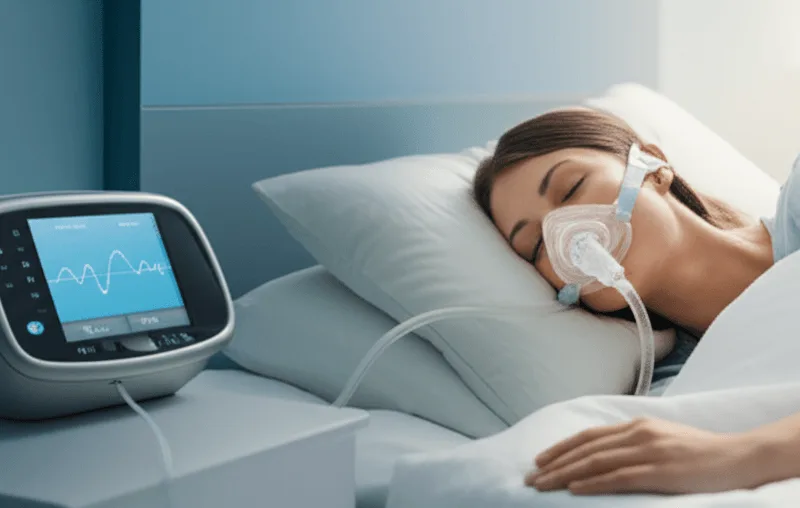
For some people, sleep is a very disturbing and frightening experience. During sleep, breathing suddenly stops, and then after a while, they breathe heavily again. We call this condition ' sleep apnea '. You may have heard of the CPAP machine used as a treatment for this. But today we are going to talk about a machine that works a little differently, and in a much 'smarter' way. That is the ASV machine. This name may be new to you, but it can be the best solution for some complex sleep breathing problems.
What is an ASV machine?
Simply put, ASV ( Adaptive-servo ventilation ) is a special machine used to treat breathing problems during sleep. Like a CPAP machine, this is a device that requires you to sleep wearing a mask connected to a tube. It works by delivering pressurized air to keep your airway open.
But here's the thing. The ASV machine is a very 'smart' machine. It doesn't just pump air continuously. Instead, it uses special sensors to continuously measure your breathing pattern. The machine understands everything from how you breathe, when you stop breathing, and how fast you breathe. Then, it delivers only the pressure you need at that moment, as needed. This means it's an adaptive machine that adapts to your body.
How is ASV different from CPAP?
Although the basic purpose of both these machines is the same, the way they work is very different. To understand this difference, see the table below.
| Characteristic | CPAP (Continuous Positive Airway Pressure) Machine | ASV (Adaptive-servo ventilation) machine |
|---|---|---|
| How to give air pressure | The doctor will continue to provide the same constant pressure as prescribed. | Depending on your breathing pattern, the pressure is changed to the required amount at the required time (variable pressure). |
| Functionality | The airway is forced open. Even when exhaling, you have to work against this pressure. | Breathing is monitored and pressure is applied only if breathing stops or becomes shallow. Intervention is minimal during normal breathing. |
| Mainly used | Often referred to as `Obstructive Sleep Apnea (OSA)` (a condition caused by obstruction of the airway). | Mainly for a condition called `Central Sleep Apnea (CSA)` and some complex sleep apnea conditions. |
What is Central Sleep Apnea (CSA)? How can ASV help?
There are two types of sleep apnea. One is ``Obstructive Sleep Apnea (OSA),'' which is caused by the muscles in the throat contracting and blocking the airway. It is the most common type.
But `Central Sleep Apnea (CSA)` is something different. In this case, there is no problem in your lungs or throat. The problem is in your brain! Our breathing is controlled by messages from the brain. In CSA, the brain does not send the message to the body to breathe properly. Therefore, breathing stops for a while during sleep.
Things that can cause CSA:
- Heart disease : Especially conditions like `Congestive Heart Failure` or ` Atrial Fibrillation (Afib)`.
- Some medications: Opioid drugs used as painkillers .
- Age: This risk is higher for people over 60 years of age.
- Nervous system diseases : Conditions such as stroke.
- Living at high altitudes: Living or traveling at altitudes higher than 8,500 feet above sea level can cause low blood oxygen levels (`Hypoxia`).
A CPAP machine may not work for someone with CSA, because the problem is not a blocked airway. The ASV machine is designed for exactly this type of situation. When breathing stops without a message from the brain, the ASV recognizes it and provides the necessary pressure to help breathe.
What are the benefits and risks of an ASV machine?
Some advantages:
- Very effective: This is a very effective treatment for the condition `Central Sleep Apnea`.
- More comfortable: Because there is no constant air pressure, this is easier for many people to use than a CPAP. It feels more natural for many people because they don't have to push against a lot of pressure when exhaling.
- Personalization: This is a treatment that is specific to your body.
Special risks to be aware of:
Very important: If you have a heart condition called `Congestive Heart Failure` , some studies have shown that there may be some risks associated with using an ASV machine. Therefore, if you have such a condition, you should definitely discuss it with your doctor before using an ASV machine and make a decision based solely on his or her advice.
Things you need to know from your doctor before using this machine
If your doctor recommends an ASV machine for you, ask these questions and resolve any concerns you may have before starting it.
- "Doctor, can I see my breathing data on this machine? What do I need to know from it?"
- “Is there anything special I should know about the pressure settings on this?”
- "Can you explain a little bit about how the sensors work?"
- “If I have used a CPAP before, will it feel different when using this one?”
Remember, never be afraid to ask your doctor any questions you have. It is very important that you have a good understanding of your treatment.
Take-Home Message
- The ASV machine is an 'intelligent' device that treats breathing problems during sleep, especially the condition `Central Sleep Apnea (CSA) .'
- It doesn't pump air continuously like a CPAP machine. Instead, it adapts to your breathing pattern and only helps when needed.
- Because of this, some people find it easier to use than a CPAP.
- Very important: If you have a heart condition such as Congestive Heart Failure , be sure to talk to your doctor before using an ASV machine.
- This is not a one-size-fits-all treatment. Your doctor will determine the best treatment for you after a medical examination. It is very important to follow his or her instructions.


💬 Comments (0)
No comments have been posted yet. Add your comment here for the first time.
Add your comment