
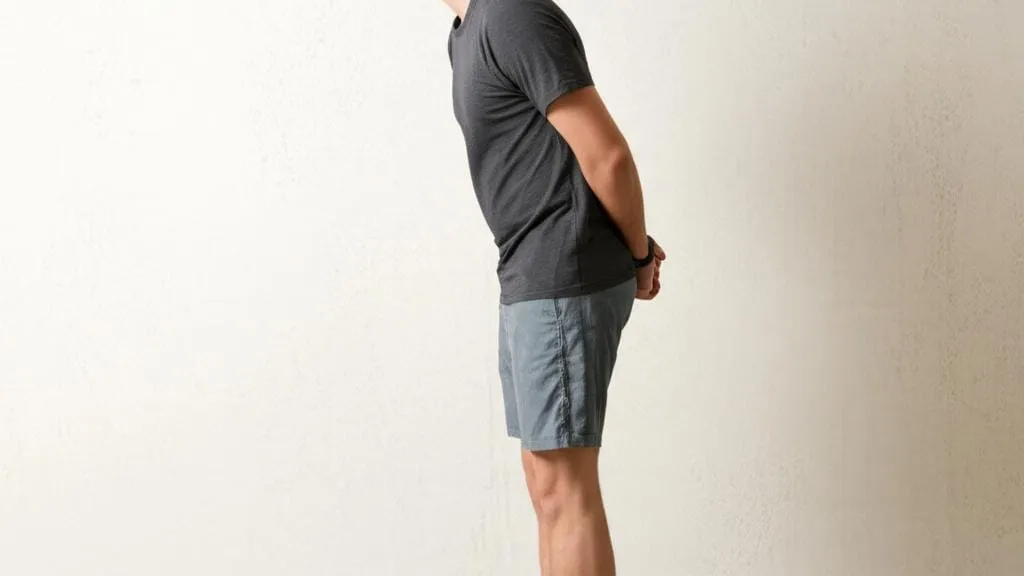
Do you sometimes feel like your lower back is arched unnecessarily, making your stomach appear to be protruding? Perhaps this is why you often get back pain. This is what we medically call hyperlordosis. But don't worry, this is usually not a serious condition. It can be corrected with proper posture and simple exercises . Let's talk about this in detail.
What is Hyperlordosis?
Simply put, Hyperlordosis is a condition in which the lower part of our spine, the lumbar region, curves inward more than normal. Our spines naturally have a slight curve. It helps the spine to be flexible and support weight. But when this curve becomes excessive, problems begin.
Think of it like a tug-of-war. The main cause of this condition is muscle imbalance . That is, when the muscles in the front of our body (the abdomen and front of the thighs) are tight and contracted, the muscles in the back (the back and buttocks) become weak. This causes the spine to curve inward and the stomach to protrude forward. This can be caused by poor posture, sitting for too long, and some muscle weakness.
This condition can cause back pain , a risk of spinal damage, and even difficulty walking. But the best part is that this muscle imbalance can be corrected with the right exercises.
What exercises can reduce hyperlordosis?
Our main goal here is to strengthen weak muscles (abdominals, buttocks) and stretch and loosen tight muscles (lower back, front of thighs). If you add these exercises to your daily routine, you will feel the difference.
1. Identifying the correct posture
It's important to maintain good posture throughout the day, not just during exercise. Try this to get into the habit.
- Step 1: Sit in a straight chair. Sit with your buttocks touching the back of the chair. Place both feet on the floor, and distribute your weight evenly across your hips.
- Step 2: Stand as straight as possible, as if you are going to touch the ceiling with your head.
- Step 3: Now relax a little and let your lower and middle back rest on the chair.
This will give you a good understanding of how to stand straight without arching your back. Practice this several times a day. Try to stand straight like this even when you are standing.
2. Kneeling Back Stretch
This is a great exercise to relax tight muscles in the lower back.
- Step 1: Kneel on the floor and place your hands on the floor at shoulder width.
- Step 2: Curve your entire spine upward, lower your buttocks to the floor, and hold for 5 seconds.
- Step 3: Slowly lean back, bringing your buttocks as close to your heels as possible. Keep your hands where they were, and gently lower your head. Hold this position for 5 seconds.
Do this about 10 times a day.
3. Knee to Chest Stretch
Stretching the hamstrings and buttocks muscles increases support for the back.
- Step 1: Lie on the floor with your legs spread wide.
- Step 2: Bend one leg, grab the bottom of the knee with both hands, and slowly pull it toward your chest. You will feel a stretch in your lower back and buttocks. Hold for 5-10 seconds.
- Step 3: Do the same with the other leg. Then bend both legs at the same time.
Do it 10 times at a time, 3 times a day.
4. Plank exercise (Plank)
This may seem a little difficult, but it's one of the best exercises to strengthen the core muscles of the entire body.
- Step 1: Lie facedown on the floor. Raise your body up on your forearms so that your elbows are under your shoulders.
- Step 2: Tighten your abdominal muscles and lift your hips off the floor. Try to keep your entire body in a straight line from your ankles to your shoulders. If your hips feel like they're going down, try to lift them up.
- Step 3: Hold this position for 30 seconds or as long as you can.
At first, you can do it for about 10 seconds, but that's enough. Gradually increase the time. Do it about 5 times a day.
5. Dead Bug Exercise
Although the name may sound a bit strange, this is a great exercise to strengthen your abdominal muscles without putting any pressure on your back.
- Step 1: Lie on the floor. Keep your lower back pressed to the floor. If there is any tightness in your shoulders, release it.
- Step 2: Raise both arms straight up. Keep your elbows straight.
- Step 3: Lift both legs and bend them at a 90-degree angle so that your knees are over your hips.
- Step 4: As you exhale, lower your right arm and left leg. But don't touch the ground.
- Step 5: As you inhale, return to the starting position. Now do the same on the other side (left arm and right leg).
This is a bit complicated, so do it slowly at first. Start with 5 repetitions on each side. Once you can do it properly without lifting your back off the floor, increase the number of repetitions to 10.
Things to keep in mind when doing this exercise
As with any exercise, it's important to start slowly . At first, you may only be able to do a few reps, or you may not be able to bend your body properly. That's okay. Gradually build up over time. These exercises are designed to reduce back pain, not increase it. If you feel any pain or discomfort, stop the exercise or reduce the number of reps.
| Status | What to do |
|---|---|
| If the pain increases after exercise | First, stop exercising and rest. Applying an ice pack to the area of pain may help. If the pain persists, see your doctor. |
| If you are unable to fully straighten your spine or if your spine feels "stuck" | This could be something more than just a posture issue. If you experience pain when trying to straighten your back, see your doctor immediately for advice. |
💡 Take-Home Message
- Hyperlordosis is an excessive inward curvature of the lower back. The main cause of this is muscle imbalance.
- This condition can often be controlled with the right exercises. The goal should be to strengthen weak abdominal and buttock muscles and stretch tight back and thigh muscles.
- When starting to exercise, start slowly and gradually increase the frequency and intensity. Stop exercising if you feel pain.
- If your pain is severe, persistent, or if you are unable to straighten your back, do not assume anything and definitely see a doctor for advice.






Janiw kuna arsuwinakas jichhakamax uñt’ayatäkiti. Aka chiqanx amuyt’awim jan ukax jiskt’awim yapxatañamawa.