
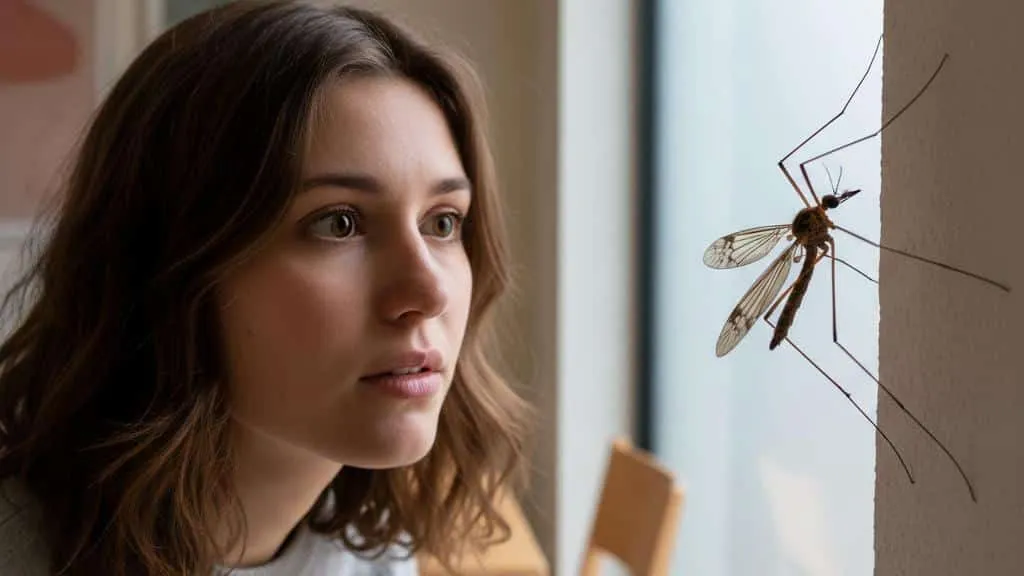
Have you ever seen a strange creature that comes into your house when you turn on the lights in the evening, or if you open a window at night? It's like a giant mosquito, with long legs, and it seems like it can't fly, but it's crawling on the walls. When you see this creature, some people feel a little scared, thinking, "Oh, this big mosquito must be poisonous." But who is this creature really? Is it dangerous? Today, let's talk about this creature called the Crane Fly.
Who is this Crane Fly?
Simply put, the Crane Fly is a long-legged fly belonging to the insect family Tipulidae. Although it looks like a giant mosquito, this animal is not a mosquito . Not only in our country, but in many countries of the world, there are these animals.
Some people also call these animals "mosquito hawks". This is because of the myth that these animals eat mosquitoes. But the truth is, most crane flies do not eat mosquitoes . That's just a myth.
The life cycle of these animals is very simple. They lay eggs near water. These eggs hatch into larvae. These larvae are called "leatherjackets." These larvae live in the soil for a while, and later develop into the long-legged Crane Fly that we see.
What do these animals look like?
It's very easy to tell a Crane Fly from a mosquito. Let's see how.
| Characteristic | Crane Fly | Mosquito |
|---|---|---|
| Size | Usually very large. Has long legs. | Very small. |
| Mouth | It has a mouth like a trunk. There is no piercing part. | It has a sharp, needle-like mouth (proboscis) that can pierce. |
| Wings | It only has one set of wings, so it's weak at flying and it crashes into walls. | It can fly well. It has scales on its wings. |
| Behavior | They don't bite people. They are attracted to light. | They bite humans and animals to suck blood. |
The larvae of these animals (leatherjackets) are gray or brown. They have no legs and no distinct head. They are the ones who damage your lawn. They sit in the soil and eat the roots and leaves of the grass.
Are these animals really dangerous? Are they harmful to us?
Here's the most important thing: Crane flies are not dangerous to humans at all.
Remember, these animals will not bite or sting you. They do not have a mouth that can do that. Also, they do not transmit any diseases to humans.
So why are we talking about this?
The main thing is that these animals can be annoying. They can be a nuisance when they come into your home at night and fly around. In addition, their larvae can damage your lawn. The grass can die and turn brown.
But the real health risk here doesn't come from these animals. It comes from the insecticides we use to kill them.
The chemicals used to kill larvae in the garden can be very dangerous. You should be very careful about this, especially if you have small children or pets in your home. If these chemicals are ingested, it can be toxic.
Therefore, if someone, especially a child, accidentally ingests such a pesticide, immediately take them to the nearest hospital Emergency Department (ETU). You can also contact the National Poisons Information Centre at the Colombo National Hospital for advice. If you are in any doubt, talk to your family doctor.
How do you control these animals?
The best way to control these creatures is to maintain your garden properly. Using chemicals should only be done as a last resort.
| Method | What to do |
|---|---|
| Soapy water test | First, you need to check your garden for a lot of grubs. Make some hot, soapy water and pour it on dead grass. The grubs will come to the surface. If there are more than 15 grubs per square foot, you have an infestation. |
| Grass cutting | Maintain the grass to a height of about 3-4 inches. When there is a thick layer of grass, other insects that control these larvae will breed in that environment. |
| Keeping the soil dry | These larvae prefer moist soil, so reduce watering your garden. Especially during the spring, reducing watering will help control the larvae. |
| Biological control (Nematodes) | Nematodes are parasitic worms that feed on these larvae. Adding species such as Steinernema feltiae to the garden can help control the larvae naturally. |
| Pesticides (last resort) | Only use a pesticide under the advice of a qualified professional if all else fails. Keep it away from children and pets when using it. Protect your skin and eyes. |
Stop adult animals from entering the house, install screens on windows and doors, and seal any holes in the house.
💡 Take-Home Message
- The Crane Fly looks like a giant mosquito, but it is a harmless and non-venomous insect to humans.
- These animals will neither bite you nor spread disease.
- The real health risk lies in the pesticide chemicals used to control these animals. Keep them very safe from children and pets.
- By maintaining the garden well, you can control the larvae of these animals.
- If you have any health concerns related to this or pesticides, consult your doctor immediately.






Janiw kuna arsuwinakas jichhakamax uñt’ayatäkiti. Aka chiqanx amuyt’awim jan ukax jiskt’awim yapxatañamawa.