
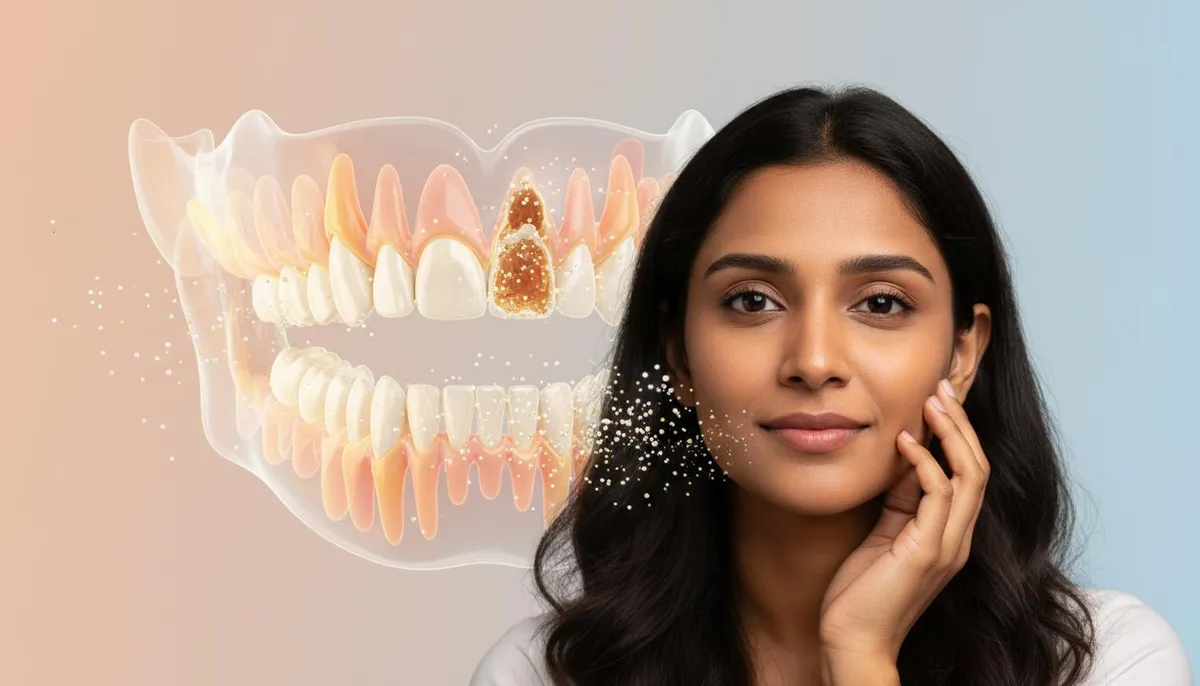
Have you ever had a tooth pulled out? Or do you feel like your teeth are moving a little due to gum disease? In such cases, what happens to us without us realizing is that the jaw bone gradually dissolves and wears away. Just like when a tree is cut down, the soil around it is washed away over time. So, if you try to implant a new tooth on top of such dissolved jaw bone, it will not be successful. That is when we need what is called 'Dental Bone Graft'.
Simply put, what is Dental Bone Graft?
This is actually a very simple thing. Imagine you are going to build a house, but the ground you are building it on is very weak and loose. What do you do then? Before laying the foundation, you compact the ground well, and if necessary, strengthen it by adding soil and stones, right? That's what happens here too.
Dental Bone Graft is a dental procedure. In this procedure, your dentist will inject a special bone grafting material into the areas of thin, eroded bone in your jawbone to help it grow back. This is like creating a scaffold for the bone to grow on. Your own bone cells can then grow on top of that scaffolding and form new, strong bone.
What types of bones are used for this?
Various types of bone grafting materials are used for this purpose. They can be mainly divided into four types.
| Graft Type | Description |
|---|---|
| Autograft | A small piece of bone taken from another part of your own body (for example, from the hip or chin). This is the most successful method. |
| Allograft | Bones from a human donor that have been specially cleaned and prepared. These are obtained from licensed donor banks. |
| Xenograft | Materials obtained from animal (cow or pig) bones, cleaned and sterilized. These are also obtained from licensed institutions. |
| Alloplast | Bone substitutes that are artificially created in the laboratory. An example is hydroxyapatite. |
In what cases is a bone graft needed?
There are several situations in which this surgery may be necessary.
- Before Dental Implants: To get a tooth implant, you need to have strong jawbone to hold it in place. If the bone has eroded, you will first need to do a bone graft to build that foundation.
- After a tooth is extracted: When a bone graft is placed in the space left by a tooth being extracted, the bone in that area stops dissolving.
- Gum Disease: Severe gum disease can damage the jawbone. This is used to repair that damage.
- Before placing dentures: For dentures to fit properly, they need a good foundation. If the bone has worn away, a bone graft is used to rebuild it.
- Accidental injuries: This method is also used to repair broken bones when the jaw is damaged in an accident.
- To stabilize loose teeth: Teeth that are loose due to bone loss can be stabilized by placing a bone graft around them.
How is the surgery performed?
This is not a major, scary surgery. It can usually be completed in about an hour.
1. Numbness: First, your dentist will inject a local anesthetic into the area. This will prevent you from feeling any pain. Sometimes, at your request, you may be put to sleep (sedated).
2. Gum incision: Next, a very small incision is made in the gum, exposing the bone.
3. Cleaning: The area is thoroughly cleaned and disinfected.
4. Bone grafting: Then, the previously mentioned bone powder (grafting material) is placed in the areas where the bone has dissolved and filled in well.
5. Covering: To prevent the bone powder from coming out, it is covered with a special membrane. There are two types of membranes. Some dissolve over time, while others need to be removed by a doctor after a few days.
6. Suturing: Finally, the gum is brought back to its original position and closed with a dissolvable suture.
In some cases, a substance called platelet-rich plasma (PRP), made from your own blood, is added to speed up the healing process.
Is this very painful?
Many people say that this is not very painful. There may be a little discomfort and swelling for two to three days after the surgery. It is okay to take the painkillers that the doctor gives you. If you follow the instructions exactly, you will not have any problems.
Are there any side effects or risks?
This is a largely safe surgery , but like any surgery, there are some minor risks.
- Infection
- Excessive bleeding
- Nerve damage
- Complications of anesthetic drugs
But the chances of this happening are very low. For a few days after surgery, small pieces of bone, like grains of sand, may come out of the bone graft site. This is normal and should not be alarmed. However, if a large amount comes out, inform your doctor.
Things to consider during recovery
Your commitment is also very important to the success of the surgery. Here are some things you need to remember.
| Do's | Don'ts |
|---|---|
| Place ice on the outside of your cheek to reduce swelling. | Avoid smoking or vaping completely. |
| Eat soft foods like porridge and yogurt for the first few days. | Do not drink alcohol for two weeks. |
| When you sleep, sleep with your head slightly elevated. | Don't forcefully spit or rinse your mouth. |
| Take the medicine prescribed by the doctor exactly on time. | Avoid heavy lifting and exercise for 2-3 days. |
| Keep the surgical site clean. | Do not touch the surgical site unnecessarily with your tongue or fingers. |
When you need to call the doctor immediately
Usually, there is no problem. However, if you have the following symptoms, talk to your doctor without delay.
- Fever over 38.3 degrees Celsius (101 Fahrenheit).
- If the pain or swelling continues to increase after the first week.
- If there is pus-like fluid coming from the surgical site.
- The pain is unbearable.
💡 Take-Home Message
- Dental Bone Graft is nothing to be afraid of. It is a very common and safe surgery.
- This is done to provide the jawbone with the strong foundation needed to place dental implants and artificial teeth.
- Minor discomfort after surgery is normal. By following the doctor's instructions exactly, you can recover quickly.
- Completely avoid smoking and alcohol consumption during your recovery. This is essential for the success of the surgery.
- If you experience any symptoms such as severe pain, fever, or pus, contact your dentist immediately.






Janiw kuna arsuwinakas jichhakamax uñt’ayatäkiti. Aka chiqanx amuyt’awim jan ukax jiskt’awim yapxatañamawa.