
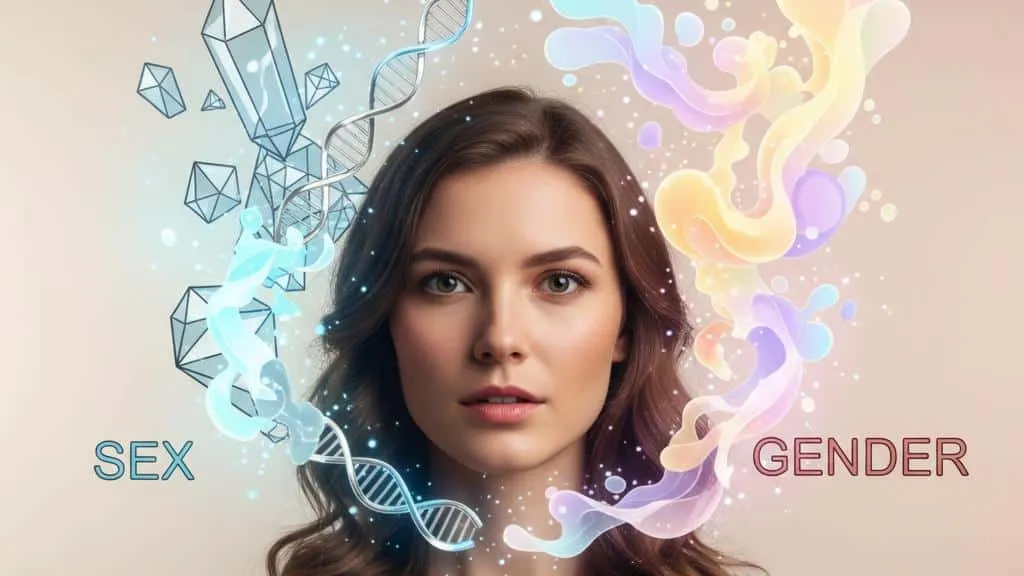
Sex and Gender. Many people get a little confused when they hear these two words, don't they? Some people think that they are the same thing. Others are even a little afraid to talk about it. This is actually a very complex and very important topic. All three of these concepts, that is, Sex, Gender and Sexual Orientation, are important in understanding who you are. So today, let's untangle this confusion and talk about it very simply, as if two friends were talking.
Let's first see what 'Sex' (biological sex) means.
Simply put, sex is the biological characteristics that we have at birth . Doctors decide whether a baby is a "girl" or a "boy" based on this sex. This is determined by three main factors.
- Chromosomes: These are tiny things inside our cells. They contain all of our genetic information (DNA). There is a special pair of these chromosomes called 'sex chromosomes'. A female usually has two X chromosomes (XX), while a male has one X and one Y (XY).
- Gonads: These are the main organs involved in reproduction. Females have ovaries and males have testes. These glands secrete hormones needed for reproduction.
- Anatomy: When a child grows in the womb, the sex is determined by the way the external genitalia develop. These are primary characteristics. In addition, secondary characteristics such as breasts, body shape, and beards also belong to this category.
What are the main types of sex?
The characteristics we discussed above are not the same for everyone. Sometimes there can be slight differences. Therefore, medically, three main types of sex are identified at birth. Let's look at this in order to understand this clearly.
| Category | Commonly seen symptoms |
|---|---|
| Female |
|
| Male |
|
| Intersex | This describes a wide range of people who do not fit 100% exactly into either of the above boxes of male or female. They are born with or naturally develop characteristics that are not specific to either male or female. These differences can be in the chromosomes, external genitalia, or reproductive system. |
This shows us that sex is not a black and white thing, but that there is diversity in it.
Sex is not sexuality!
When talking about sex and gender, another word comes along and makes things even more confusing. That's sexuality. But it's not as complicated as you might think.
Sexuality is who you are romantically or sexually attracted to. It is related to your feelings, relationships, and identity. The important thing is that your sexual orientation is not determined by your biological sex. For example, a biologically male person may be attracted to another male. That is a completely different thing.
Here are some words that describe sexual orientation:
- Gay
- Lesbian
- Bisexual
- Pansexual
- Queer
Okay, so what is 'Gender'?
This is where many people get stuck. Gender is not a biological thing. It is a social and cultural thing. That is, what you feel inside and how you express it to society. It is not determined by the sex you were born with. Let's break this down.
Gender Roles
In every society and culture, there are certain expectations that "women should be like this" and "men should be like this." There are certain opinions in society about how to dress, how to speak, what jobs to do, and how to behave. These are called Gender Roles. These vary from country to country and from culture to culture.
Gender Identity
This is the most important part of gender. Gender Identity is your inner sense of who you are. Regardless of your sex, your identity is whether you are a woman, a man, or neither.
- Cisgender: This refers to people whose biological sex at birth and their gender identity match. For example, someone who was born female but identifies as a woman is cisgender.
- Transgender: This refers to people whose biological sex assigned at birth and their gender identity do not match. For example, if a person was born male but feels and identifies as a woman, that person is transgender.
- Non-binary: This refers to people who feel their gender identity does not fit neatly into either the "female" or "male" boxes. This is also a broad term that encompasses a wide range of identities.
Gender Expression
This is how you present your gender identity to the world. That means things like the clothes you wear, the hairstyle you wear, the way you act, the way you speak. A person's expression can be masculine, feminine, or a combination of both (androgynous). This varies greatly from person to person.
💡 Take-Home Message
- Sex is the biological characteristics (color, body parts) that are given at birth.
- Gender is what you feel inside and your identity that you express to society. It is both social and personal.
- Sexuality is who you are romantically or sexually attracted to.
- These three concepts are distinct and independent of each other. One does not determine the other.
- It is very important to respect the identities of others and try to understand them.
- If you feel any confusion, questions, or stress about these matters, don't be afraid to talk about it with a trusted adult, friend, or your doctor .






Janiw kuna arsuwinakas jichhakamax uñt’ayatäkiti. Aka chiqanx amuyt’awim jan ukax jiskt’awim yapxatañamawa.