
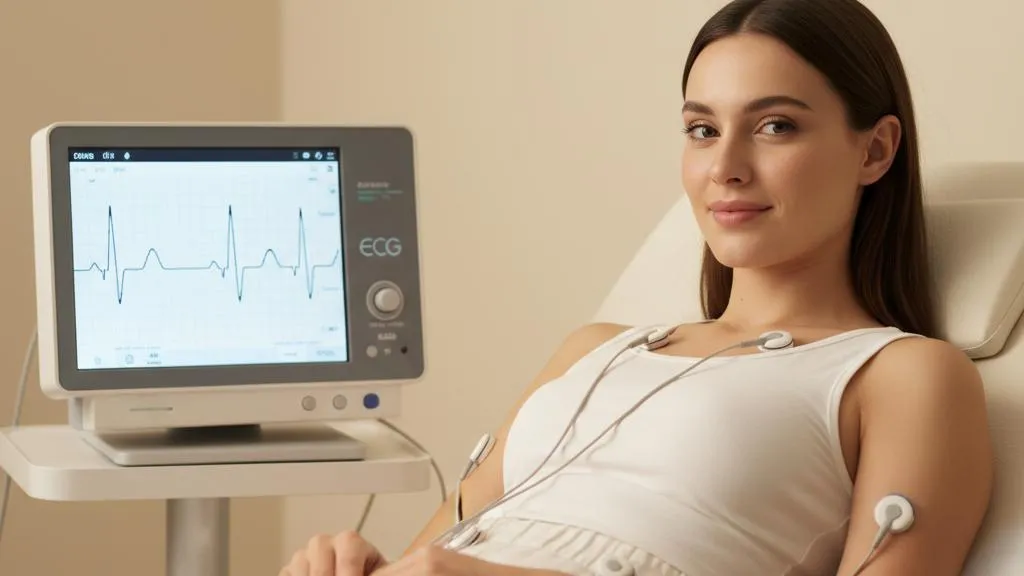
Did you feel a little scared when your doctor told you to get an ECG? You might have thought, "Oh, I wonder if there's something wrong with my chest." But an ECG is actually not something to be afraid of. It's a very simple test that can be done in a few minutes and is completely painless. So, today we'll talk briefly about what an ECG is, what it says, and how to prepare for it.
Simply put, what is an ECG?
An ECG, or electrocardiogram, is a test that records the electrical activity of your heart. Think of your heart as a small motor. It uses small electrical signals to do its job. What an ECG machine does is, like an antenna, it picks up these electrical signals from your heart and displays them as a picture on paper or a computer screen.
This test is very quick, does not cause any harm to the body, and is not painful. You can have it done while lying in bed. Sometimes an ECG is also taken as part of a Stress Test during exercise.
You may have heard the words ECG and EKG. These are both names for the same test. ECG is an English word. EKG is a German word. So there is no difference between the two.
Also, remember, an ECG is different from an Echocardiogram. An Echocardiogram is an Ultrasound Scan of the heart. It allows you to see pictures of the heart beating.
How many types of ECG are there?
Yes. Doctors use different types of ECG devices depending on how long they need to monitor your heart rhythm. Some heart rhythm problems develop over time. At times like these, a regular ECG may not pick them up. That's why there are different types.
| ECG type | A simple explanation |
|---|---|
| Standard 12-lead ECG | This is what we usually get in a doctor's office or hospital. It's done in a few minutes. It's not a device you take home. |
| Holter Monitor | This is a small device. You have to wear it for 24 or 48 hours. It is used to continuously record your heart rhythm as you go about your daily activities. |
| Event Monitor | This is also a wearable device. But for a week or more. As soon as you feel symptoms (e.g., a pounding in your chest), you can press a button and record your heart rhythm at that time. |
| Implanted Loop Recorder | This is a very small device. It is implanted under the skin of your chest with a minor surgery. It can monitor your heart rhythm for several years. |
| Stress Test ECG | This ECG is taken to see how your heart responds when you walk on a treadmill, that is, when you exercise. |
When does a doctor order an ECG?
Your doctor uses an ECG for a variety of reasons. Perhaps to diagnose a disease or to see how well a treatment is working.
Conditions that can be diagnosed with an ECG
- Heart rhythm disorders (Arrhythmia): A fast, slow , or irregular heartbeat.
- Reduced blood flow to the heart muscle (Ischemia): This condition can occur due to blockage of the arteries that supply blood to the heart.
- Heart attack: Identify a current or past heart attack.
- Heart valve issues
- Congenital heart disease
- Enlarged heart chambers
- Heart muscle damage or heart failure
Symptoms that may prompt an ECG
If you have the following symptoms, your doctor may suggest an ECG.
| Symptom | Description |
|---|---|
| Chest pain | It can be a major symptom of a heart problem. |
| Difficulty breathing | Shortness of breath, especially when you are tired. |
| Dizziness or fainting (Syncope) | A problem with the functioning of the heart may cause a decrease in blood supply to the brain. |
| Feeling like your heart is beating fast | Chest pain, feeling like your heart is racing. |
| Feeling unusually tired | Feeling extremely tired even after doing a small task. |
How do you prepare before an ECG?
There is no special preparation required for an ECG. You can eat and drink normally. However, it is a good idea to keep these things in mind:
- Do not apply oily creams: Do not apply oily creams or lotions to your body, especially your chest, on the day of your ECG. Doing so will prevent the electrodes (sensors) from contacting your skin properly.
- Take care of your clothing: Wear clothing that is easy to remove and that makes it easy to attach the electrodes to your chest, arms, and legs.
- Avoid socks that cover the entire leg: This can interfere with the electrodes being attached to the leg.
What actually happens when an ECG is taken?
Okay, now let's see what actually happens when you take an ECG. It's a very simple process.
1. First, you will be made to lie down on a bed.
2. Then a medical assistant or nurse will attach about 12 small, sticky patch-like electrodes to the skin of your chest, arms, and legs.
3. Sometimes, if it interferes with the electrodes sticking well, you may need to remove some of the hair in those areas.
4. The wires connected to these electrodes are connected to the ECG machine.
5. Then you will be told to remain still, without moving, and breathe normally.
6. When the test begins, the machine records your heart's electrical activity for a short period of time, about 10 seconds.
7. The entire process, from applying the electrodes, recording, and removing them, takes no more than 10 minutes.
The most important thing is that you will not feel any pain or electric shock during this test. The machine only receives electrical signals from your body, it does not send anything to your body.
When the test is over, the electrode patches will be carefully removed. You can then continue with your normal activities.
What does the ECG report say?
The ECG report is read by a doctor. It is a wavy line graph. The different waves ) in the graph represent different stages of the heart's activity.
- "P wave" (P wave): This shows how the two upper chambers of the heart (atria) begin to contract.
- "QRS complex" (QRS complex): This is the largest spike-shaped part of the ECG. It shows when the two powerful chambers (cells) at the bottom of the heart contract and pump blood around the body.
- "T wave" (T wave): This shows how the lower chambers of the heart return to their resting state, that is, how they prepare for the next beat.
The doctor examines the shape, height, and time intervals of these waves. In a normal ECG, these wave patterns repeat in the same rhythm and order. If there is any abnormality in this pattern, it can indicate a problem with the heart.
Are there any risks in this test?
No. An ECG is a very low-risk, safe test.
- Radiation is not used in this.
- No electricity is being injected into your body.
- The only minor discomfort that may occur is that after removing the electrode patches, the areas may become a little red and itchy. This will go away after a while.
How long does it take to know the results?
This depends on the reason you had the ECG. If you went to an emergency room (ETU), the doctor will review the report and tell you the details right away. However, if it was done in a general clinic or with other tests, it may take a few days to get the results. The doctor may also compare the new report with your old ECG records.
💡 Take-Home Message
- An ECG is a very simple, painless, and safe test that measures the electrical activity of your heart.
- This helps diagnose heart rhythm problems, heart attacks, and many other heart diseases.
- There is no special preparation required for an ECG, but it is important to avoid applying oily creams.
- You won't feel anything during the test. The entire process only takes a few minutes.
- Always talk to your doctor about the results of your ECG report and any action you need to take. Don't be afraid to ask any questions you may have.





Janiw kuna arsuwinakas jichhakamax uñt’ayatäkiti. Aka chiqanx amuyt’awim jan ukax jiskt’awim yapxatañamawa.