
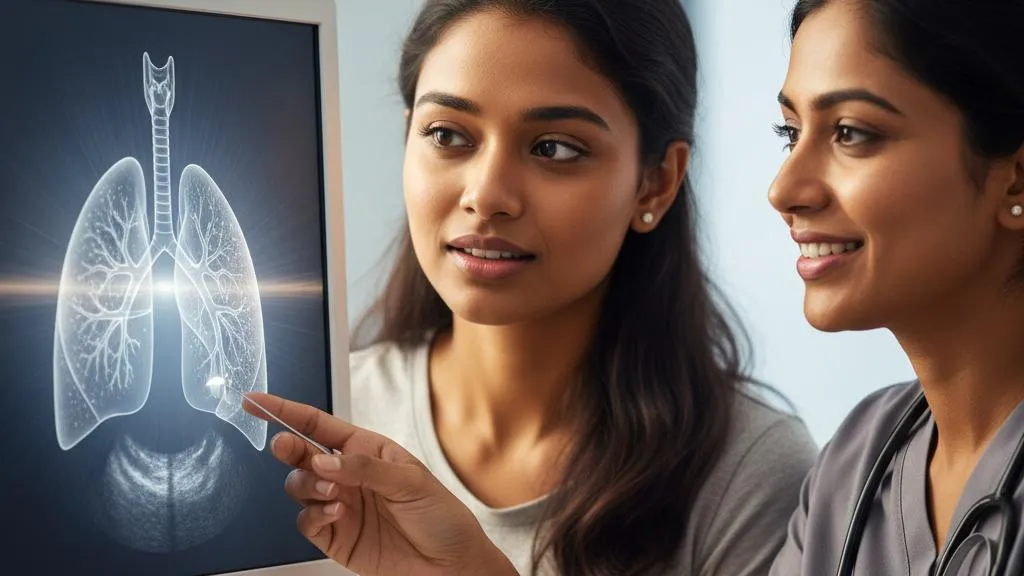
After looking at your X-ray or CT scan, did your doctor tell you to have an EBUS test? You might be a little scared when you hear the name. "What is EBUS? Do they put something in your lungs? Will it hurt?" You probably have a lot of questions in your mind. Don't worry. Today we will talk about this EBUS test in a very simple way, in language that you can understand.
Simply put, what is EBUS?
Imagine that the doctor wants to take a closer look at a small problem inside your lungs. EBUS (Endobronchial Ultrasound) is a very advanced test that is done at such times. In this, a very thin tube with a light and a small camera at the front (we call this a bronchoscope) is passed into the lungs.
But the special thing about this is that in addition to the camera, there is also a small ultrasound scanner attached to the end of the tube. Just like the ultrasound scan that looks at a baby in the womb, this small machine can see the tissues and lymph nodes inside and around the lungs very clearly. This means that the doctor can sit inside the lungs and take pictures of the inside.
Simply put, EBUS is an advanced method that combines ultrasound technology with a camera inserted into the lungs (bronchoscopy) to make more accurate diagnoses.
What are the main types of EBUS tests?
There are several main types of EBUS tests. Your doctor will decide which type is best for you based on your medical condition.
| EBUS type | Description |
|---|---|
| Radial probe EBUS (Radial probe EBUS - RP-EBUS) | This can go deep into the lungs, down to the thin airways. It provides a very clear 360-degree view. However, if you want to take a tissue sample (biopsy) with this method, you have to use a separate device for that. |
| Convex probe EBUS (CP-EBUS) | This is used to examine large airways such as the main airways (trachea and bronchi). The biggest advantage of this is that a tissue sample can be taken during the examination, if necessary. |
| EBUS-TBNA | This is not a separate type. This refers to the method of obtaining a tissue or fluid sample (biopsy) using a thin needle during the CP-EBUS examination mentioned above. This is called EBUS-Transbronchial Needle Aspiration (TBNA). |
Why are you being asked to do an EBUS test?
A doctor will usually recommend an EBUS to further investigate something that was seen on an X-ray or CT scan. This test can mainly diagnose and confirm several diseases.
- To diagnose lung cancer and determine its stage.
- To diagnose problems in the space between the lungs (mediastinum).
- To identify lung infections and abscesses.
- To diagnose other inflammatory lung conditions such as Sarcoidosis and Silicosis.
- To check for conditions such as narrowing of the airways (stenosis).
- To check for small lumps in the lungs (pulmonary nodules).
How should I prepare for this test?
Your doctor will give you specific instructions before the test. Don't be afraid to ask if there's anything you're unsure about. You'll usually need to do the following:
- Do some blood tests before the test.
- Refrain from eating and drinking for a few hours before the test (fasting).
- Your doctor may tell you to stop taking certain medications (especially blood thinners) for a few days . Tell your doctor about all the medications you take, even vitamins.
- Most importantly: Since you will not be able to drive after the test, arrange for someone to drive you home in advance.
What happens during the test?
Although this may sound a little scary, it's actually something that's done very safely and without any discomfort.
Before the test
- You will be made to lie down on a bed and, if necessary, helped into the correct position.
- A small cannula ((IV)) is placed in a vein in your arm, through whichYou will be given sedation or general anesthesia to make you feel completely asleep. This will prevent you from feeling any pain.
- A numbing spray is applied to your mouth or nose. This will help reduce any discomfort you may feel when the tube is inserted.
During the test
After you are anesthetized and your mouth/throat is numb, the pulmonologist will carefully insert a bronchoscope through your mouth or nose and into your lungs. While watching the scan monitor, they will examine the area. If necessary, a small piece of tissue (biopsy) will be taken for examination. The entire procedure can take between 30 and 90 minutes. The tube will be carefully removed when the procedure is complete.
What can you expect after the test?
After the test, you will be kept under medical supervision for about an hour or two. Once you have regained consciousness and are sure that you are not having difficulty swallowing, you can go home.
Minor discomforts such as these may occur for a day or two after the test:
- A sore throat
- Hoarseness of voice
- A slight cough
Important: It is normal to cough up a small amount of blood after the test. This will go away within a few hours or a day. However, if the bleeding continues for several days or if there is a lot of bleeding, inform your doctor immediately.
What are the risks and benefits of this test?
EBUS is a very low-risk procedure. However, as with any medical procedure, there are some rare complications that can occur. However, the benefits of this procedure far outweigh them.
| Benefits | Risks - (rarely) |
|---|---|
| The ability to go anywhere inside the lungs and obtain very clear images. | Bleeding. |
| Being able to do the test and biopsy at the same time, without two separate procedures. | Infectious conditions. |
| Performing the procedure without making a large incision like surgery and with minimal impact on the body (minimally invasive). | Collapsed lung. |
| Being able to go home the same day without staying in the hospital (outpatient procedure). | Difficulty breathing. |
When should I see the doctor?
If you have any concerns or unusual symptoms, call your doctor. Seek medical advice immediately, especially if you have any of the following symptoms:
- Fever
- Chest pain
- Difficulty breathing
- Difficulty swallowing something
- Coughing up blood continuously
- Inability to urinate
💡 Take-Home Message
- EBUS is a very safe and advanced test used to diagnose lung diseases, especially conditions such as cancer.
- This test is performed under anesthesia, so you will not feel any pain.
- This is not surgery. The risk is very low because there is no major incision in the body.
- It is very important to follow your doctor's instructions exactly before and after the test.
- If you have any questions or concerns, talk to your doctor about them openly. It will be a great relief to know everything.



Janiw kuna arsuwinakas jichhakamax uñt’ayatäkiti. Aka chiqanx amuyt’awim jan ukax jiskt’awim yapxatañamawa.