
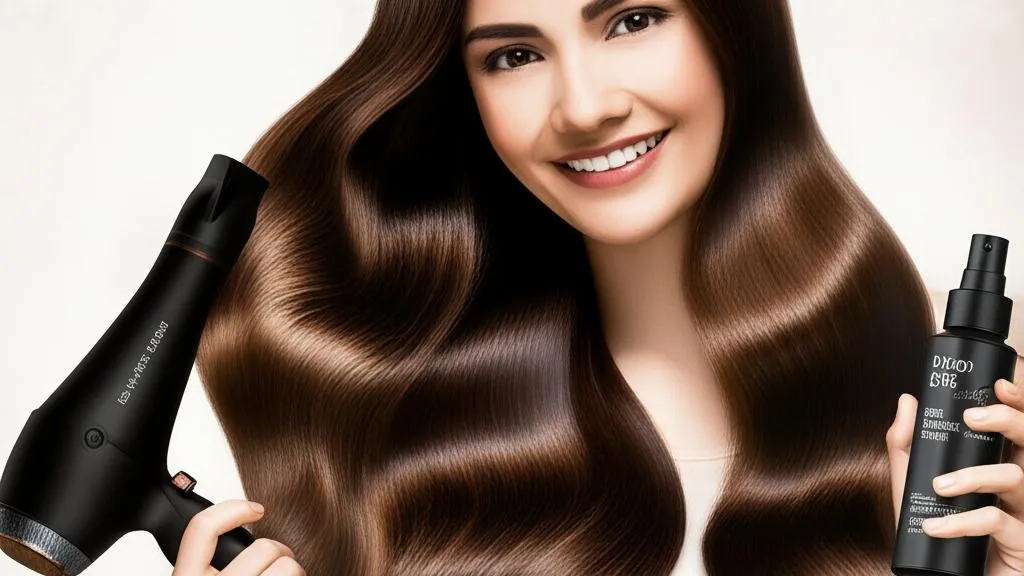
The blow dryer, flat iron, or curling iron you use to style your hair can be your best friend or your worst enemy. If you use these tools correctly, they can make your hair look beautiful. However, if you use them incorrectly, too much, or if you buy a cheap tool, they can end up damaging your hair, causing it to become brittle, dry, and unsightly. So today, let's talk about how to style your hair at home without damaging it, and how to restore damaged hair to its former glory.
First, let's choose some good equipment, shall we?
You don't have to spend a lot of money on hair styling tools, but there are a few basic features that you should definitely have.
The first thing is to choose a device that can be adjusted to different heat settings . Some cheaper devices have only one heat setting. It may or may not work for our hair. Therefore, it is very important to choose one that can increase or decrease the temperature.
Also, check to see if the temperature setting on the appliance you're buying is set to a specific temperature. Some flat irons have a temperature setting that can range from 175 to 400 degrees. But remember, temperatures as high as 400 degrees are not suitable for home use, except for professional use in a salon. Such extreme temperatures can cause serious damage to your hair.
If possible, it's best to buy a professional blow dryer from a good beauty supply store, as they have more air flow and power. Also, when choosing a dryer, choose one that has a nozzle attachment that can focus the air in one spot and a diffuser that helps distribute the heat evenly throughout your hair.
First understand the nature of your hair.
Before you choose the heat setting on your dryer or iron, you need to think about how thick your hair is.
The simplest rule is: the thinner the hair, the lower the temperature.
Think about it, someone with very fine, baby- like hair should use the lowest possible temperature. It's like ironing thin paper with a hot iron. It can burn quickly.
However, the flip side of that is not true either. Don't go for the maximum heat setting just because your hair is very thick. Even in salons, high temperatures are often used very sparingly.
Also, get used to working with your hair's natural texture. Don't try to go against it. For example, if your hair is naturally curly, styling it to look its best will reduce the damage to your hair, rather than trying to straighten it with a flat iron every day.
Protecting your hair from heat is essential.
There are heat protectant products that are designed to protect your hair from the heat from blow dryers, curling irons, and flat irons. These create a protective barrier around your hair. Many of these products contain ingredients like silicone .
Speaking of damage, irons (flat and curling) are more damaging to hair than blow dryers because the heat hits the hair directly.
To protect your hair while styling, you need to do the work quickly.
If you're using a flat iron , don't hold it on one section of hair for more than three to four seconds. That's plenty of time. Leaving it on longer than that will burn your hair.
What to do with damaged hair?
If your hair suddenly starts breaking, feels rough to the touch, is more frizzy than before, and you see split ends, it means your hair is damaged. What should you do now?
Don't worry. There are things you can do about that too.
| Treatment method | Description |
|---|---|
| Haircut | If your hair is split, the best and quickest solution is to cut off the damaged part and remove it. This will stop the damage from spreading further. |
| At-home treatments | Hair care products that contain oils and moisturizers are great for heat-damaged hair. If your hair is also damaged by chemicals like hair color, you can use hair repair products that contain protein to nourish the hair. |
| Professional help | If at-home treatments don't work, you can try something like a deep conditioning treatment at a salon. These work to fill in damaged areas, strengthen hair, and make it look smoother. |
| Being patient | This is the hardest part. Damaged hair cannot be repaired overnight. If your hair is only an inch long, it can take two to three months to get back to normal. So be patient and take care of it. |
Get help from your hair stylist.
This is also very important. Even if you've been doing your own hair for years, the next time you go to the salon, ask your hair stylist about their hair styling techniques . They may know new, easy ways that you don't. Make a separate appointment for this, or ask for a little extra time in advance.
Once your hair is healthy again, maintain it by using the right tools and trimming it regularly (every 4-6 weeks) . If the damage to your hair is severe, such as excessive hair breakage or scalp problems, it is best to consult a dermatologist .
💡 Take-Home Message
- Before styling your hair, always use a heat protectant spray .
- Choose a good device that suits your hair and has adjustable temperature .
- Understand your hair type and use the lowest temperature that suits it.
- When using a flat iron, don't hold your hair in one place for more than 3-4 seconds .
- Trimming the ends of your hair regularly (every 4-6 weeks) can help prevent split ends.
- Treat damaged hair with deep conditioning and nourishment.
- If your hair damage is severe or you have scalp problems, be sure to see your doctor or a dermatologist .





Janiw kuna arsuwinakas jichhakamax uñt’ayatäkiti. Aka chiqanx amuyt’awim jan ukax jiskt’awim yapxatañamawa.