
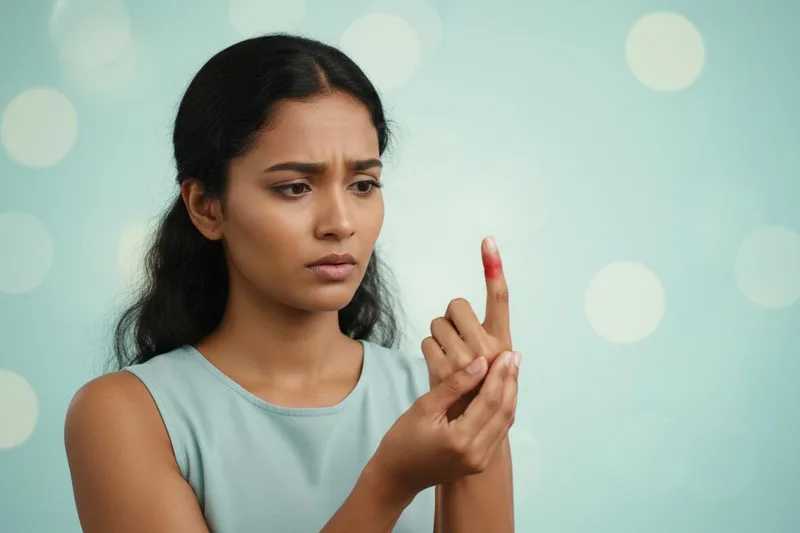
Did you suddenly get hit by a ball while playing? Or did you fall somewhere and get your hand stuck on the floor? Maybe you got your finger stuck in a door. It's very common for your finger to become stiff, swollen, and painful at times like this. We call this a 'Jammed Finger' or 'Sprained Finger'. While many people simply call it a "sprained finger," sometimes it can be more serious than you think. So, let's talk about this today.
What exactly is a jammed finger?
Simply put, a sprained finger is an injury to the soft tissues in your finger. Specifically, the ligaments that connect the bones of our fingers and provide strength to the joints are overstretched. Think of a rubber band. It can be pulled normally, but what happens if you suddenly pull it too hard or too far? It can tear and become damaged. The same thing happens to the ligaments in our fingers.
This type of injury can happen while playing sports, falling, or even doing normal work. While most of the time it can be treated at home, in some cases, medical treatment is required.
Are there levels of severity for this tightening?
Yes, absolutely. A doctor will examine your finger and grade it according to its severity. This will make treatment easier.
| Grade | Description |
|---|---|
| Grade 1 | There are some small tears in the ligaments. That means there's been a little stretching. But the joint is stable. That means there's very little room for the bones to move around. |
| Grade 2 | The ligament is torn in half. The joint is a little unstable. That means the bones can move around a little. |
| Grade 3 | This is the most serious case. The ligament is completely torn. The joint is very unstable. This means that the bones can easily move and slip. Sometimes this can even lead to a dislocation of the joint. |
What is the difference between a sprained finger and a broken finger?
Many people confuse the two because the symptoms of both are very similar. However, there is a clear difference between the two. A sprain is an injury to the soft tissues. A fracture is an injury to the bone. If a bone is broken, you should definitely seek medical attention immediately.
The most important thing is, if you're not sure about the difference between the two, think it could be a broken bone and go see a doctor immediately .
The table below makes the differences between the two more clear.
| Characteristic | Jammed Finger | Broken Finger |
|---|---|---|
| Pain | There is pain, but it is usually tolerable. | There may be very severe, unbearable pain . |
| Moving | It's difficult and painful to bend and unbend, but you can move it a little. | Often unable to move. |
| Shape | The swelling makes it look bigger, but the shape of the finger is normal. | The finger may become crooked, stretched, or take on an unnatural shape . |
| Other features | Swelling, redness, stiffness. | In addition to swelling, severe bruising (blackening) and numbness may occur. |
What causes this?
There are many reasons why a finger can become stuck. These things are very common in our daily lives.
- When playing sports: Hitting your finger, especially when trying to catch a ball. This often happens to people who play sports like cricket, volleyball, netball, and basketball.
- Falls: Falling and hitting your hand while walking or running.
- Bending the finger back too far: We call this `(Hyperextension)`.
- Getting stuck in a door or window: When closing a vehicle door or a house door, a finger can become trapped without realizing it.
- Workplace accidents: Can occur when working with machinery or lifting heavy objects.
- Accidents : This can happen in something like a car accident.
What treatments can be done at home? (RICE method)
If your finger is a mild sprain (Grade 1), and there is no severe pain, swelling, or deformity, you can treat it at home. A very simple, yet very effective method we use for this is the RICE method .
- R - Rest :
Rest the injured finger. Stop working with that hand, lifting weights , or playing the sport that caused the injury for a few days. The more rest the finger gets, the faster it will heal.
- I - Ice (Icing):
Apply ice to the injured area for 15-20 minutes. Never apply ice directly to the skin. Place a few ice cubes in a plastic bag, wrap it in a thin cloth, and place it on the injured area. Doing this several times a day, especially within the first 24-48 hours , will greatly reduce pain and swelling.
- C - Compression (bandaging):
To reduce swelling and support the joint, gently wrap the injured joint with an elastic compression bandage. But remember, don't wrap it too tightly. Doing so can cut off blood flow and cause the finger to turn blue and numb.
- E - Elevation :
Try to keep your injured arm above the level of your heart. Keep your arm propped up with a pillow when you are in a chair. Keep a pillow under your arm when you are sleeping. This will help reduce swelling.
For pain, you can take a painkiller like paracetamol as directed by your doctor. If you are taking other medications like NSAIDs , be sure to follow your doctor's instructions.
When should you see a doctor?
Even after home treatments, sometimes you still need to see a doctor. If you have any of the following symptoms, don't waste time and see a doctor.
- If there is unbearable pain .
- If the swelling or pain does not go away after 24-48 hours or if it gets worse.
- If you can't move your finger.
- If the shape of the finger has changed and looks stretched .
- If the finger is numb or discolored (dark blue/black) .
- If you hear a "cracking" sound at the time of the injury (this could be a sign of a broken bone).
The doctor will examine your finger and, if necessary, order an X-ray to check for bone damage. He may also recommend an MRI scan to see exactly what damage has occurred to the ligaments.
After that, treatment is determined based on the severity of the injury.
- Buddy Taping: Taping the injured finger to the adjacent healthy finger. This provides good support to the injured finger.
- Splinting: A plastic-like support that is placed on the finger to keep it straight and immobile. This gives the ligaments the rest they need to heal.
- Surgery: In severe cases, such as when the ligament is completely torn (Grade 3), surgery may be needed to repair the torn ligament.
How long will it take to heal?
This depends on the severity of the injury.
- Mild sprain (Grade 1): Usually heals completely within a week or two.
- Moderate stiffness (Grade 2): Can last about three to six weeks.
- Severe stiffness (Grade 3):It can take more than six weeks, and possibly even several months, to fully heal. Swelling and pain are likely to persist for some time.
It is very important to follow medical instructions exactly during the recovery period and, if necessary, seek physiotherapy for a speedy recovery.
Take-Home Message
- A jammed finger is a common injury. Most of the time, it's not serious.
- A minor injury can be treated at home using the RICE method (rest, ice, compression, elevation).
- If there is unbearable pain, a change in shape, an inability to move, or if there is no improvement after 48 hours, you should definitely see a doctor.
- If you suspect a broken or sprained finger, consider it a possible fracture and seek medical advice.
- Proper treatment and rest can help prevent long-term complications (such as joint pain and stiffness) and help you recover quickly.


💬 Comments (0)
No comments have been posted yet. Add your comment here for the first time.
Add your comment