
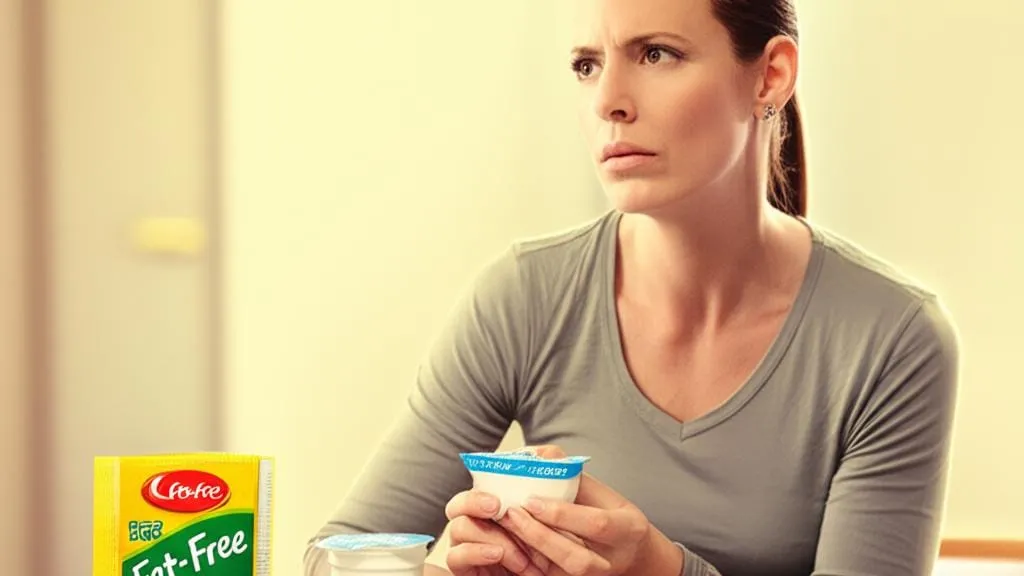
What do these 'Fat-free' and 'Low-fat' labels really mean?
We see these words a lot when we buy something like a yogurt or a packet of biscuits from a store. But each of these labels tells a different story. Simply put, this is what it means:| Label Term | What It Means |
|---|---|
| Fat-free | Fat should be less than 0.5 grams per serving. |
| Low-fat | A meal should contain 3 grams of fat or less. |
| Reduced-fat | The food should have at least 25% less fat than the regular product. |
| Light | Calories should be reduced by 1/3, or fat should be reduced by 50%. |
The hidden problem with 'Fat-Free' foods
Think about it, what happens when you completely remove fat from a food? Often, it loses its flavor . So what do food manufacturers do to restore this flavor? They add other things to it. Specifically, things like sugar, bread flour, various thickeners, and salt . This results in the calorie content of the food increasing even though the fat is gone.That means you're fat.Eating less than you think can add unnecessary sugar and calories to your body.Also, since these foods don't taste very good, they don't fill us up. Then, we end up eating more of them without even realizing it. In the end, we end up gaining weight instead of losing weight.
Instead of saying 'no fat', let's think about 'good fat'!
When it comes to a healthy lifestyle, what's more important than how much fat we eat is what kind of fat we eat . Our bodies need fat. But it's the "good" kind. When we talk about cholesterol, we've heard about two types, right?- LDL (Low-Density Lipoprotein): This is the " bad cholesterol " . It builds up on the walls of our blood vessels , narrowing them and paving the way for heart disease .
- HDL (High-Density Lipoprotein): This is the "good cholesterol." HDL protects our heart by removing bad LDL cholesterol from our blood vessels.
| Fat Type | Good/bad and examples |
|---|---|
| Good Fats - Eat More of These | |
| Monounsaturated Fats | Lowers bad LDL cholesterol. Examples: olive oil, canola oil, peanuts, avocados. |
| Polyunsaturated Fats | Lowers bad LDL cholesterol. Examples: Oily fish like mackerel, salmon, tuna, sunflower seeds, pumpkin seeds. |
| Bad Fats - Reduce these as much as possible | |
| Saturated Fats | Increases bad LDL cholesterol. Examples: beef, pork, butter, cheese, and full-fat dairy products. |
| Trans Fats | These are the worst types of fats . They increase LDL and decrease good HDL. Examples: margarine, bakery products, deep-fried fast foods. |
How to make healthy choices?
This doesn't mean that 'fat-free' foods are completely bad. But we need to be smart when choosing them.- Read food labels carefully: Don't buy anything that says 'fat-free'. Check how much sugar and salt it contains, and whether it actually has fewer calories than the regular product. Also, pay attention to the serving size .
- Be mindful of your portion size: Imagine that a cup of 'low-fat' ice cream has 3 grams of fat and 250 calories. If you eat three cups of that, you'll be adding 9 grams of fat and 750 calories to your body! Sometimes, it's better to indulge in a little bit of something delicious with full fat than to eat a lot of sugary treats like this.
- Give priority to natural foods: Add more vegetables, fruits, whole grains, and nuts to your diet. They are high in fiber and nutrients, which helps keep you feeling full longer. They are also low in calories and naturally low in fat. For example, it is much better to eat a home-baked sweet potato or a potato (without butter or cheese) than a store-bought "baked" potato. This is because the whole potato is higher in nutrients and fiber, and lower in calories.
💡 Take-Home Message
- A "fat-free" label doesn't always mean "healthy." Be aware of added sugar, salt, and calories for flavor.
- The type of fat you eat is more important than the amount of fat you eat . Choose foods that contain "good fats" such as avocados, oily fish, and olive oil.
- Limit "bad fats" (saturated and trans fats) found in processed foods, baked goods, and deep-fried foods as much as possible.
- Make it a habit to read food labels. Pay attention not only to fat, but also to sugar, sodium (salt), and calorie content.
- If you have any concerns about your weight, cholesterol levels, or diet, always consult your doctor for proper advice.



Janiw kuna arsuwinakas jichhakamax uñt’ayatäkiti. Aka chiqanx amuyt’awim jan ukax jiskt’awim yapxatañamawa.