Have you ever wondered how we can smell the beautiful flowers, the delicious food our mother cooks, or the earth after a light rain? All of this is thanks to a small but very important part of our body. That is
the olfactory nerve . So today we will talk about this amazing olfactory nerve, this friend that helps us with our sense of smell.
What is the Olfactory Nerve?
Simply put, your olfactory nerve is your
first cranial nerve (Cranial Nerve I or CN I) . It is the first of the twelve main nerves in our head. It is also part of our
Autonomic Nervous System . That is, the system that controls many of the processes that occur naturally in our body. The main function of this nerve is
to give us the ability to smell . Surprisingly, it is
the shortest sensory nerve in our body. It starts in our brain, specifically at the bottom of the brain, and then it travels and connects to the top and inside of the nose. Imagine how big a job it does, even though it is so small!
What is the main function of the olfactory nerve (CN I)?
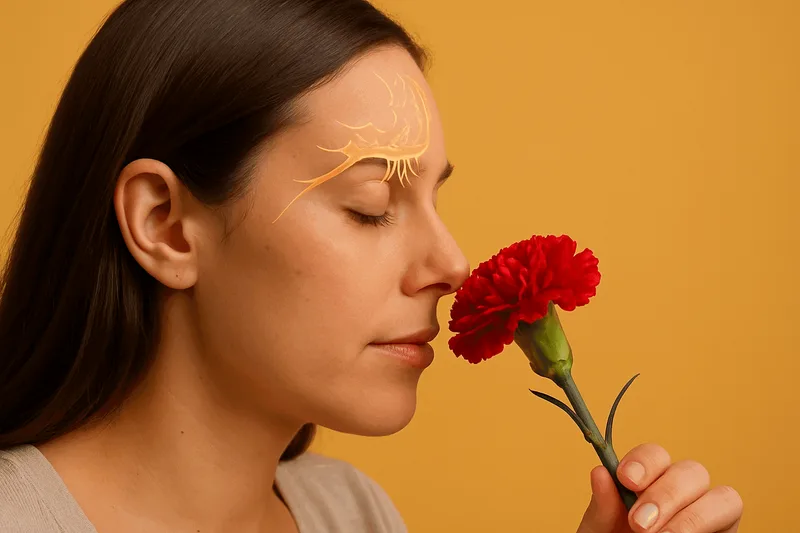
The main thing is that it helps us to identify different smells, such as the smell of perfume, the smell of food, the smell of flowers. How does this happen? Imagine, when we smell something, it adds very small, invisible particles (molecules) to the air. When we breathe, these particles enter through our nostrils. There, a special type of cell in the upper part of our nose, called
olfactory receptors , captures these particles. Then these receptors send a message to the brain via the olfactory nerve, saying, "Here comes a smell like this." That's when we understand, "Ah, this is the smell of a rose" or "This is the smell of delicious chicken curry."
How does our sense of smell work?
Our olfactory system allows us to smell in two main ways: 1.
Through the nostrils: As mentioned earlier, tiny particles released from things that have a smell enter our nostrils and stimulate the olfactory receptors. These receptors are activated in different combinations, allowing us to distinguish and identify different types of smells. Think of it as mixing a little bit of the same basic color in different ways to create different colors. 2.
At the back of the throat: When we chew food or take a sip of a drink, the odor particles in those foods are also released. These particles travel up our throat and reach the olfactory receptors at the back of the nose. That's why sometimes we can smell food while it's still in our mouth.
Olfactory Mucosa and its Role
The olfactory mucosa also plays a major role in our sense of smell. It is located at the top of our nasal cavity. This membrane contains different types of cells:
- Olfactory receptor cells: These are the cells that detect odors. These cells have two processes: Dendritic processes push the cells toward tiny hairs on the olfactory mucosa, stimulating the olfactory cells. Central processes push the cells in the opposite direction.
- Sustentacular cells: These act as support for the surrounding tissues.
- Basal cells: Both olfactory receptor cells and supporting cells are formed from these basal cells.
What is the anatomy of the olfactory nerve?
Our olfactory nerve, unlike other cranial nerves, is one of two nerves that originate directly from our
cerebrum , the large upper part of the brain. (The other is the optic nerve, the second cranial nerve that helps us see.) Most of the other cranial nerves originate from the lower parts of the brain,
the brainstem . The fibers of the olfactory nerve travel a short distance to reach
the olfactory bulb at the top of the nose. Before reaching the olfactory bulb, the nerve fibers pass through a bone in our skull called
the cribriform plate . This is a spongy, light bone. This is what separates the area around our nose from the brain.
What symptoms can occur if the olfactory nerve is dysfunctional?
Certain problems affecting our olfactory system can cause a variety of symptoms. Let's take a look at what they are:
- Anosmia: This is the complete loss of smell . A condition in which you cannot smell anything.
- Dysosmia (also called phantosmia): This is the perception of unpleasant, unpleasant, or strange smells for no apparent reason. It can be a burning smell or a musty smell.
- Hyposmia: This is a decreased sense of smell . Smells that were previously perceived well are now barely perceptible.
- Parosmia: This is a distorted sense of smell . For example, you might smell a familiar food, a chemical, or a musty smell. Imagine how upset you would be if your favorite food smelled differently.
What conditions can affect the olfactory nerve?
Various medical conditions and other factors can affect the functioning of our olfactory nerve. Some of them include:
- Sinus infections and nasal polyps .
- TobaccoTobacco use (cigarettes, beedis, etc.).
- Poor oral and dental health (Poor dental hygiene) .
- Exposure to environmental toxins and chemicals like insecticides .
- Serious head injuries , including concussions, are conditions where the brain is subjected to a strong blow.
- Some medications, for example antibiotics .
- The ` SARS-CoV-2` virus that causes the coronavirus ( COVID-19 ) is something we've all heard of.
- Head and neck cancer .
- Diabetes (Diabetes Mellitus) .
- Alzheimer's disease .
- Brain tumor .
- Parkinson's disease .
- Epilepsy .
Important: As you can see, loss or decreased sense of smell can sometimes be a symptom of a more serious condition. Therefore, it is very important to take care of it if you experience something like this.
How does COVID-19 affect our sense of smell?
You may have heard that about half of people who get COVID-19 lose their sense of smell. Researchers are still trying to figure out exactly why this happens. But one possibility is that viral infections like SARS-CoV-2 may damage our olfactory receptor cells. The good news is that most people regain their sense of smell. However, it can take several months. The key is to be patient.
To be honest, it's hard to prevent the effects of certain neurological conditions, such as brain tumors, on our sense of smell. They're things we can't control. However, there are things we can control and try to prevent:
- Avoiding dangerous activities that can cause brain injury.
- Getting the COVID-19 vaccine .
- If you are working with chemicals, wear a mask to protect your nose .
- If you are a tobacco user (cigarettes, vaping), stop using them .
- Brushing and flossing your teeth dailyMaintaining good oral hygiene habits like dental flossing.
- If you have other medical conditions (e.g. diabetes) that can affect your olfactory system, it's important to get them treated properly .
- Protect yourself from injuries such as concussions by using protective equipment like helmets when playing sports.
When should you see a doctor for a problem with the olfactory nerve?
If you notice one or more of these symptoms, it's best to see a doctor:
- If there is a difference in the way things smell .
- If you suddenly lose your sense of smell .
- If you smell bad, unpleasant odors for no reason.
Why is it important to seek medical advice?
It is important to seek medical advice about these symptoms, as they can pose certain risks to your health and safety. For example:
- You may be tempted to overeat or undereat because you can't smell food .
- It's easy to miss signs of danger, such as a gas leak, smoke from a fire, or spoiled food. Imagine a gas leak in your house, but how dangerous it would be if you couldn't smell it.
Finally, things to remember
So, you now know that the Olfactory Nerve is our first cranial nerve (CN I), and that this nerve is essential to our olfactory system and sense of smell. This nerve can be affected by various conditions such as COVID-19, Diabetes Mellitus, and Alzheimer's disease.
If you have any discomfort or changes in your sense of smell, be sure to see a doctor. He or she can tell you if the condition will return to normal or if it will return to normal. He or she can also advise you on how to stay safe and healthy even without your sense of smell.
Every part of our body is valuable, so it is our responsibility to take care of it all.



💬 Comments (0)
No comments have been posted yet. Add your comment here for the first time.
Add your comment