

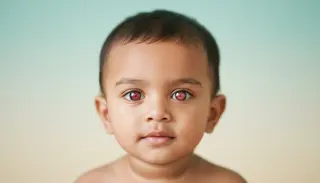
Have you ever noticed that your little one's eyes are set a little further apart than normal? Or has a doctor told you about it? In medical terms, we call this condition Orbital Hypertelorism . Sometimes it is also called Ocular Hypertelorism. Although these words can be scary, this is not as serious as we think. Today, we will talk about this very simply, in a way that you can understand.
What exactly is Orbital Hypertelorism?
Simply put, Orbital Hypertelorism is not a separate disease. It usually occurs as a symptom of another birth defect or genetic disorder.
Think about it, when a baby is in the womb, the bones of his face are gradually taking shape. At this time, the two eye sockets that house his eyes are positioned a little further apart than normal. Therefore, the gap between the eyes is more visible than in a normal child. This increased space is filled with extra bone.
The important thing is that most children with eyes that are this far apart will not have any vision problems. Whether vision is affected depends on how far apart the eyes are and what other symptoms the child has.
How do doctors diagnose this exactly?
Usually, a doctor diagnoses this condition as soon as the baby is born. Sometimes, it can even be detected during an ultrasound scan while the baby is still in the womb.
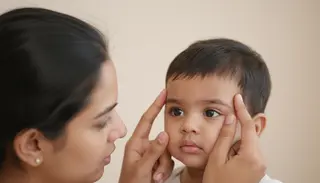
There is no set distance between the eyes, but doctors use two main measurements to determine this.
| Measurement method | Simply explained |
|---|---|
| Inner Canthal Distance | The distance from the corner of one eye closest to the nose to the corner of the other eye closest to the nose. |
| Pupillary Distance | The distance from the center of the pupil of one eye to the center of the pupil of the other eye. |
Both of these measurements are higher than normal in children with orbital hypertelorism.
Why is this happening? What are the main reasons?
Doctors believe that the foundation for this condition is laid between the fourth and eighth weeks of a baby's development. Think of the bones of a baby's skull as pieces of a three-dimensional (3D) puzzle coming together. If there is any disruption or change in the steps involved in putting these pieces together, the two eye sockets can become misaligned and become far apart.
The two main reasons for this are:
1. Birth defects
2. Genetic disorders
1. Congenital conditions
A birth defect is an abnormality in the appearance, internal organs, or chemical processes of a baby's body at birth. These can be caused by:
- Genetic and hereditary factors.
- Some infections that the mother gets during pregnancy.
- Exposure to radiation.
- Drug or alcohol use during pregnancy.
Sometimes birth defects can occur for no apparent reason, even randomly. Craniosynostosis is one such birth defect. What happens here is that the sutures that connect the bones of the baby's skull fuse together. This can also cause Orbital Hypertelorism.
2. Genetic disorders
Genes are small units of DNA that give instructions to the cells in our body. Mutations in these genes can cause genetic diseases. Some of the genetic diseases that can cause orbital hypertelorism are:
- Apert syndrome
- DiGeorge syndrome
- Edwards syndrome
- Crouzon syndrome
- Noonan syndrome
- Neurofibromatosis type 1
If your child has this condition, your doctor may refer you for genetic counseling, which can help you understand more about your family's risk for genetic diseases.
What are the treatments for this?
Children with this condition can have their eyes brought back together through surgery. This is called reconstructive surgery . This surgery is usually done when the child is between 5 and 7 years old. This surgery gives the child a more normal appearance and reduces the distance between the eyes.
Your child will need regular eye exams before and after surgery to monitor changes in the eyes and vision.
Surgeons mainly use two surgical techniques for this.
| Type of surgery | What is happening? |
|---|---|
| Box Osteotomy | Here, the surgeon removes excess bone and skin above the nose and reshapes the eye sockets to fit into that space. Imagine cutting a square-shaped section along the eyebrows and above the nose, and bringing the eye sockets into that square. |
| Facial Bipartition | This is a slightly more complex surgery. It is performed on children who have orbital hypertelorism and other facial bone problems (e.g., jawbone, cheekbones). It involves reshaping the eye sockets, nose, and cheekbones to bring the eyes closer together, while also correcting problems with the jaw and teeth. |
Possible complications after surgery
As with any surgery, there are very small risks involved. These include:
- Bleeding
- Infections
- Scarring
- Drooping eyelid ( Ptosis )
- Diplopia (double vision)
- Vision loss or blindness (this is very rare)
Your surgeon will explain these risks to you in detail.
When should you see a doctor?
If you notice any changes in your child's eyes or vision, see your doctor immediately.
Also, if your child develops any of the following symptoms, immediately go to the Emergency Department (ETU) of the nearest hospital.
- Sudden loss or decrease in vision.
- Severe pain in the eyes.
- Seeing new flashes or floaters before the eyes.
Remember, just because a baby is born with Orbital Hypertelorism doesn't mean they won't grow up healthy and well like other children. Depending on the underlying condition that caused it, your baby may need treatment for a while. Talk to your doctor about it.
💡 Take-Home Message
- Orbital Hypertelorism is not a separate disease. It is a symptom of another birth defect or genetic condition.
- Many children with this condition do not have any vision problems.
- When the child is around 5-7 years old, surgery can be performed to bring the eyes back to their normal spacing.
- If your child has this condition, don't be afraid to talk openly with your doctor and get the necessary advice and treatment.
- It is very important to see the doctor on time and have eye exams.


Janiw kuna arsuwinakas jichhakamax uñt’ayatäkiti. Aka chiqanx amuyt’awim jan ukax jiskt’awim yapxatañamawa.