
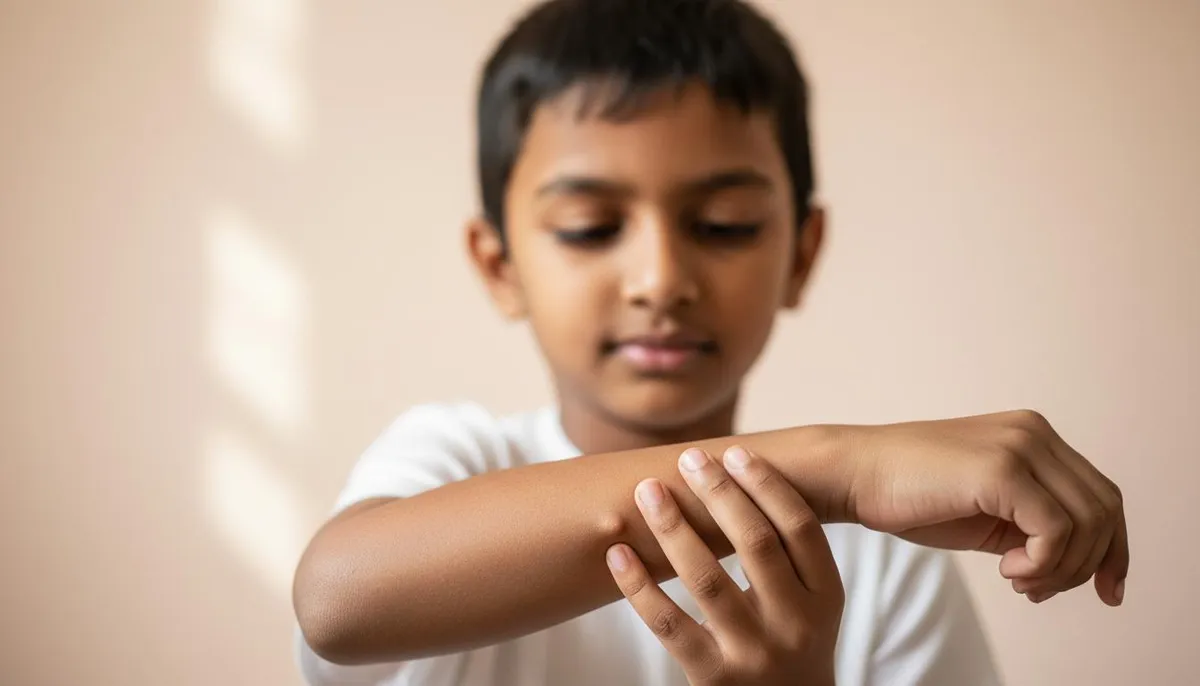
Have you ever been worried about a lump on your child's arm or leg, especially near a joint? Or did the doctor say that there was a small growth on the bone when he or she took an X-ray for something else? It's normal for us to get scared when we hear the word 'lump'. But most of the time, these things are not something to be afraid of. Today, we're talking about a common condition called Osteochondroma.
GAD-7 ukax llakisiñ uñakipiri. 7 jiskt’awinakaru jaysaña, trastorno de ansiedad generalizada uñakipañataki. Sapa kutiw mä profesional de salud mental ukar jiskt’asiñama, ukhamat diagnostico lurañataki.
Simply put, what is Osteochondroma?
Osteochondroma is a noncancerous growth of bone and cartilage. To be precise, it looks like a small growth that grows out of a bone. If we look at the meaning of this word, "Osteo" means bone, "Chondro" means cartilage, and "oma" means tumor. But remember, in medicine, not all tumors are cancerous.
These are most commonly seen at the ends of long bones in children and young adults. That is, in places like the knees, shoulders, and hips. As a child grows, their bones lengthen from a special plate made of cartilage at the end of the bone. We call this the growth plate. Osteochondroma is an abnormal, protruding growth that occurs in this growth plate. The best part is that when the child's skeleton stops growing, which means they stop growing taller, the osteochondroma also stops growing.
There are two main types of osteochondroma:
We can see this situation in two main ways. That is, as a single knot or as multiple knots. These two are considered two different situations. Let's look at the table below to understand this clearly.
| Type | Description |
|---|---|
| Solitary Osteochondroma | This is the most common type. It forms in one place on the body, just one lump. Most of the time, it doesn't cause any symptoms. It's usually discovered incidentally when an X-ray is taken for another reason. It's not cancerous, so it doesn't spread to other parts of the body. The exact cause of its formation has not yet been found. |
| Multiple Osteochondromas | In this condition, these lumps form in several places on the body. This is usually due to a genetic cause, meaning it is inherited. This is also called Hereditary Multiple Exostoses. However, sometimes multiple lumps can form without any hereditary cause. Although these are not cancerous, the presence of multiple lumps increases the risk of affecting the normal growth of the bones. |
So is this a serious situation?
Most of the time, no . A solitary osteochondroma usually doesn't require any treatment. However, your doctor may recommend surgical removal if the tumor is pressing on nearby tissue, nerves, blood vessels, or other bone.
The important thing is that the chance of an osteochondroma turning into cancer over time is very, very low . The chance of that happening to someone with a single nodule is about 1%. Even if someone has multiple nodules, the risk is as low as 5%. Because of this low risk, the doctor may want to keep the nodule under observation.
In severe cases of multiple osteochondromas, a child may have abnormal bone growth. This may only affect appearance, but it can sometimes interfere with movement or cause pain. Doctors will monitor these children regularly to check for any complications.
What is the difference between osteochondroma and cancer?
This is a question that many people have. There is a clear difference between these three situations.
| Status | Simple explanation |
|---|---|
| Osteochondroma | A noncancerous growth of bone and cartilage. |
| Chondrosarcoma | This is cartilage cancer.. Very rarely, if an osteochondroma turns into cancer, it becomes a chondrosarcoma. The cancer develops from the cartilage cap over the osteochondroma. |
| Osteosarcoma | This is a bone cancer . It is not related to Osteochondroma at all. This cancer arises from the bone tissue itself. |
How does this knot look and feel?
An osteochondroma is a growth that grows out of the bone. It can vary in size from 1 to 10 centimeters. Some come with a mushroom-like stem and a bulbous top. These are called pedunculated. The other type has a flat, broad base . These are called sessile. The pedunculated type is more common in cases of single nodules, while the sessile type is more common in hereditary conditions with multiple nodules.
You may not feel anything if you have an osteochondroma, but you may be able to feel a small, hard lump under the skin, close to the bone .
What are the main symptoms?
Since there are often no symptoms, this condition can go undetected for a long time. However, sometimes the following symptoms may appear.
| Symptom | Reason |
|---|---|
| Feeling a hard, small lump on a bone. | This is the physical development of Osteochondroma. |
| Pain when making any movement. | This can happen when the knot rubs against a tendon. |
| Feeling numb or tickling somewhere. | The lump may be caused by pressure on a nerve. |
| Circulatory problems in an arm or leg. | This happens when the clot blocks a blood vessel. |
| Symptoms that may be seen when children have multiple osteochondromas: | |
| |
How do you know if this is cancer?
Again, the chance of this turning into cancer is very low . However, your doctor will keep an eye on it. If you have any of the following symptoms, your doctor may decide to do further testing:
- If there is pain for no reason .
- If the lump continues to grow even after the child's skeletal growth has stopped.
- If the cartilage cap on top of an adult's knee is thicker than 1.5 centimeters .
How is the disease diagnosed and treated?
Your doctor will first ask you about your symptoms and perform a physical exam. If an osteochondroma is suspected, they will order an X-ray . In most cases, an X-ray can clearly identify the condition. If more information is needed, they may order an MRI or CT scan.
Regarding treatment:
- Most people with a single nodule do not need any treatment. The doctor will take X-rays periodically to monitor its growth.
- Surgical removal: Surgical removal is only recommended if the lump is causing pain, restricting movement, or compressing nerves or blood vessels.
- Special attention for children: Children with multiple nodules should be checked regularly and any nodules that are affecting bone growth can be removed.
Should you be afraid of surgery?
This surgery is usually simple. It is done under general anesthesia. The surgeon makes a small incision where the lump is and removes the lump at the bone level. Except for a few complicated cases where blood vessels or nerves are involved, this is usually a simple surgery. You can often go home the same day as the surgery..
Most people can return to normal activities soon after surgery. You may be asked to use a sling or crutches for a few weeks. Your doctor will explain what to do for the pain in the first few days.
The chance of a removed tumor growing back is very low.
💡 Take-Home Message
- Osteochondroma is not cancer . It is just an extra growth made up of bone and cartilage.
- These are most commonly seen in the growing bones of children and young adults.
- Most of the time, there are no symptoms and no treatment is required.
- The risk of developing cancer is very low .
- Only if the knot is causing pain or other problems can it be removed with a simple surgery.
- If you or your child has a lump like this, don't panic and see your doctor for advice . That's the best thing to do.





Janiw kuna arsuwinakas jichhakamax uñt’ayatäkiti. Aka chiqanx amuyt’awim jan ukax jiskt’awim yapxatañamawa.