

Your little one gets a fever sometimes, right? It's actually very common for young children to get a fever . But as a mother or father, it's also normal to feel a little scared, and there's nothing wrong with that. You might think, "Oh, my child doesn't know if he has some serious illness." But most of the time, a fever isn't something to be afraid of. Sometimes, it can even be a good thing. How does that happen? Let's talk about this in a little more detail today, okay?
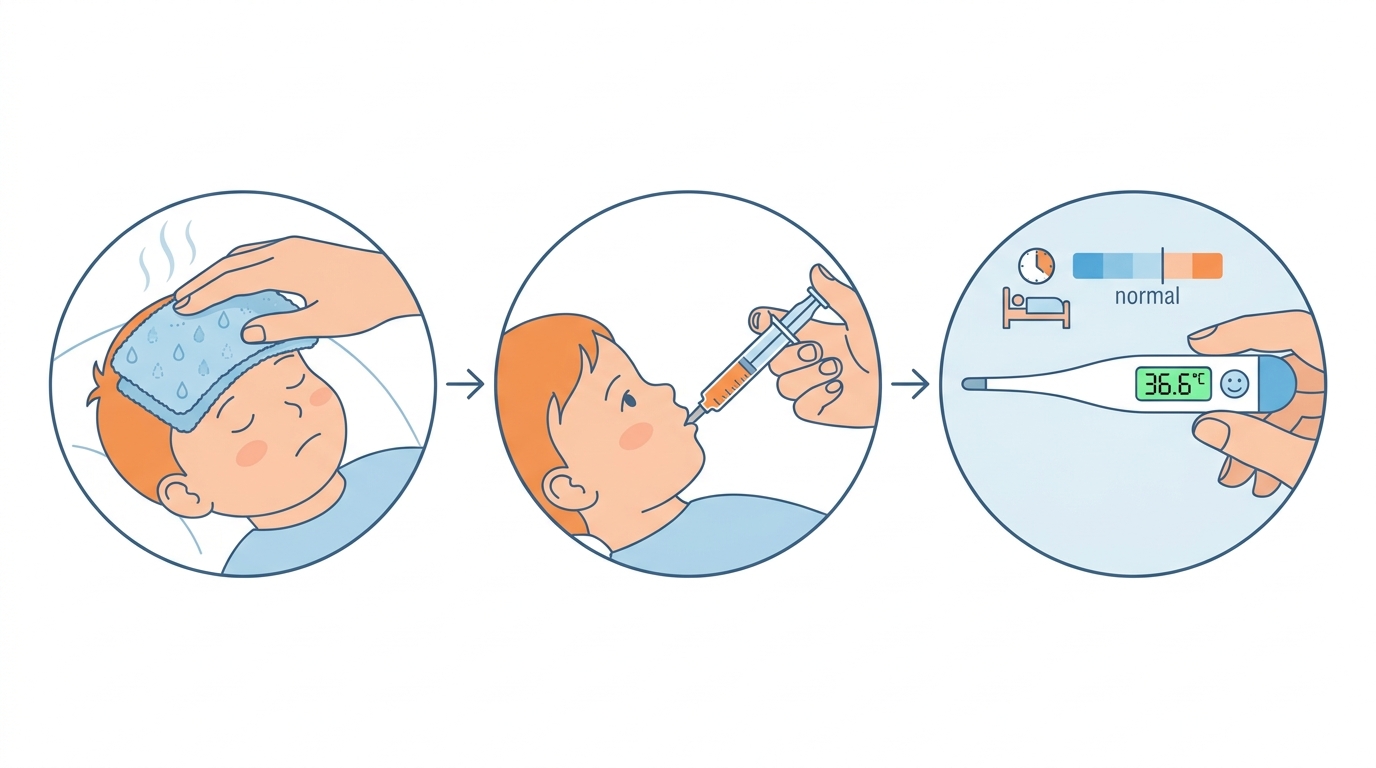
So what is this fever? Is it a feeling of heat in the body?
Simply put, yes. A fever is when our body temperature is higher than normal. We usually consider a "fever" to be 38 degrees Celsius (100.4 degrees Fahrenheit) or higher . However, this value can vary slightly depending on how we measure fever.
Now look, we use different methods to measure fever, right?
- They put a bamboo skewer in the crook of their leg and look.
- Checking for fever through the mouth (in slightly older children).
- There are also ear piercings that look inside the ear.
- You may have seen forehead thermometers.
- In very young babies, a rectal temperature is sometimes taken. This is the true temperature inside the body.
So, the value obtained when measuring in each way can vary a little. That's why the value that can be accurately said to be fever also varies a little. But usually, the previously mentioned 38 Celsius is what we consider most of the time.
Why do our babies get this fever? What are the causes?
Most of the time, your child will get a fever when they have an infection . Think of it this way: when you get a cold, a sore throat, or any other virus or bacteria, your body starts to fight it off. A fever is actually part of this fight.
How does that happen?
When we have a fever, our immune system , the system that protects us from disease, is stimulated even more. It's like telling our soldiers, "The enemy is coming, get ready for battle!" Doctors believe that when our body temperature rises a little, it becomes harder for germs to grow. This means that a fever is not just a disease, but something that helps the body fight the disease.
However, infections are not the only cause of fever. There can be several other minor causes:
- Wearing too much clothes:This is especially true for newborns. Babies can't regulate their body temperature as well as adults. So if we overdress them, wrap them up in blankets, and leave them in a slightly warmer environment, they can develop a fever. But remember, if a newborn has a fever, don't assume it's because they're overdressed. You should see a doctor right away. It could be a sign of a serious infection.
- Immunizations / Vaccinations: After a baby receives a vaccine , they may sometimes develop a slight fever. This usually subsides after about a day. It is the body's response to the vaccine.
- Teething: Some mothers say that their baby also gets a fever when teething. It is true that when teething, the body temperature may rise slightly . But if it is higher than 37.8 degrees Celsius (100 Fahrenheit), and it comes in the form of a real fever, then the reason for it cannot be teething alone. There may be something else.
Is a fever always dangerous? Do I need to see a doctor?
This is the question that many parents worry about. A fever in a healthy, well-behaved child is usually not dangerous. It will go away in a few days.
However, sometimes a fever can be a sign of something serious, so we need to be aware of this.
In these cases, you should definitely call a doctor or take your child to the hospital:
- For a baby under 3 months old: If your little one is under 3 months old, and their rectal temperature is 38 degrees Celsius (100.4 Fahrenheit) or higher, call a doctor immediately, or take them to the hospital's emergency room (ER). This is very, very important! A fever in a very young baby can sometimes be the first sign of a serious infection.
- If your child has another chronic medical condition: If your child has any ongoing health problems, such as asthma, heart disease, or kidney problems, it is very important to ask your doctor in advance about whether and when you should call the doctor if they develop a fever.
When should you not be so afraid of the flu?
If your baby is over 3 months old and has a fever but shows these symptoms, it's most likely not a serious condition:
- Is the child interested in playing? (Will he play when the fever goes down a bit?)
- Do you drink plenty of fluids like water and milk?
- Are you in good spirits and smiling? (When you don't have a fever)
- Is the skin color normal? (Is it blue or pale?)
- Does the child seem to be doing well once the fever goes down a bit?
If these things are present, most of the time there is nothing to worry about. You can take care of the child at home.
Another thing, it's normal for a child with a fever to be a little reluctant to eat. Don't worry about it too much. The most important thing is that the child is drinking plenty of fluids and urinating ( peeing ) normally. If that's going well, it won't be a big deal to eat less for a few days.
How do I know for sure if my child has a fever? What are the symptoms?
Sometimes we can tell if a child is hot just by touching them. But the most accurate way to check is to take a temperature with a thermometer. A child with a fever may show the following symptoms:
- Feeling hot to the touch.
- Changes in the child's behavior : They may be more irritable than usual, cry more, or be very quiet and depressed.
- Your breathing rate may increase slightly, or your heart rate may be higher than normal.
- You can say your head hurts (if it's a slightly older child).
- You may shiver as if you are cold, or you may sweat.
- The face and body may become red and appear swollen.
If you see any of these signs, check your child's temperature. That way you can know exactly if they really have a fever and how high it is. Only then can we decide what to do.
So, what are the most important things to remember from what we've talked about? (Take-Home Message)
Okay, we've talked a lot about the flu, haven't we? Don't worry, just remember this:
1. A fever is usually not dangerous. It is the body's way of fighting infection.
2. If a baby under 3 months old has a fever (38 Celsius/100.4 Fahrenheit or higher), see a doctor immediately. This is a must!
3. If the child has a fever but is playing well, drinking fluids, and smiling, there is usually nothing to worry about.
4. Give your child plenty of fluids when he has a fever. It doesn't matter if he eats less, fluids are the most important thing.
5. Don't overdress your baby. Wear light, cotton clothes. Keep the room temperature comfortable.
6. Never give aspirin to young children without the advice of a doctor.
7. If you have any concerns or worries about your child's fever, never hesitate to talk to a doctor. Ask your questions and get answers. That's the best thing to do.
Remember, you know your child best. If your child is acting differently than usual, or if you notice something, pay attention to it. Although fever is a common occurrence for young children, it is important to be aware of it. Then we can decide what to do without panicking.
` Fever, fever in children, treatment of fever, high temperature, childhood diseases, causes of fever, symptoms of fever
ukat juk’ampinaka Doctoran qillqatapa
ukat juk’ampinaka Calenturax janiw mä usukiti, jan ukasti cuerpon inmunológico ukan janchipar mantanir gérmenes ukanakamp nuwasitapat uñachtʼayatawa. Mä calenturax 38 grados Celsius (100,4 Fahrenheit) jan ukax juk’ampiruw termómetro digital ukampix amuyasi. Paracetamol uka dosis ukaxa wawaru pesaje ukarjamawa churañawa. Wawaruxa algodón k’achachata isimpiwa isthapiyañama ukatxa cuartoxa suma thayampi mantañapawa. Thaya esponja lurañaxa janiwa lurañakiti, ukatxa Tepid esponja ukaxa lurasirakispawa mä 30 grados Celsius ukharu junt’u umampi.
❓ ukat juk’ampinaka Mä qawqha juk’amp jiskt’äwinakampiw jikisipxasma (FAQ) .
ukat juk’ampinaka ¿Kunjamatsa mä wawax calentura usunïtap chiqapar qhanañchsna?▼
ukat juk’ampinaka Sapa kutiw termómetro digital ukampi apnaqañama ukatxa axilas jan ukaxa anus ukata temperatura apsuña ukatxa amparampi llamkt’añat sipansa.
ukat juk’ampinaka ¿Kunjamatsa mä chhullunkhayat wawar janchipa thayt’ayaña?▼
ukat juk’ampinaka Axilas, ingle, kunka ukat nayraqatax mä telampiw pichthapispa, ukax mä juk’a umampiw ch’allt’ata. Janipuniw ukatakix hielo uma jan ukax alcohol apnaqañakiti.
¿Kuna jan walt’awinakas utji, ukax jank’akiw qullañ utar apasiñapa, calentura usumpi?▼
ukat juk’ampinaka Mä wawax 3 phaxsit aynacharu, calentura, convulsiones, jank’ak samsuña, jan ukax jan uñt’at erupciones cuerpopan utjki ukax mä emergencia ukhamawa.


💬 Comments (0)
No comments have been posted yet. Add your comment here for the first time.
Add your comment