
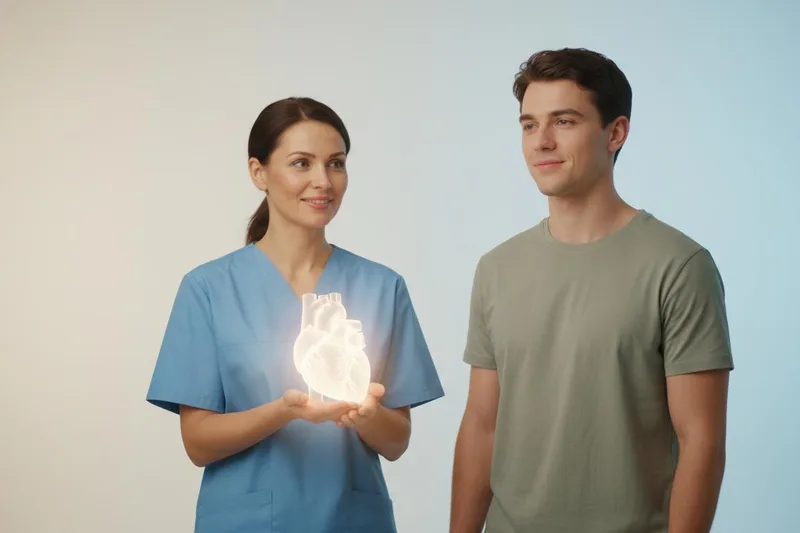
When your doctor tells you or someone you know has a heart tumor, you may feel a great sense of fear and shock. It's normal to have a thousand questions running through your mind, like, 'Oh my God, a heart tumor? Is it cancer? What do I do now?' But don't worry. That's what we're talking about today. Let's take a simple look at what a heart tumor really is, what the surgery is like, and everything you need to know about it.
What exactly is a heart tumor?
Simply put, a heart tumor is an abnormal growth of cells that forms inside the heart or on the wall of the heart. These can be divided into two main types. One is a tumor that starts in the heart itself, which we call primary tumors. The other type is a tumor that forms somewhere else in the body (for example, in the lungs ) and spreads to the heart.
But the good news here is that more than 90% of tumors that start in the heart are not cancerous. In medical terms, we call these 'benign'. This means that these tumors do not spread to other parts of the body (metastasis). Once they are removed surgically, there is no impact on the patient's life expectancy.
Most often, non-cancerous tumors such as myxoma or papillary fibroelastoma are seen. Although these are not cancerous , they can cause problems.
- They can interfere with the functioning of heart valves.
- Also, if small pieces of these tumors break off and travel along blood vessels , forming a blood clot and blocking a blood vessel in the brain, a serious condition such as stroke can occur.
Because of this risk, doctors recommend surgical removal of these tumors. Sarcomas of the heart are very rare, and surgery is rarely performed for them.
Who wants to have this surgery?
Now you may be wondering, "Do I really need this surgery?" Your medical team will only recommend surgery if they are certain that the benefits of surgery outweigh the risks of not having surgery. Surgery is usually considered in the following cases:
- If you are experiencing symptoms such as difficulty breathing and chest pain due to the tumor .
- Because of the tumorIf the normal functioning of the heart is disturbed .
- As mentioned above, there is a high risk of serious complications such as blood clots (embolism) or stroke .
- If the tumor is growing rapidly , as seen in medical tests.
How do you remove a heart tumor? What are the surgical methods?
Because heart tumor removal surgeries are quite complex, they are usually performed in large, well-equipped hospitals by teams of surgeons who have specialized knowledge and experience in this field. They will examine your condition and decide which surgical procedure is best for you. There are two main surgical procedures.
| Surgical method | How to do it |
|---|---|
| Open-Heart Surgery | This is the traditional method. This surgery is performed by making a long vertical incision in the middle of the chest (Median Sternotomy) and opening the chest cavity. This allows the surgeon to see the heart and surrounding tissues clearly. You are fully anesthetized and connected to a cardiopulmonary bypass machine that temporarily works in place of your heart and lungs. This allows the doctor to operate on a heart that has stopped beating and is still. The tumor is removed and, if necessary, the damaged parts are repaired. |
| Minimally Invasive Surgery | This is a new, advanced method. Instead of making a large incision in the middle of the chest, this is done through several small incisions between the ribs. When robotically assisted surgery is used, a camera and a robotic arm are inserted through these small incisions, which the surgeon carefully controls while looking at a computer screen. In this method, anesthesia and connection to a heart-lung machine are also performed. |
Minimally invasive surgery results in less pain, smaller scars, and faster recovery and a faster return to normal life.
What happens before and after the surgery?
Preparation before surgery
Your medical team will prepare you thoroughly before the surgery. It is very important that you follow their instructions exactly.
- Medications: You may be asked to stop some of the medications you are currently taking (especially blood thinners) a few days before surgery.
- Fasting: You will be asked to completely stop eating and drinking from midnight the night before surgery (fasting).
- Smoking: If you are a smoker, you should definitely quit smoking a few weeks before surgery to minimize complications.
Additionally, several tests such as a CT scan, Echocardiogram (echo test), and MRI scan may be performed to get a clear picture of the tumor and heart.
After the surgery
After surgery, you will be kept in the intensive care unit (ICU) for a day or more for close observation. Then you will be transferred to a regular ward. The number of days you will stay in the hospital will vary depending on your recovery rate and the type of surgery you had.
What are the benefits and risks?
Like any surgery, this one has both benefits and risks.
| Benefits | Risks |
|---|---|
|
|
Most importantly, minimally invasive surgical techniques can reduce many of these risks. Talk to your doctor about the specific risks associated with your surgery.
When to call a doctor immediately
It's normal to have some discomfort and pain when you go home after surgery. But if you experience any of these symptoms, call your surgeon or the hospital immediately .
- Chest pain that does not subside over time and increases in intensity.
- Fever.
- Persistent nausea and vomiting.
- Difficulty breathing.
- If the surgical incision is red, swollen, or oozing pus (these are signs of infection).
- If you are showing signs of a stroke, such as slurred speech or drooping of one side of your face, go to the nearest hospital's Emergency Department (ETU) immediately .
Take-Home Message
- Most tumors that develop in the heart are not cancerous (benign). They can be completely cured if they are removed surgically.
- There are two types of surgery: open-heart surgery and minimally invasive surgery. Your medical team will decide which method is best for you.
- Robotic surgeries with minimal incisions are less painful and can heal faster.
- If you have any concerns or questions about the surgery, don't keep them to yourself, but talk openly with your doctor. They will explain everything to you.
- Following medical instructions exactly after surgery is essential for a speedy recovery.




💬 Comments (0)
No comments have been posted yet. Add your comment here for the first time.
Add your comment