
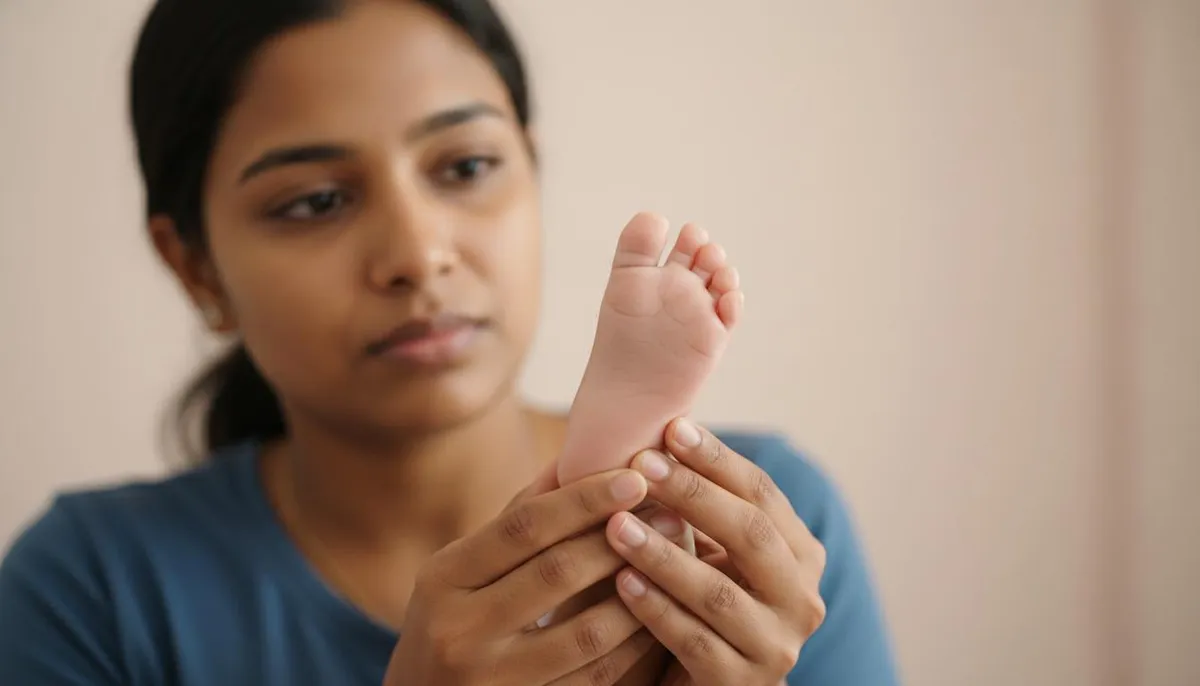
When you look at your little one's feet, you might sometimes think, "Wow, that looks a little weird, doesn't it?" Some children's feet are born with a slightly different shape. This condition is called Skew Foot . Don't panic when you hear this, because the most important thing is to be aware of it. Let's talk about it simply, in a way that you can understand.
Gratis usurïña uruxa calculadora. Qhipa periodo uru jan ukax concepción uru qillqt’aña, EDD, jichha trimestre ukat jach’a lurawinakat jikxatañataki.
What exactly is Skew Foot?
Simply put, Skew Foot is a condition that occurs when children are born with a change in the way the bones of their feet (legs) form. This means that the bones of the foot develop in a slightly different way than normal. This can cause the child's feet to look like the letter "Z" or just like a serpentine. That's why some people call it a Z Foot or a Serpentine Foot .
This is considered a birth defect . That is, it is a condition that occurs while the baby is still in the womb. Any baby can develop this condition.
What effect does Skew Foot have on a child's feet?
Imagine that the bones on the medial side of the child's foot suddenly bend inward, while the bones on the lateral side curve outward like a circle. Also, the bones in the heel and ankle do not line up properly, giving the foot that "Z" shape.
Some children may also notice a small lump-like swelling on the top of their foot, at the Lisfranc joint . This looks like a small bump in the middle of their foot.
How common is this condition called Skew Foot?
Skew Foot is actually a very rare condition. It is also considered a type of flat foot that can be seen in children. Also, doctors call it a part of a condition called Metatarsus Adductus . Metatarsus Adductus is another condition in which the foot turns inward. It usually occurs in one in 100 children and can occur in one in 5,000 children. So Skew Foot is something that is seen in even less number.
What causes Skew Foot?
We've said before that this is a congenital condition . That means it's something that's present at birth. In fact, doctors still haven't figured out exactly what causes this condition to occur at birth.
However, babies with Skew Foot have a difference in one of the 26 bones in their feet, the Cuneiform bone, which is located in the arch of the foot. Normally, this bone is square in shape, but in these children it is triangular in shape. This is the main difference that has been discovered so far.
What are the symptoms? How do you recognize it?
A child with Skew Foot typically exhibits the following symptoms:
- Misalignment of the heel and ankle bones.
- It is clearly visible that the metatarsal bones in the front of the foot are turned inward .
- If your child is a little older, they may have gait problems. Maybe they walk with their feet tucked in, or they may have difficulty balancing.
How do doctors find this?
You or your doctor may notice that your baby's feet are unusually shaped or misaligned. However, sometimes this condition is only diagnosed when the child is a little older, perhaps around 6 years old. Because young children's feet are very flexible , it can be difficult to recognize this condition in the early stages.
To determine if a child has a skew foot condition, doctors will carefully examine the child's feet during a physical examination . They will check the shape of the foot and, if the child is old enough to walk, the way they walk.
What kind of tests are done?
To confirm the diagnosis, doctors use imaging tests such as:
- An MRI scan.
- X-ray examination.
These tests can clearly see the position and shape of the bones in the foot.
How is it treated?
Treatment for Skew Foot varies with the age of the child. For infants and very young children, non-surgical treatments may include:
- Casts and Splints: These are used to help keep the foot in the correct position. It's like putting a cast on a broken leg, but the goal is to correct the shape of the foot.
- Physical therapy: This involves doing things like special exercises and stretching exercises.
- Special shoes: Special shoes are provided to help keep the foot in the correct position.
Your child's doctor will regularly monitor the development of your child's feet and recommend the necessary treatments to correct the Skew Foot condition.
Will the baby need an operation?
The doctor may recommend surgery in the following cases:
- If the previously mentioned nonsurgical therapies are not effective.
- If the child is over 6 years old and the foot is very stiff. That is, if the foot is so stretched that it cannot be straightened by hand.
- If the child is in severe pain or has difficulty walking.
Imagine, Nilanthi Amma took her 7-year-old daughter Chamali to a doctor because Chamali kept saying that her leg hurt when she ran and played. The doctor examined her and said that Chamali had a condition called Skew Foot , and that physical therapy alone was not enough, and that she would need to undergo a minor surgery.
What happens during surgery?
During surgery, doctors may remove parts of the bone (osteotomy). They may also insert small pins to keep the bones in proper alignment and tighten loose ligaments . The hope is that this will bring the bones of the foot into the correct shape and position.
What happens after the surgery?
After the surgery, the child will need to wear a cast . They will also need to stay off the ground until the bone heals. It is important to be patient with your child during this time.
How long does it take to heal?
Most children take about six weeks to recover from Skew Foot surgery. After this initial healing period, the child may need to wear a support such as a brace or a walking cast while the bone continues to heal.
Your doctor may also refer you to a physical therapist . They can retrain your child's muscles and help them stand and walk properly.
Is there a way to prevent this?
Since Skew Foot is a birth defect , there is nothing you can do to prevent it. Also, it is not caused by anything you did. This is very important to understand, because some parents blame themselves when things like this happen. Don't think that way.
If my child has Skew Foot, what should I expect?
If your child has Skew Foot , a doctor will regularly monitor the development of the child's feet. As changes occur in the child's feet, the doctor may recommend different exercises or other treatments. Therefore, it is important to follow the doctor's instructions and take your child for checkups on the scheduled dates.
How long does this condition last? Are there any long-term effects?
Most of the time, doctors successfully treat children with Skew Foot . After treatment, children are able to walk normally, without pain.
However, there are some adults who were born with Skew Foot but did not receive proper treatment. Such people may later develop bunions ( bone protrusions on the big toe) or arthritis (joint inflammation). That is why it is important to pay attention to this and treat it at an early age.
How do I take care of my child?
This is the most important thing. Your doctor's adviceFollow the instructions exactly. Wear any splints, casts, or special shoes your child is prescribed for the full length of time. If your doctor has given you any stretching or other exercises, do them exactly as recommended.
Remember, your support, patience, and love are very important for your child to get through this situation.
💡 In summary (Take-Home Message)
Skew Foot , or Serpentine Foot, is a congenital condition that causes a change in the shape of the feet in children. Although there is no way to prevent this, your doctor will monitor your child's growth and development and recommend the necessary treatment to correct Skew Foot . If diagnosed early and treated correctly, children can live a normal, comfortable life. Therefore, it is best not to be afraid of this and act on medical advice.






Janiw kuna arsuwinakas jichhakamax uñt’ayatäkiti. Aka chiqanx amuyt’awim jan ukax jiskt’awim yapxatañamawa.