

Sometimes your doctor asks you to do a urine test, right? Among them, you may have been asked to do a test called 'UPCR'. What exactly is this UPCR test? What does it check for in our body? Don't be afraid of anything, let's talk about this simply.
What is this UPCR test?
Simply put, UPCR (Urine Protein Creatinine Ratio) is a test that takes a sample of your urine and mainly measures the levels of two things.
1. Protein: Protein is essential for the growth and repair of cells in our body. It's like bricks needed to build a house.
2. Creatinine: This is a waste product that is produced when our muscles work. It's like the garbage that accumulates in a workplace.
This test gives the doctor a lot of important information about how well your kidneys are working.
What is the connection between our kidneys and this test?
Think of our kidneys as the most advanced filtration system in the house. This filter filters out unwanted waste products (like creatinine) from the blood and excretes them in the urine. It also reabsorbs important substances (like protein) back into the blood.
A healthy pair of kidneys doesn't let proteins out. They filter them right back into the body.
However, if the kidneys are damaged for some reason, it becomes as if a hole has formed in that filter. Then, the valuable protein that the body needs starts leaking out with the urine. This condition of having too much protein in the urine is medically called proteinuria .
The UPCR test measures the amount of protein that should not be excreted in your urine sample compared to the amount of creatinine, a waste product that should normally be excreted. This ratio gives a very clear picture of kidney function.
In what cases is a UPCR test recommended?
There are several reasons why a doctor might order this test. Let's take a look at what they are.
| Opportunity | Description |
|---|---|
| As a routine medical examination | Even if you don't have any symptoms, this test can be done to get a general idea of the health of your kidneys. |
| If you have symptoms of kidney disease | If you have symptoms such as swelling of the legs and ankles, foaming urine, and extreme fatigue, this test is performed to find the cause. |
| If you have diabetes or high blood pressure | Both of these conditions are more likely to cause kidney damage. Therefore, this test is routinely performed to monitor the condition of the kidneys in these patients. |
| During pregnancy | This test is very important to identify a dangerous condition called preeclampsia that can occur during pregnancy. |
Do you need to prepare for this test?
No. This is the easiest part of this test. There is no special preparation required. All you have to do is collect a small amount of urine in a clean bottle that the doctor will give you.
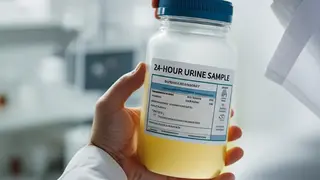
In the past, sometimes you had to collect the entire amount of urine you pass over a 24-hour period and test it. That was a bit of a hassle. But with this UPCR test, you can get a very accurate result from a urine sample taken at any time. That's a great convenience for both patients and doctors.
What do the results say?
This is the most important part for you. Normally, a healthy person's urine contains very little protein. But if your results show that your protein levels are elevated, there could be a number of reasons for this.
Causes of temporarily elevated protein levels:
Sometimes, the protein level in the urine may be slightly elevated due to temporary reasons that are nothing to worry about.
- Dehydration: When the body does not drink enough water.
- Infectious condition: When you have something like a fever or a urinary tract infection.
- Excessive exercise: When you exercise too hard.
- Stress: When you are under a lot of pressure.
- Pregnancy:Changes in protein levels can occur naturally during this time.
Reasons to pay attention to in the long term:
But if your urine protein levels are consistently high, it could be a sign of a medical condition. In particular, it could be an early sign that your kidneys are starting to get damaged . Diabetes and high blood pressure are two of the main causes of kidney damage.
Most importantly: Don't jump to conclusions based on the numbers on your test report. Only your doctor can analyze the results, compare them with your health, and decide what to do next.
Do I need to talk to the doctor?
Absolutely yes. After you receive your test report, be sure to see your doctor to discuss it. He or she will explain to you:
- What do the results say?
- Are the results normal or are there any areas that need attention?
- If necessary, further tests should be performed.
- If you are already receiving treatment, do you need to make a change in that treatment?
Talk to your doctor about any questions or fears you have and resolve them.
💡 Take-Home Message
- UPCR is a very simple, painless urine test that checks the health of your kidneys.
- This checks to see if protein is leaking from the kidneys. If so, it could be an early sign of kidney damage.
- This test does not require any special preparation and has no risks or side effects.
- Elevated protein levels in the urine do not always indicate a serious illness. They can also occur for some temporary reasons.
- The most important thing is to not make decisions about your test results on your own, but to definitely discuss them with your doctor. He is the one who will give you the best guidance.





Janiw kuna arsuwinakas jichhakamax uñt’ayatäkiti. Aka chiqanx amuyt’awim jan ukax jiskt’awim yapxatañamawa.