

Have you ever thought about how much help the little ligaments in your ankle help you stand, walk, and run? They're like little bands that give strength to our legs. Without them, we wouldn't be able to do any of these things properly. So today, let's talk about the ligaments in your ankle.
What are these ligaments in the ankle?
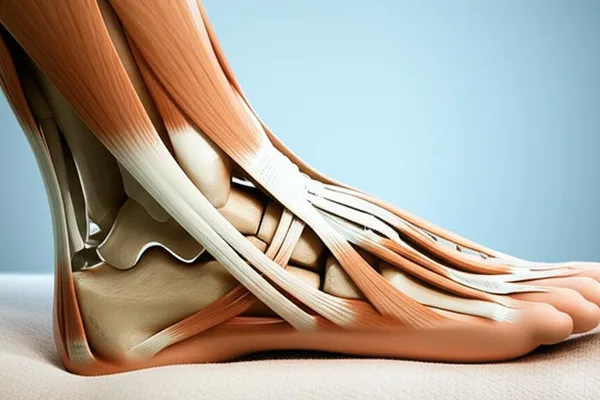
Simply put, the ligaments in your ankle are strong, fibrous bands of tissue . They connect the bones in your foot (the talus and calcaneus) to the bones in your lower leg (the tibia and fibula). Think of them as rubber bands, but much stronger.
The main function of these ligaments is to keep your bones in place and your ankle joint stable. They also prevent your ankle from twisting and rolling unnecessarily.
In fact, without these ankle ligaments, you wouldn't be able to stand, walk, or run. They're located on both sides of your ankle. They also help absorb the shock of any movement you make. So, if you experience any pain in your ankle ligaments, it's important to see a doctor right away to find out exactly what's wrong and get treatment.
How many ligaments are there in the ankle?
There are three main groups of ligaments in our ankle. Each of these is located around different parts of the ankle, providing support and helping our body move properly. Let's take a look at what they are.
Medial Ligaments
We also call these `(Deltoid Ligaments)`. Just touch the inside of your ankle, there's a little boney bump there, right? That's the `(Medial Malleolus)` – that's the bottom end of your `(Tibia)` bone. These ligaments start there. Then they spread out and connect to the `(Talus)`, `(Calcaneus)` and `(Navicular)` bones in your foot. There are four main types of ligaments:
- Anterior Tibiotalar Ligament (ATTL)
- Posterior Tibiotalar Ligament (PTTL)
- Tibiocalcaneal Ligament (TCL)
- Tibionavicular Ligament (TNL)
Lateral Ligaments
These ligaments are on the outside of your ankle. You have a similar bone on the outside of your ankle, right? That's the ``Lateral Malleolus`` – that's the bottom end of your ``Fibula`` bone. These ligaments start there. Then they connect to your ``Talus`` and ``Calcaneus`` bones. There are three main ligaments in this group:
- Anterior Talofibular Ligament (ATFL) – This is the ligament most commonly injured in an ankle sprain.
- Calcaneofibular Ligament (CFL)
- Posterior Talofibular Ligament (PTFL)
Syndesmotic Ligaments
These ligaments connect the two bones in your leg, the tibia and fibula. They are located slightly higher up, above the ankle joint. If they are injured, we call them a 'high ankle sprain' , because they are located slightly higher up than a typical sprain. There are five main ligaments in this group:
- Anterior Inferior Tibiofibular Ligament (AITFL)
- Posterior Inferior Tibiofibular Ligament (PITFL)
- Inferior Transverse Ligament (ITL)
- Transverse Tibiofibular Ligament (TTFL)
- Interosseous Ligament (IOL)
What is the function of these ligaments?
Although we don't think much about these ligaments in our daily lives, they actually perform a significant service for our bodies. Let's take a look at what they do:
- Shock absorption: These help absorb the shock when your foot hits the ground, much like shock absorbers in a car.
- Bone connections: These are what connect the bones in your foot to the bones in your lower leg.
- Keeping bones in place: Helps keep bones in their proper places, preventing them from moving around.
- Prevents ankle sprains: Prevents your ankles from twisting, rolling, and bending unnecessarily.
- Stabilizing the ankle joint: These are essential to keep the ankle joint, which is formed by the lower leg bones and the ``Talus'' bone, stable and strong.
- Stopping unsafe movements: Stops the ankle from moving in an unsafe, unnatural way.
What are these ligaments made of?
The ligaments of the ankle are made up of strong, cord-like connective tissue . They contain two main components:
- Collagen: This is the protein that binds the tissues of our body together. This is what gives ligaments their strength.
- Elastic Fibers: These allow ligaments to stretch to some extent, but can also return to their original position.
Where are the ligaments of the ankle located?
These ligaments are found throughout your foot, ankle, and lower leg. They mainly connect the following bones to each other:
- Heel bone `(Calcaneus)`
- Fibula (thin bone on the back of the leg)
- A bone on the top of the foot (Navicular bone)
- Talus (This is the main bone that makes up the ankle joint)
- Tibia (the thick bone on the inside of the leg)
Can an ankle ligament be injured?
Yes, it definitely can. An ankle ligament can be injured if it moves in the wrong direction, is overstretched, or tears . We call this type of injury to a ligament a sprain .
Ankle sprains are a very common injury. They can happen to anyone of any age and level of health. Most often, an ankle sprain occurs when a person twists their ankle. For example:
- When you are about to fall or when you fall. Imagine that you are going down a flight of stairs and suddenly your foot gets tripped. Then your ankle can suddenly roll inward or outward.
- If someone steps on your leg, it twists unnaturally. Things like this can happen while playing sports.
- This risk is higher in sports that require rapid changes of direction and footwork, such as basketball, football, netball, and tennis.
- When walking or running on uneven surfaces. For example, on a mountain road, in a place with rocks and gravel, or if your foot falls into a pothole in the road.
How does a doctor know if I have an ankle ligament injury?
If you think you have a sprained ankle, when you see a doctor, they will do things like:
- You will be asked about your symptoms. How is the pain, is there any swelling, is there any bruising, how long has it been there, how did the injury occur, and if you heard a "pop" sound when you were injured.
- A physical exam will be performed. Your injured ankle will be examined carefully, how it moves, and compared to other ankles. Sometimes, the injured area may be touched and examined a little to help pinpoint the pain and assess the extent of ligament damage.
- They will ask you to take an ``(X-ray)`` to see if a bone is broken or if there is some other problem. Often, an ``(X-ray)`` is done to see if there is a fracture along with a sprain.
- If your pain doesn't go away and you think the injury is serious, you may be asked to do other imaging tests, such as an MRI (Magnetic Resonance Imaging). An MRI can show the damage to the ligaments, and if they are torn and how far they are torn. Sometimes an ultrasound scan may also be done.
How to prevent ankle ligament injuries?
While not all ankle injuries can be prevented, there are a few things you can do to protect your ankle ligaments, especially when engaging in physical activity. Let's take a look at what they are:
- Avoid uneven surfaces: Try to avoid walking or running on rocky, gravel, or potholes as much as possible, as these are areas where the ankle is more likely to roll or twist.
- Improve your flexibility and balance: This will train your body to be able to deal with sudden trips and falls without putting pressure on your ankles. Do regular stretching exercises and practice standing on one leg (Yoga is great for this).
- Do ankle strengthening exercises: Exercises like heel raises, squats, squat jumps, and lunges will strengthen the muscles around your ankles. This will also provide more protection for the ligaments. You can also do ankle strengthening exercises using a resistance band.
- Strengthen your core muscles: This will make it easier for your body to safely change direction and respond when needed.
- Maintain a healthy weight that suits you: As you gain weight, the pressure on joints like your ankles increases.
- Diversify your exercise routine: Instead of doing the same type of exercise every day, include both weight training and cardio (e.g., running, cycling).
- Before doing any physical activity, do a good ``warm up'' (at least 5-10 minutes), gradually increase the intensity, and then ``cool down'' and ``stretch'' afterwards. This is very important.
- Wear well-fitting, supportive shoes, especially when playing sports or exercising. Avoid wearing old, worn-out shoes. Using ankle braces or taping, specific to some sports, can also help prevent injuries.
Finally, a few things to remember (Take-Home Message)
Even though you may not think about it much in your daily life, the ligaments in your ankle are actually some of the most important parts of your body. So it's your responsibility to take good care of them.
Always remember to stretch and warm-up/cool-down before and after any physical activity. Also, always wear shoes that support your feet and fit well.
If you experience any pain, swelling, or discomfort in your ankle ligaments, don't just ignore it . See a doctor right away. You may also need to see a physical therapist. That's when they can figure out exactly what 's wrong, give you the treatment you need (perhaps the RICE method, exercises, or other treatments), and get you back on your feet quickly. Remember, even a minor sprain can become a chronic problem if left untreated, which can lead to frequent ankle sprains.
` Ankle, Ligaments, Ankle Sprain, Joint Disorders, Bone Health, Sports Injuries, Physical Therapy




💬 Comments (0)
No comments yet. Be the first to share your thoughts here.
Add Your Comment