

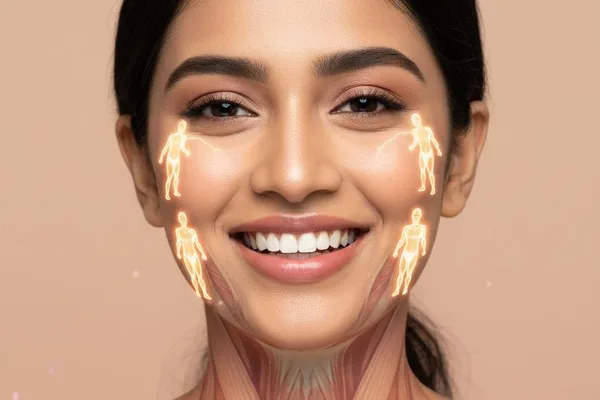
Have you ever stood in front of a mirror and wondered how you smile, frown when you're angry, or widen your eyes in surprise? Behind all of this are some invisible, but very powerful heroes. They are the muscles in your face. Without them, we wouldn't be able to talk, eat, smile, or even express our emotions to each other. Today, let's talk about these small but very important muscles.
What are these facial muscles?
Simply put, the facial muscles are a group of about 20 flat muscles in your face. They are sometimes called craniofacial muscles. Unlike other muscles, these muscles are directly attached to the bones and skin of your skull. That's why we can move the skin of our face to create different expressions.
These muscles work together to control these parts of your face:
- Cheeks
- Chin
- Eyebrows and eyelashes
- Forehead
- Upper and lower lips
- Nose and nostrils
- Ears (but not everyone can do this, only some people can wiggle their ears!)
What are the main functions of facial muscles?
The facial muscles have two main functions. One is chewing food (mastication), and the other is facial expressions (facial expressions). Imagine that when you eat a delicious meal, these muscles help you chew it properly. Similarly, when you laugh out loud with a friend, when you purse your lips when you feel sad, when you raise your eyebrows when you are surprised, all these are done by the muscles in your face.
In addition to those two main functions, these muscles perform many other very important functions. Let's see what they are.
| Function | Simply put... |
|---|---|
| Giving yourself a unique look | These muscles determine the shape of your face, your smile, everything. |
| Preventing food and drink from coming out of the mouth | The muscles around your mouth help keep saliva from escaping when you drink water or eat food. |
| Eye protection | When something like a speck of dust suddenly comes near, your eyes close without you even realizing it because the muscles around your eyes are activated. |
| Talking | The muscles of the lips and cheeks are essential for pronouncing words clearly when we speak. |
| Singing and moustache shaping | These muscles also help with things like pronouncing the words of a song correctly and whistling with your lips. |
How are the facial muscles formed? Let's look at them in parts.
There are many muscles in your face. They are usually located in pairs. That is, one is on the left side of your face, and one is on the right side. Let's talk about these muscles in two groups: the muscles that help you chew food and the muscles that control facial expressions.
Muscles of Mastication
These are the four main muscles that move your jaw and help you chew your food properly. They are very strong.
| Name of Muscle | What happens with this? |
|---|---|
| Lateral pterygoid | This muscle helps you open your mouth, like when you yawn. |
| Masseter | This is a very strong muscle that runs from the cheek to the jaw. It helps to close the mouth and clench the teeth together. |
| Medial pterygoid | This is also a thick muscle that helps close the mouth. |
| Temporalis | This is a fan-shaped muscle. It's located above your ear, right by your cheekbone. It also helps close your mouth. |
Muscles of Facial Expression
These muscles help us express our emotions to the world. They can be further divided into parts based on where they are located.
Auricular muscles
These are the small muscles around the ear. While not everyone can control them, some people can use these muscles to wiggle their ears.
- Auricularis anterior
- Auricularis posterior
- Auricularis superior
Muscles around the mouth (Buccolabial muscles)
These are the most important muscles around your mouth and cheeks that show everything from your smile, sadness, and anger.
| Name of Muscle | What happens with this? |
|---|---|
| Buccinator | A thin muscle in the cheek that helps hold your cheek against your teeth when you eat. |
| Depressor anguli oris | When you're sad, this helps to pull the corners of your mouth down and give you a sad look. |
| Depressor labii inferioris | Helps control lower lip movements. |
| Levator anguli oris | Another muscle that helps you smile. |
| Levator labii superioris | It helps to raise the upper lip. This means it is used to smile and also to show something like disgust. |
| Levator labii superioris alaeque nasi | Helps enlarge the nostrils and lift the upper lip. |
| Mentalis | This muscle, located in the middle of your chin, helps control your lower lip. It's because of this muscle that your lower lip appears to tremble when you're sad. |
| Orbicularis oris | The circular muscle around the mouth. This is what helps to close the lips and make a pout. |
| Risorius | Another muscle that helps you smile. |
| Zygomaticus major and minor | These two muscles are the main ones that help you give a beautiful, big smile. |
Epicranial muscles (forehead, skull, and neck muscles)
- Occipitofrontalis: This is a long muscle that runs from the eyebrows to the top of the skull. This muscle is what works when you raise your eyebrows in surprise and frown.
- Platysma: Helps to wrinkle the skin of the neck, open the mouth, and pull the corners of the mouth down.
Nasal muscles
- Nasalis: Helps to flare the nostrils.
- Procerus: This muscle, located between the two eyelids, helps to pull the eyelids down and enlarge the nostrils.
Orbital muscles
- Corrugator supercilii: This muscle near the eyebrow is what helps you frown by bringing your eyebrows together when you're angry.
- Orbicularis oculi: The circular muscle around the eye that helps close the eyelids.
Are there any medical conditions that affect the facial muscles?
Yes, absolutely. For these muscles to work properly, they need to receive signals from your brain through the facial nerve . Sometimes, there can be problems with receiving these signals. This can cause the muscles in your face to become weak and lose control.
Most importantly, if you ever feel a dullness, a dullness on one side of your face, or a drooping sensation when you smile, see a doctor immediately. These can sometimes be signs of a serious condition.
Some conditions that can damage the facial nerve and affect the muscles include:
- Autoimmune diseases
- Bell's palsy - This is a temporary paralysis of the muscles on one side of the face.
- Head and neck cancer
- Infection
- Stroke - This is an emergency. If you have symptoms such as facial drooping, numbness in a limb, or difficulty speaking, you should go to a hospital's Emergency Department (ETU) immediately.
- Traumatic injury
Did you laugh while reading this article? Then you've already used a lot of your facial muscles. Although we don't think about them much, these muscles are essential for eating, laughing, talking, and expressing our emotions. So, the next time you're enjoying your favorite food or laughing with a friend, remember that behind it all are these small, but very amazing muscles in your face.
Take-Home Message
- Your face has more than 20 small muscles specialized for chewing food and making various facial expressions.
- These muscles are what give you your unique look and help you express your emotions.
- Facial muscles are controlled by signals from the brain via the facial nerve.
- If you notice any changes in your face, such as sudden weakness, numbness, or twitching, seek medical advice immediately as it could be a sign of a serious condition.




💬 Comments (0)
No comments yet. Be the first to share your thoughts here.
Add Your Comment