
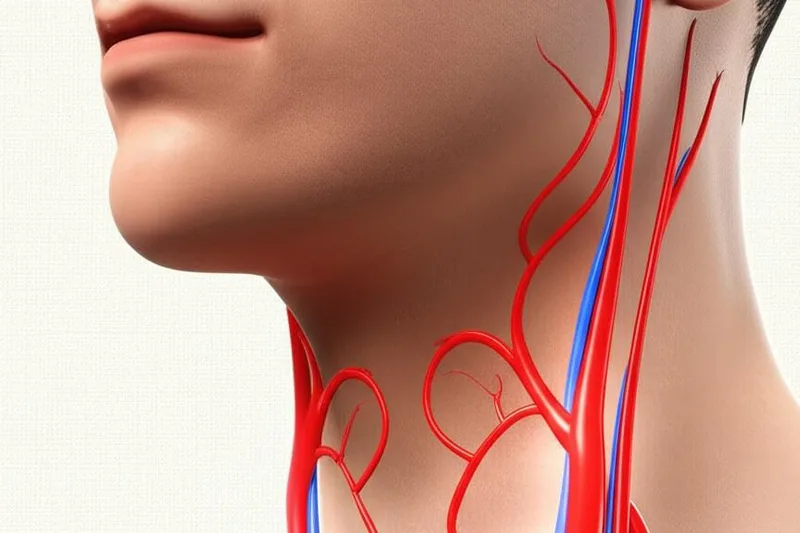
We all care a lot about our physical health. It is especially important to know about the vascular system that supplies blood to our brain and spinal cord. Today we are going to talk about one such very important type of blood vessel. This is what we call `(Vertebral Arteries)`. To be precise, these are like the lifeblood that nourishes the upper part of our body.
What are these `(Vertebral Arteries)`? What do they actually do?
Simply put, the `Vertebral Arteries` are two major blood vessels located in our neck that carry blood to the brain and spinal cord (the main nerve that runs through the spine). Yes, there are two, one on the left side and the other on the right side. The name `Vertebral` comes from the fact that these arteries run along our vertebrae, the bones of the spine. These two arteries join at the base of the skull to form a large artery called the `Basilar Artery`. We also call this entire system `Vertebrobasilar system`.
So, the main function of these is to supply our brain with the oxygen and nutrients it needs . Did you know that 20% of the total blood flow to our brain is supplied by these ``Vertebral Arteries`` . The remaining 80% is supplied by the other main artery in the neck called ``Carotid Artery``. So imagine how important these are!
These `(Vertebral Arteries)` give off many small branches. The largest of them is called `(Posterior Inferior Cerebellar Artery)`. This is one of the three main arteries that supply blood to our `(Cerebellum)`, that is, a small part of the brain (the cerebellum). This `(Cerebellum)` is very important. It helps control many things in our body, such as balance, movement, speech, and vision.
So, where are these ``Vertebral Arteries'' located?
These two `(Vertebral Arteries)` start from the `(Subclavian Arteries)` under our collarbone, that is, under the ``clavicle`` bone. These `(Subclavian Arteries)` start from the ``Aorta``, which is the largest blood vessel in our body. The ``Aorta`` is the one that carries blood from the heart to the whole body. To be precise, the ``Subclavian Artery`` on the right side starts from the ``Brachiocephalic Artery`` that comes from the ``Aorta``. The ``Subclavian Artery`` on the left side starts directly from the ``Aorta``.
Then these two `(Vertebral Arteries)`, separately, go up the left and right sides of our spine in the neck. These arteries are covered by muscles called `(Suboccipital muscles)` at the base of the skull. We also call this area `(Suboccipital triangle)`.
What are the special parts of the Vertebral Artery along its path?
Think of it like a long road. There are different intersections and different areas on that road. That's how this `(Vertebral Artery)` is divided into four parts (`segments`) according to the area it travels. Let's see what they are:
- V1 (pre-foraminal) segment: This is the first segment that starts from the ``Subclavian Artery''. It runs behind the ``Carotid Artery'', another major artery in the neck.
- V2 (foraminal) section: This section goes up along with the vertebral veins (veins that carry blood back) and nerves. This ``Vertebral Artery`` enters through an opening called the ``Transverse Foramen`` in the C6 vertebra (i.e. the sixth vertebra in the neck) and exits through the C2 vertebra (the second vertebra under the skull).
- V3 (extradural or extraspinal) segment: This segment curves and twists slightly as it passes over the C1 vertebra (also called the ``Atlas'', which is the topmost bone in the spine) and enters the skull.
- V4 (intradural or intracranial) segment: This is the last segment that enters the skull. Then the right and left `(Vertebral Arteries)` join to form the previously mentioned `(Basilar Artery)`.
Have you seen how complex these veins are to supply blood to our brains?
What diseases and disorders can affect the `(Vertebral Arteries)`?
Okay, now let's see what kind of problems these precious blood vessels can cause.
Most of the time, problems arise because of the buildup of fat and cholesterol in these arteries, which we call `(plaque)`. This is like the dirt and debris that builds up in a water pipe over time. We call this condition `(atherosclerosis)` . If this `(plaque)` builds up too much, the artery can become completely blocked.
When `(Atherosclerosis)` develops in the `(Vertebral Arteries)` like this, it is called `(Vertebral Artery Stenosis)`. That means the artery becomes narrow. What can cause this?
- Blood clots can form. Blood flow can become blocked in these narrowed areas and blood clots can form.
- A temporary interruption of blood supply to the brain can cause a ``Transient Ischemic Attack - TIA''. We also call this a ''mini stroke''.
- Stroke can occur. This can happen if a blood clot completely blocks an artery in the brain.
- A condition called ``Vertebrobasilar insufficiency'' can occur. This means that the brain does not receive enough blood.
In addition to this, there are other conditions that affect these veins:
- Cervical Artery Dissection: This is a tear in the wall of either the carotid or vertebral artery in the neck. This can occur as a result of trauma, or in people with certain connective tissue disorders (such as Fibromuscular Dysplasia) who have weakened blood vessels.
- `(Rotational Vertebral Artery Stenosis)`: This is a somewhat rare condition. It usually occurs when a `(Vertebral Artery)` is compressed due to an unwanted growth of a bone, restricting blood flow to the brain. This is also called `(Bowhunter's Syndrome)` because this compression sometimes increases during the archery position.
So how do we keep these precious `(Vertebral Arteries)` healthy?
This is the most important thing. If we make a few small changes in our lifestyle, we can greatly reduce the risk of developing conditions like `(Vertebral Artery Stenosis)`. See if you can do these things:
- Stay active most days of the week. That means exercising. Even a short walk is fine.
- Eat a heart-healthy diet. Foods low in fat, cholesterol, and salt are best. Eat more vegetables, fruits, whole grains, and foods high in fiber.
- Maintain a healthy weight. Maintaining a weight that is appropriate for your height is very important.
- If you have conditions like diabetes, high blood pressure, or high cholesterol, control them well. Follow your doctor's instructions exactly.
- If you smoke, definitely quit. Smoking is very harmful to blood vessels.
Remember, these things help keep not only your ``Vertebral Arteries'' but the entire body's vascular system healthy.
When should you see a doctor?
There are some symptoms that, if they appear, you should definitely see a doctor immediately, as they may be signs of a serious condition.
- Signs of stroke: Specifically,
- Severe vertigo
- Loss of balance in the body (imbalance)
- Double vision or visual loss
- Paralysis
- If you frequently fall for no reason `(Unexplained falls)`
If you or someone you know is experiencing this, don't waste time and seek medical advice immediately. The sooner you treat a condition like `(Stroke)`, the better the outcome.
So, let's remember the most important points from what we've talked about? (Take-Home Message)
You now know that the ``Vertebral Arteries`` that we talked about today are a very important system of veins that supply blood to our brain and spinal cord. Keeping these healthy is essential for the healthy functioning of our ``Nervous system``.
Vertebral Artery Stenosis, or Vertebrobasilar insufficiency, is caused by the buildup of plaque in the arteries. This restricts blood flow and increases the risk of stroke and TIA.
But the good news is that we can significantly reduce this risk by making healthy lifestyle changes. The best ways to do this are to eat a healthy diet, exercise regularly , avoid smoking, and manage existing medical conditions (such as diabetes and high blood pressure) .
So, take care of your health. Because there is nothing more valuable than health!
` vertebral artery, blood to the brain, neck veins, paralysis, stroke, narrowing of the arteries, cholesterol deposits


💬 Comments (0)
No comments yet. Be the first to share your thoughts here.
Add Your Comment