
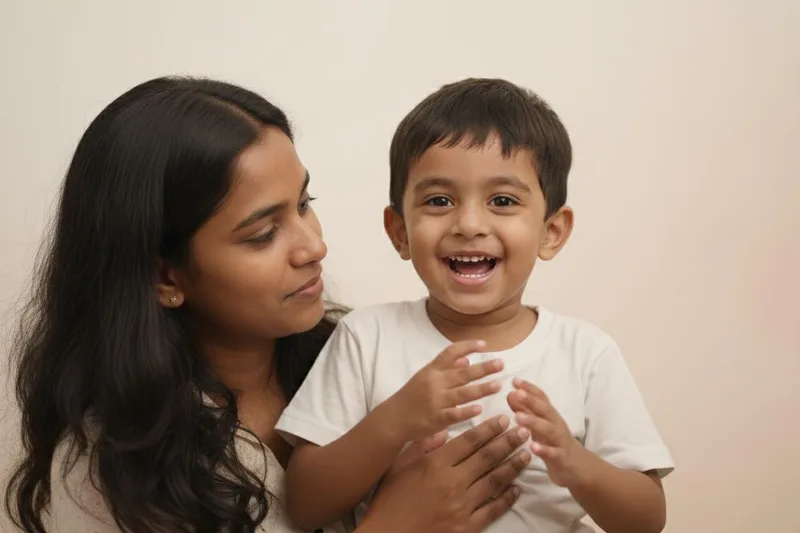
It's a joy for any parent to see their little one smiling and happy all the time, isn't it? But have you ever thought that sometimes this constant cheerfulness and clapping behavior could be a sign of a rare genetic condition? You might be surprised to hear this. Today we're talking about one such condition, Angelman Syndrome.
Simply put, what is Angelman Syndrome?
Angelman Syndrome is a rare genetic condition that affects your child's development, speech, balance, and movement. In some cases, it can also cause seizures.
When you look at a child with this condition, you will notice that they are always happier and in a better mood than a normal child. They smile a lot, laugh out loud. They make a hand-flapping motion when they are happy. In fact, we also feel happy when we see a child smiling. Therefore, it may seem strange to you to think that this happy nature of the child could be a symptom of a disease.
Other symptoms may start to appear as the child gets older. For example, you may start to notice developmental delays , such as not saying their first word by the time they are one year old. Seizures may also occur between the ages of two and three.
This condition is not life-threatening. That is, it does not shorten the child's lifespan. However, as the child grows, he or she may face some challenges with movement, speech, and development. But don't worry, there are good treatments to manage these symptoms.
How common is this condition?
Angelman Syndrome is a very rare condition, affecting approximately one in 12,000 to 20,000 people.
What are the symptoms of Angelman Syndrome?
The symptoms of this condition can vary from person to person and with age. Let's break them down into two categories.
| Mainly visible features | |
|---|---|
| Characteristic | Description |
| Developmental delay | Failure to crawl, sit, or walk as appropriate for age. |
| Intellectual disability | Learning and comprehension difficulties. |
| Difficulty speaking | Some children speak only a few words, while others may not be able to speak at all. |
| Difficulty walking | An unsteady, swaying walk and a splayed gait . |
| Balance problems (Ataxia) | Difficulty maintaining body balance and coordination. |
| Seizures | It can often start between the ages of 2 and 3. |
| Other symptoms that may be seen | |
|---|---|
| Characteristic | Description |
| Eating difficulties in young children | Difficulty sucking or swallowing food. |
| Sleep problems | Frequent waking, insomnia. |
| Scoliosis | Bending the spine to the side. |
| Digestive system problems | Constipation or reflux of stomach acid into the esophagus (GERD) . |
| Eye problems | Uncontrolled eye movements (nystagmus) , strabismus , and sensitivity to light (photophobia) . |
| Decreased skin color (hypopigmentation) | Skin, hair, and eye color becoming lighter than normal. |
The special features seen on the faces of these children
- Short and broad skull `(brachycephaly)`
- Large tongue `(macroglossia)`
- Smaller than normal head (microcephaly)
- Mandibular prognathia
- Wide mouth
- Large gaps between teeth
These symptoms may become more apparent as you get older.
Why does Angelman Syndrome occur? What is the cause?
Imagine that our bodies have a set of instruction books. We call these genes . These genes control everything in our bodies. Angelman Syndrome is caused by a change or defect in a gene called `UBE3A` . This gene is very important in regulating the functioning of our nervous system.
Normally, we get two copies of each gene, one from our mother and one from our father. In most parts of the body, both copies are active. However, in certain areas of the brain, only the copy of the gene `UBE3A` we get from our mother is active.
If the copy of the `UBE3A` gene inherited from the mother is somehow damaged or lost, there is no functional `UBE3A` gene in those parts of the brain. This is the primary cause of the symptoms associated with Angelman Syndrome.
The important thing is that this condition is not usually hereditary. This means that even if no one in the family has the disease, a child can develop it due to a random change in genes.
How do doctors diagnose this disease?
The symptoms of this disease are usually not obvious at birth. Doctors usually diagnose the disease when a child is between one and four years old.
If the doctor notices that the child is developing slowly, such as not speaking at a pace appropriate for their age or not starting to walk, he may be suspicious. He will then carefully examine the child's behavior and other symptoms.
To confirm the diagnosis, genetic testing is required. These tests can accurately determine whether there is a defect in the `UBE3A` gene.
Is it possible to misdiagnose this disease?
Yes, sometimes it can be that way, because the symptoms of Angelman Syndrome are similar to several other medical conditions.
- Autism spectrum disorder
- Cerebral palsy
- Prader-Willi syndrome
Because conditions like these can overlap, genetic testing is essential for an accurate diagnosis.
What are the treatments for Angelman Syndrome?
There is currently no cure for Angelman Syndrome. However, there are many treatments that can help manage the symptoms and help the child live a better life.
- Antiseizure medications: Administer the medications prescribed by the doctor properly.
- Speech therapy: Helping the child express themselves using sign language, pictures, and special communication devices.
- Physical therapy: Helps improve walking, balance, and coordination.
- Occupational therapy: Training the child to perform daily tasks independently and become independent.
- Assistive devices: The use of braces worn on the back, ankles, or feet to help with walking and standing.
- For sleep problems: Establish good sleep habits and get into the habit of going to bed at a set time.
- For digestive problems: Give medication prescribed by the doctor.
Every child's treatment needs are different. Your doctor will determine the best treatment plan based on your child's symptoms and needs.
What can I do to take care of my child?
As parents, you have a big role to play.
- Give the medications prescribed by the doctor on time and in the correct dosage.
- Be sure to attend clinics that check your child's development.
- Have your child participate in physical, occupational, and speech therapy sessions.
- Be sure to go to the doctor on every scheduled appointment.
Children with Angelman Syndrome may need help with daily activities throughout their lives. The medical team treating your child will provide you with the support and advice you need.
When do you need to see the doctor?
A child with this condition needs regular medical checkups to make sure that the treatments and therapies are working properly. If you notice any new changes or worsening of your child's symptoms, let your doctor know right away.
Most importantly: If your child has a seizure for the first time, take them to the hospital's Emergency Department (ETU) immediately.
What will the future of these children be like?
Most people with Angelman Syndrome have a normal lifespan. This means that they do not die quickly from the condition. As the child grows, there will be some delays in movement, speech, and development. However, the child can play, learn, and work with other children.
As adults, some people can live independently with some support. Others may need full-time care.
It's understandable to feel a heavy burden when you learn that your child's beautiful smile is a symptom of a disease. But remember, even after this diagnosis, your little one will still have that sweet smile, that sweet smile. The most important thing is to pay attention to your child's development and provide the necessary treatment on time, as the doctor says. Your doctor and the medical team will help you every step of the way. So don't be afraid to ask questions and learn more about this condition.
Take-Home Message
- Angelman Syndrome is a rare genetic condition. It is not caused by any fault of the parents.
- The main characteristics of this include being happy all the time, smiling, developmental delays, and difficulty speaking.
- Although there is no complete cure for this condition, therapeutic methods and medications can help manage the symptoms and give the child a good life.
- The lifespan of these children is generally normal.
- Early diagnosis and initiation of treatment and therapeutic services are very important for the child's future.
- Always follow your doctor's instructions and attend all scheduled clinics.




💬 Comments (0)
No comments yet. Be the first to share your thoughts here.
Add Your Comment