
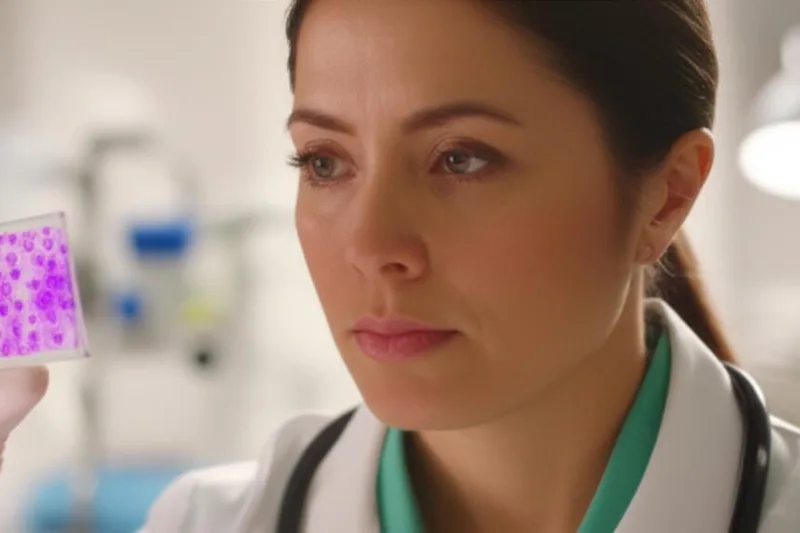
Have you ever heard of a 'Cytology' test? Perhaps a doctor has asked you to do such a test. This is actually a very important test. It looks at the smallest cells in our body and helps in early detection of some diseases, especially cancer. So, today we will talk about this science of cytology in a simple way that you can understand.
What is Cytology? Simply put...
Think about it, our bodies are made up of billions of tiny cells. So this cytology, sometimes called 'cytopathology', involves taking a few cells from your body's tissues or fluids (for example, urine, mucus) and examining them to see if there is anything different or abnormal in them.
Like a detective, a specialist doctor, we call him a 'pathologist' , he is the one who looks at these cells very carefully under a microscope and finds out, 'Oh... there is a problem here' or 'No, everything is fine'. This does not require a large piece of tissue, a very small cell sample is enough. That is why this test can be done without much difficulty in most cases.
Although doctors use these cytology tests for a variety of things, they are most often used to diagnose cancer or screen for the presence of cancer.
What are the main types of cytology?
Now let's see, there are two main methods in cytology. Let's talk about them.
1. Exfoliative Cytology
The name may sound a bit complicated, but it's actually quite simple. Exfoliative cytology is the process of examining cells that are either shed from our bodies (like dead skin cells) or gently scraped off the surface, like a small brush.
Let's look at some examples of this.
- Gynecological samples: Most women are familiar with this. A very popular type of test is the Pap smear , which involves taking a small sample of cells from the cervix with a small brush and testing them.
- Gastrointestinal tract samples: Sometimes, when a doctor performs an endoscopy (looking inside with a camera), they may scrape some cells from the inside of the intestine and send them for a cytology test.
- Skin or mucus samples: These can be tested by scraping cells from your skin, inside your nose, or inside your mouth.
Another way is to collect cells from things that are simply excreted from the body. Think about it:
- Respiratory samples:You can test the phlegm or sputum that comes out when you cough to see the cells in it.
- Urinary samples: Some diseases can be detected by taking a sample of your urine (pee) and examining the cells in it.
- Abnormal discharge or secretion samples: If there is an abnormal discharge, such as from the eyes, vagina, or breasts, a sample can be taken and a cytology test can be performed.
2. Interventional Cytology
In this, as the name suggests, the doctor has to make a small incision on the surface of your skin and take a sample of cells from inside. This means that the sample may have to be taken by piercing the skin.
The most common test of this type is called a fine-needle aspiration (FNA) .
- This involves using a very thin needle to insert it into the area to be examined (e.g., a lump) and withdrawing a sample of fluid or cells from there. The pathologist then looks at the cells under a microscope.
There are several places where an FNA can be performed:
- Cysts are watery lumps under the skin.
- Nodules or masses under the skin.
- Your lymph nodes.
- Pericardial fluid .
- Pleural fluid is the fluid that is present in the pleural space (between the lungs and the inner lining of the chest).
When is a cytology test done?
As we mentioned before, this is often used to detect cancer or to screen for cancer early.
- Diagnostic testing is a test that is done when you have symptoms (e.g., a persistent cough, stomach ache, a lump in your body) to find out what the problem is. Cytology can help determine if there are any abnormal cells and, if so, what type of disease it is.
- A screening test is a test that checks whether you are at risk of developing certain diseases (especially cancer), even if you don't have any symptoms. The Pap smear is one such test that many people are familiar with.
In addition to this, cytology helps with other things:
- Identify infectious diseases.
- Detect inflammatory conditions.
- Check for thyroid lesions.
- Identify diseases associated with certain body cavities (e.g., fluid that forms between the membranes covering the lungs).
Who performs this cytology test?
This is also a good question. When doing a cytology test,There are usually two people: the one who collects the sample and the one who tests it.
- The method of collecting the sample varies depending on the nature of the test. For example, a gynecologist may collect the cell sample for a Pap smear. For an FNA, a trained doctor will do it.
- Then, this sample is sent to a laboratory.
- There, a pathologist or cytopathologist examines these cells under a microscope and makes a diagnosis. They are the experts in this field.
How is a Cytology test performed? Step by step
Okay, now let's see exactly how this cytology test is performed. There are generally four main steps to this.
1. Collecting the sample cells
This is the first step. Your doctor will take a sample of cells from your body to test. As we discussed earlier, it may be:
- Remove by scraping or brushing the surface.
- Collected as a liquid (like urine, mucus).
- It may have been taken using a 'fine needle aspiration ' (FNA) method.
2. Processing the sample cells
Once the sample arrives at the lab, it needs to be prepared to make it easier to test.
- For some tissue samples, a doctor or someone in the lab will smear them on a thin glass slide. These are called 'smears' .
- If it's a liquid sample, it may not be possible to make a smear directly because of the low number of cells in it. It is then placed in a small container and sent to the lab.
- Once in the lab, a pathologist or lab technician will dip these smears, or prepared cells, into special dyes (stains). This staining makes it easier to see different parts of the cells clearly under a microscope. Just like coloring a picture makes it easier to see the details.
- If the sample is liquid, a machine called a centrifuge is sometimes used to separate the cells from the liquid. This machine spins the sample very quickly and separates the cells by weight. The separated cells are then placed on a slide and stained if necessary.
3. Examining the sample cells
The prepared and stained cell sample is then carefully examined by a pathologist under a microscope. He or she will look at:
- Are the cells normal?
- Are there any abnormal cells?
- Are there any signs of infection?
- Do you see things like cancer cells?
If he finds any abnormal cells, he marks them on the slide with a special pen. Then, based on what he sees, he makes a diagnosis and creates a detailed report.
4. Sharing the results
Finally, the pathologist will send the report to your doctor (the doctor who referred you for the test). Your doctor will then explain the results to you and discuss with you what to do next (e.g., more tests, medication).
How should I prepare for a cytology test?
This is a problem that many people have. The good news is that most cytology tests are very simple and not very painful. So you don't need to do anything special to prepare for them.
However, your doctor will explain the details of the test you are going to have. He will also clearly state if there is anything you need to do before that particular test (such as not eating for a few hours, stopping certain medications). So follow those instructions carefully.
What to expect after the test?
After the test, the sample of cells taken from you is sent to a lab, where a pathologist examines it and sends a report to your doctor. The doctor will tell you the results. Sometimes there may be some discomfort or bruising where the sample was taken for a few days, but this usually goes away quickly.
Are there any risks and disadvantages to these tests?
As with all medical tests, there are potential complications. However, serious complications from cytology tests are rare. However, they are often minor (e.g., a little bleeding or bruising at the site of the FNA).
- Sometimes, 'false positive' or 'false negative' results can occur. A 'false positive' means that a result indicates that a disease is not present, and a 'false negative' means that a result indicates that a disease is not present. But this happens very rarely, and pathologists are very concerned about this.
- In some cases, a biopsy (a test that takes a piece of tissue) can provide more information than a cytology test, and therefore may be more accurate.
So what are the benefits of cytology tests?
There are advantages as well as disadvantages. Because it only requires a small sample of cells, a cytology test has several advantages over a biopsy:
- Less invasive. That means no major incisions.
- Discomfort and pain are very minimal. Some are even painless.
- The chance of complications is low.
- The cost is relatively low.
- It can be done quickly.
What are the results of a cytology test?
The results you receive may vary slightly depending on what test was done, and where the sample was taken from. Typically, a pathologist's report may include the following:
- A description of the sample (e.g. where it was taken, how it was taken).
- Whether or not abnormal cells were found.
- If abnormal cells are found, what kind of disease, infection, or cancer is it?
- If it's cancer, what is the 'grade' of the cancer? This tells you how similar or different the cancer cells are from normal cells, and how fast they can spread.
- Whether further tests, such as a biopsy, are needed.
- Perhaps, a definitive diagnosis or a few guesses.
How long will it take for me to know the results?
This is also something that many people ask. The time it takes to know the results depends on each individual.
- The results of some routine screening tests (like a Pap smear) can take a few days (maybe a day or two).
- Some more complex tests can take a week or two or even longer.
Things that affect this are:
- The workload in the lab.
- Need to see more cells or tissue.
- Special stains or additional tests may be required.
- Sometimes a second opinion from another doctor is needed.
- Processing time is the time it takes for the sample to go to the lab, be prepared, tested, the report written, and then be delivered to your doctor.
Your doctor will be able to give you an idea of how long it usually takes.
What is the relationship between cytology and pathology?
Don't confuse the two. Cytology, or we call it 'Cytopathology', is a branch of Pathology, that is, a subspecialty.
In medicine, pathology is the field of medicine that deals with the laboratory examination of cells and tissues from body tissues or fluid samples for the purpose of diagnosing disease. So, cytology is just one part of that larger field.
What is the difference between Cytology and Histology?
Cytology and Histology are two other branches of Pathology. The main difference between the two is what is examined.
- Cytology mainly looks at individual cells or clusters of cells. These can be cells that have been recovered or cells taken from an FNA.
- Histology looks at a whole section of tissue.The tissue sample is examined to see how many different types of cells there are, how they are connected to each other, and the structure of the tissue. This is usually done by taking a tissue sample through a biopsy.
Simply put, cell science is like taking a leaf from a tree and looking at it, while tissue science is like taking a branch from a tree.
What is the difference between a cytology test and a biopsy?
The purpose of both is to make a diagnosis, but there are several important differences between the two.
- Sample size:
- In cytology, a very small sample of cells is examined under a microscope.
- A biopsy usually involves taking a larger piece of tissue than a cytology sample.
- How to do it:
- Taking a cytology sample (e.g., a Pap smear, a swab) is often simple, painless, and may not require anesthesia.
- Biopsy tests are usually more invasive than cytology tests. They may require local anesthesia or general anesthesia.
- What is checked:
- Cytology looks at individual cells or clusters of cells .
- In a biopsy, the pathologist examines not only the cells, but also the entire tissue architecture .
Finally, things you need to remember
So, I hope you now have a good idea about Cytology. The most important thing is that Cytology tests are a very common and safe method that is often painless and used to diagnose diseases and detect things like cancer early.
Waiting for test results can be a bit overwhelming and stressful. That's normal. But remember, your medical team is always there to help you and take care of you, no matter what the results are. If you have any questions about your test, your results, or what to do next, don't be afraid to ask your doctor. You have the right to be heard and understood. Got it?
👩🏽⚕️ Additional questions (FAQs)
💬 What is this 'Cytology' test?
In a biopsy, we take out a piece of tissue from the body and examine it. However, in a cytology test, we don't cut the tissue. Instead, we use a syringe to draw out individual cells and a small amount of fluid, such as water, from a different area inside the body, and then examine it under a microscope to see if there are any cancer cells.
💬 Does the 'Pap Smear' test performed by women also belong to the same category of Cytology?
That's right! A Pap smear involves using a small brush-like device near the cervix to take a few individual cells and check for cervical cancer. It's called Exfoliative Cytology because it only looks at cells, not tissue.
💬 Is this better than a biopsy?
This is easier for the patient than a biopsy. Because there is no need to cut or sew. However, there are times when it is difficult to confirm 100% whether there are cancer cells. In such cases, a biopsy is definitely necessary.
` Cytology, Cytology, Cell Testing, Cancer Detection, Pap Test, Pap Smear, FNA, Diagnosis, Pathology


💬 Comments (0)
No comments yet. Be the first to share your thoughts here.
Add Your Comment