
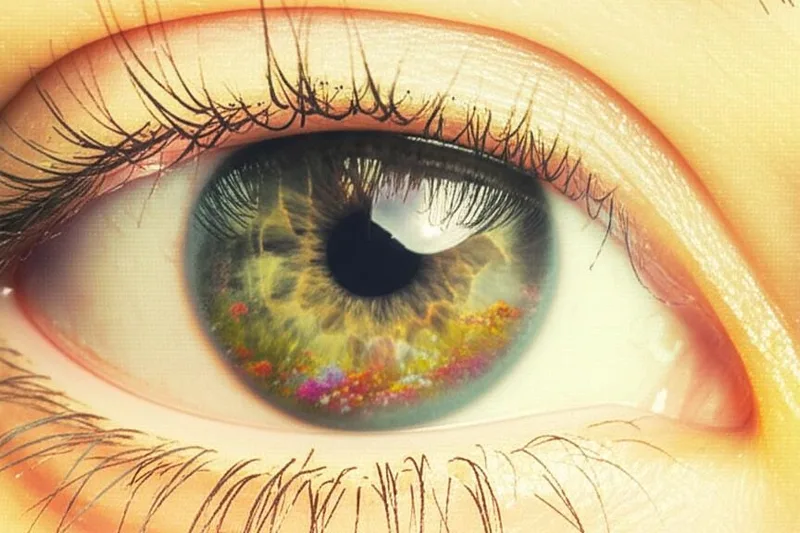
How do you see this beautiful world? Colorful flowers, beautiful landscapes, the faces of your loved ones... All of this is shown to us through our precious eyes , right? In fact, these two eyes are two of the most amazing organs in our body. So, what are these two eyes? How do they work? Let's learn about this simply, as if we were talking to a friend.
How do the eyes work? It's amazing!
Think of it like two very sophisticated cameras. Everything we see starts with light from outside. This light enters our eyes and travels through several transparent parts of the eye. These parts are the cornea , the aqueous humor , the lens , and the vitreous humor . These parts bend the light rays and focus them precisely.
This focusing has to be precise . Otherwise, we see blurry images. Small muscles inside your eye help move your eye a little, so that this focusing point, the focal point , falls exactly on the retina .
When light hits the cells in your retina, they send signals to your brain. These signals are like coded messages. They contain all the details of the light, including its color and intensity. Your brain then interprets these signals and creates an image for you. Isn't that amazing?
Some people think that the words "sight" and "vision" are the same, but there is a slight difference. "Sight" refers to what your eyes do. "Vision" refers to the entire process that starts with the eyes and ends with the brain interpreting it and creating an image.
Some surprising parts of our eyes!
The human eye is a very complex thing. For you to see, all these parts have to work properly. Let's take a look at what they are.
- Cornea : This is like the windshield of your eye. It protects the inside of your eye. It is moistened and lubricated by your tears . It also helps bend light that enters the eye.
- Sclera : This is the white part of your eye. It gives the eye its normal shape and structure.
- Conjunctiva : This is a very thin, transparent membrane that covers the sclera and the inside of your eyeball.
- Aqueous Humor: This is a fluid. It is filled with an anterior chamber inside the eye. The pressure of this fluid is what keeps the eye from shrinking and maintains its shape.
- Iris : This is where your eye color is determined. Some people have brown, some have blue, some have green, or a mixture of brown, yellow, and green ( hazel ). The black spot in the middle of the eye, or pupil, is dilated by muscles located here.
- Pupil : The black circle in the middle of the iris. It's like a window. It controls how much light enters the eye. It gets smaller in bright light and bigger in dark.
- Lens : This is what focuses the light entering the eye and directs it to the back of the eye, that is, to the retina.
- Vitreous Humor : This is a clear, gel -like fluid that fills the space between the lens and the retina. It helps the eye maintain its shape. It is sometimes simply called the vitreous .
- Retina : A layer of light-sensitive cells at the back of the eye. This is where light is converted into electrical signals. Rods are used to see in low light, and cones are used to see color and see clearly.
- Macula : A small but very important area in the retina. It is responsible for the center of your vision. That is, it is responsible for seeing things clearly, and for seeing colors and fine details.
- Optic Nerve : The main nerve that connects the retina to the brain. It is like a data cable. It carries signals from the eyes to the brain. It is connected to several parts of the brain.
- External muscles : These help move the eye back and forth and keep it in one place. They also help change the focus of the eye when looking at objects that are near or far.
Some common diseases that can affect our eyes
Our eyes have different types of tissue - muscles, connective tissue, nerves, blood vessels, etc. So, eye diseases also come in different forms, depending on the part affected. Let's look at some of the common conditions.
- Refractive errors : These are the most common vision problems that many people have. Simply put, they occur when light is not focused properly on the retina. For example, nearsightedness (Myopia) causes objects to appear clear but distant objects to appear blurry.Things like farsightedness (Hyperopia) , where distant objects are seen clearly but nearby objects are blurred, or astigmatism, where vision is distorted.
- Corneal diseases : Diseases that affect the cornea, the transparent part of the eye. These can be congenital or develop later in life.
- Retinal Diseases : These can be caused by problems that directly affect the retina. Or they can be a side effect of another disease. For example, people with diabetes mellitus can damage the retina over time. Retinal detachment is another serious condition.
- Optic Nerve Conditions : Diseases that affect this important nerve that connects the eye to the brain. Examples include Optic Neuritis ( inflammation of the optic nerve) and Optic Atrophy (wasting of the optic nerve).
- Age-related eye disorders : These eye disorders become more common as we age, especially after the age of 65. Some are minor, like presbyopia . But others, like cataracts , age-related macular degeneration, or glaucoma, are serious conditions that can lead to permanent vision loss.
In addition, the eyes can also be affected by things like infections, injuries, cancer, and birth defects.
Eye problems? Be aware of these symptoms!
If there is a problem with our eyes, the way we feel it, that is, the symptoms, can vary greatly. The reason for this is that there are many parts that affect our vision. Let's look at some of the common symptoms.
Problems seen on the surface of the eye:
- Itching, soreness, and burning sensation in the eyes.
- Redness of the eyes.
- Constantly shedding tears, eyes feeling wet.
- A discharge of a liquid or pus-like substance from the eye.
Changes in the appearance or position of the eye:
- Change in color of the white part of the eye (sclera) (e.g. blue, yellow).
- A change in the appearance of the iris or pupil (e.g., leukocoria - the iris appears white, coloboma - the loss of part of the iris).
- Strabismus is when the eyes are not aligned, one turning inward ( Esotropia) , outward ( Exotropia ), upward (Hypertropia) , or downward ( Hypotropia ). This is called strabismus .
Changes in visual function:
These are the symptoms we feel immediately.
- Not seeing clearly, seeing blurry: This may be due to vision problems.
- Specific vision problems : Night blindness , Color blindness .
- Decreased or lost vision : Sudden loss of vision, or gradual loss of vision leading to blindness.
- Visual disturbances : Double vision , seeing bright lights ( Auras ) before the eyes (e.g., as in ocular migraines ).
- Photophobia / Photosensitivity : Eyes hurt when looking at bright light, resulting in a preference for dark places.
The connection between the eyes and the brain is very important!
This is something very important to know. Sometimes, even though the symptoms of eye disease are present, the problem is not in the eye itself. It can also be due to a disease elsewhere in our body. For example, jaundice causes the eyes to turn yellow.
We have heard that "the eyes are the window to the soul." Medically speaking, the eyes are like the window to our brain. Because, some symptoms seen in the eyes can indicate problems in the brain. Your optic nerve is the direct connection between the eye and the brain. In fact, your retina is technically part of your Central Nervous System , which is part of the brain and spinal cord. That is why vision changes are a major symptom in cases of brain injuries (concussions) or conditions like stroke .
How is the health of your eyes? You can find out with these tests!
There are several tests that doctors do to check the health of your eyes. You may have heard of some of these.
- The most important thing is to get a regular eye exam. Whether you need glasses or not, it's a good idea to get an eye exam once a year or every two years. This can detect many eye diseases before you have symptoms. It's especially important to get these tests done if you have other conditions, like diabetes.
- Color blindness test.
- Routine imaging tests, such as ultrasound or magnetic resonance imaging (MRI) scans.
- Glaucoma tests.
- Intraocular pressure test .
- Retinal imaging tests .
- Slit lamp exam: This allows the ophthalmologist to magnify the delicate structures inside the eye.
- Visual acuity test: Reading letters and checking eyesight.
- Visual field tests : Check how far you can see your surroundings.
Depending on your symptoms and suspected causes, your eye doctor may recommend further tests. He or she is the best person to know about these.
What are the treatments for eye diseases?
There are different treatments for eye diseases. Some minor problems have simple treatments. Some require more complex treatments. There is nothing to worry about, there are now good treatments for most things.
- Vision correction : This is the main treatment for vision problems. Glasses and contact lenses are the most commonly used. Some people need prescription glasses or contact lenses. Some people may only use reading glasses . Others may choose to have vision correction surgery .
- Medications : Many diseases that directly or indirectly affect the eyes can be treated with medications. These can be in the form of eye drops or ointments, or oral medications or injections. It depends on the disease.
- Surgery : Many eye diseases can be treated with surgery. For example, there are various methods such as phacoemulsification (which uses ultrasound to break up the white matter of the eye), cryotherapy (which uses extreme cold) , radiofrequency ablation (which uses extreme heat) , and laser surgery .
There may be other treatments available. Your eye doctor will explain to you which treatment is best for your condition.
How can we keep our precious eyes healthy?
There are a few things we can do to keep our eyes healthy. They are very simple, but very important.
- Get regular eye exams : It's important for everyone, whether they wear glasses or not, to have an eye exam every year or two. If you're at high risk for eye disease, you may need to have your eyes checked more often. Your eye doctor will advise you on this.
- Protect your eyes : Wear safety glasses or goggles when working in the workplace, with chemicals, with machinery, or while playing sports. It may seem like a hassle, but it can save you from serious eye damage and pain.
- Quit smoking, or don't start : NicotineTobacco products (cigarettes, vaping, chewing tobacco) can damage your circulatory system over time, especially the delicate blood vessels in your eyes. If you need help quitting, talk to your doctor.
- Prioritize nutritious foods : Get the vitamins, minerals, and other nutrients that are essential for eye health. Include green vegetables, fruits, and fish in your diet.
- Maintain a healthy weight that suits you : Your body weight and overall health also affect the health of your eyes.
- Never ignore eye symptoms : A change in your vision, or any other symptom that affects your eyes, could be the first sign of a bigger problem. Be sure to see an ophthalmologist or other healthcare professional and discuss your concerns. It's fine if there's no problem, but if there is, it's worth finding out before it gets worse.
In times like this, definitely seek immediate medical advice!
There are times when you should seek immediate medical attention if something happens to your eyes. Be aware of these things, as they could be emergencies:
- Sudden loss of vision, partial or complete, or greatly reduced vision in one or both eyes.
- If something is stuck in your eye, or if it feels like there is something in your eye but you can't see anything.
- If you get a burn around your eyes or in your eyes (even if it's a minor burn).
- If the eye becomes red, swollen, bruised, or bleeding due to any injury.
- If there is swelling in the bone cavity around the eyeball.
- If the eyes protrude more than normal.
- If your vision suddenly becomes blurry and looks like fog.
- If you have other signs of infection, such as vomiting, chills, and fever, along with eye problems.
- If you see flashes of light before your eyes, if you suddenly have more floaters , or if you see a black screen falling before your eyes (these may be signs of retinal detachment ).
- If your vision appears as if it is a collection of different colored pieces ( Kaleidoscope vision ).
- If you can't turn your eyes in one direction as you normally can.
- If your vision suddenly becomes like tunnel vision (meaning you can't see around you, only straight ahead).
- Distortion or loss of central vision (with or without changes in peripheral vision).
Even if it's not on this list, if you think you have a serious eye condition, definitely see a doctor right away. Doing so can protect your vision and possibly even save your life.
What are the most common eye problems?
Aside from temporary conditions (such as eye infections and scratches), the most common eye problems are:
- Refractive errors .
- Age-related cataracts.
- Age-related macular degeneration .
- Retinal diseases (especially diabetic retinopathy caused by diabetes).
- Glaucoma .
- Dry eye disease .
Finally, a few things for you to remember...
So, from what we've talked about today, you can probably understand how valuable our eyes are, and how important it is to protect them. Our eyes are like a window to our brain through which we see the world. We may not realize their value until they are working properly. But it's only when we have a small problem that we realize how valuable they are.
If you have any doubts or concerns about your vision, don't ignore them. Don't dismiss them as minor. See an eye doctor right away. Not only can it protect your precious eyesight, it can also help you detect a more serious condition early.
Take care of your eyes!
👩🏽⚕️ Frequently Asked Questions (FAQ) from the Doctor
💬 How do we see things with our eyes?
Our eyes work like two very sophisticated cameras. First, light from outside enters our eyes. It passes through several transparent parts, such as the cornea and the lens, and is focused precisely on the retina. Then, cells in this retina convert this light into signals that the brain can understand and send them. Finally, our brain interprets these signals and creates the image that we see. Isn't it amazing?
💬 Are 'seeing' and 'seeing' the same thing? Or is there a difference?
Good question! Many people think that these two words are the same. But there is a slight difference. 'Seeing' refers to what our eyes do, which is to take in light and send it to the retina. But 'vision' is much broader than that. It refers to the entire process that starts with the eyes, and the brain interprets those signals and presents them to us as an image. In other words, seeing is both the eyes and the brain working together.
` Eyes, vision, eye diseases, eye examination, eye health, vision problems, eye care


💬 Comments (0)
No comments yet. Be the first to share your thoughts here.
Add Your Comment